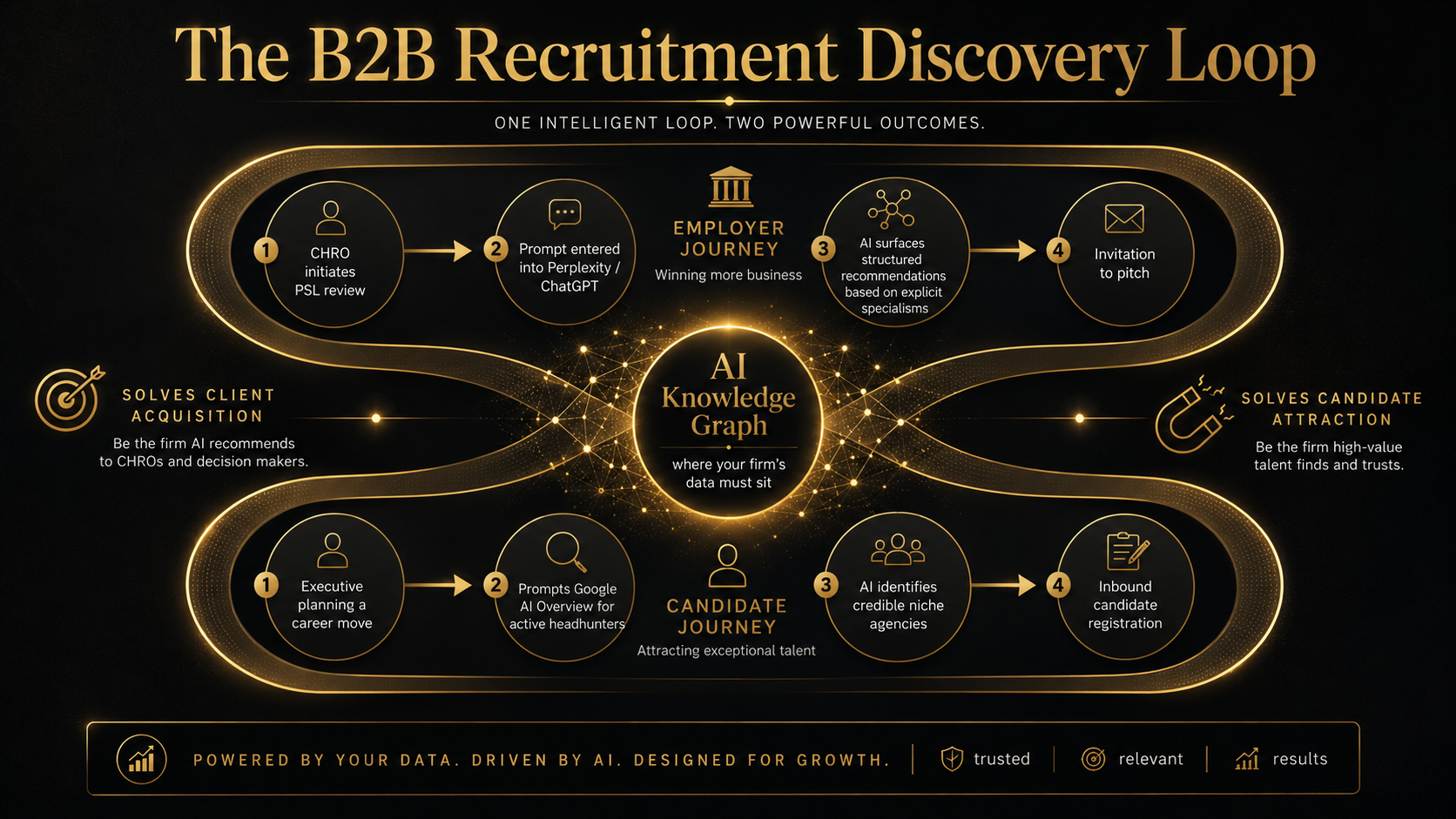
A chief human resources officer at a FTSE 250 business is reviewing the company's Preferred Supplier List for executive recruitment.
The current list was built three years ago. Two of the firms on it have underperformed. One has lost the consultants who built the relationship. The CHRO wants to open the process to the market (finding two or three specialist search firms that are genuinely credible for the critical C-suite appointments coming in the next eighteen months).
They are not yet ready to send formal RFIs. First, they want to understand who is worth approaching.
They open ChatGPT and ask: "Which UK executive search firms specialise in FTSE 250 CFO and Chief Operating Officer appointments?"
The AI constructs an answer. It names the firms it considers authoritative, credible, and specifically experienced in this space.
The firms that appear in that answer get invited to pitch for PSL inclusion. The ones that don't (including some with genuinely strong track records in exactly this area) are not on the CHRO's radar when the formal invitations go out.
Or a managing director of a rapidly scaling fintech business needs to appoint a Head of Sales for their UK operation. They have never used a specialist recruiter before. They use Perplexity to understand the difference between a recruitment agency and an executive search firm, and to identify which firms in the UK specialise in senior sales leadership appointments in financial services technology.
Or a senior finance director, considering a move for the first time in seven years, uses a Google AI Overview to research which executive search consultancies are most active in FTSE 100 CFO placement (so they know who to register with before they make their availability known).
Three separate audiences. Three separate behaviours. Three separate moments where your firm is being evaluated or overlooked.
And in almost every case, the recruitment and executive search firms that appear in those AI-generated answers are not the largest or the most established. They are the ones that have built the clearest, most structured, most consistent AI visibility around a defined specialism.
Most UK recruitment agencies and executive search firms have no strategy to build that visibility.
Generative Engine Optimisation (GEO) is the practice of making your business visible, trustworthy, and citable in AI-generated search answers. For recruitment and executive search firms (where a single mandate can generate five or six figures in fees and a PSL position can represent years of recurring income) it is one of the most commercially significant investments available right now.
This article explains what GEO is, why it matters specifically for UK recruitment and executive search businesses, and how the Tenacious 7-step GEO framework gives you a clear system to build that visibility before your competitors do.
Traditional SEO focuses on ranking in search results.
A recruitment agency targets "sales recruitment agency UK" or "financial services recruiter London." An executive search firm optimises for "CFO executive search UK" or "retained search firm FTSE 250." The goal is to appear in the top results when a hiring manager or HR director actively searches for a firm.
GEO addresses something different (and in recruitment, something more commercially consequential).
When a CHRO uses ChatGPT to map the executive search market before a PSL review, they are not clicking through a search results page. When a hiring manager uses Perplexity to understand which agencies specialise in their sector before briefing anyone, they are reading an AI-generated answer. When a senior candidate researching their next move asks a Google AI Overview which headhunters are most active in their function and sector, they are forming views about which firms are worth approaching.
GEO is the discipline of ensuring your firm is consistently present (and consistently compelling) in all of those answers.
It works by building:
For recruitment and executive search firms whose revenue depends on being the first call when a hiring need arises, GEO is not a marketing channel. It is the infrastructure that determines whether you are on the shortlist when that moment comes.
Gartner predicts that traditional search engine volume will decline by 25% by 2026 as AI tools become the primary way people find information and make decisions.
In recruitment (where relationships have traditionally been the primary channel) this shift is creating a parallel research behaviour that most firms have not yet built a strategy to address.
The specific ways AI is now being used across both sides of the recruitment market:
PSL and supplier review research - HR directors and CHROs conducting periodic PSL reviews are using AI to identify firms worth approaching (before any formal RFI is issued). The firms that appear in AI-generated answers about specialist recruiters in a given function or sector are the ones included in the review. Those that don't appear may not receive an invitation even if they have an existing relationship with the organisation.
First-time buyer education - Business leaders who have never used a specialist recruitment firm or executive search partner (a founder preparing to hire their first Sales Director, a scale-up MD making their first board-level appointment) use AI to understand the market and the process before approaching anyone. They learn what retained search involves, what typical fee structures look like, and which firms are considered credible in their space. The firms referenced during this education phase begin the relationship with a significant trust advantage.
Pre-mandate market mapping - Experienced HR leaders preparing to brief a search firm use AI to sense-check the market (ensuring they are approaching the most relevant firms for a specific brief, not just those already on their PSL). A firm not visible in AI's answer to "who specialises in CHRO appointments in the UK hospitality sector?" may not be included in the briefing even if they are genuinely the strongest option.
Senior candidate and executive research - This is the behaviour that most recruitment firms overlook (and one of the most commercially significant). Senior executives and professionals considering a move use AI tools to research which headhunters and specialist recruiters are most active and credible in their function and sector. "Which executive search firms in the UK have the strongest track record in placing Chief Digital Officers?" is a question being asked by exactly the kind of senior candidate an executive search firm most wants to attract. The firms that appear are the ones candidates proactively register with.
Validation of existing relationships - Just as accountancy clients validate referrals via AI, hiring managers and HR directors validate existing relationships before extending or renewing them. A firm on a PSL whose AI representation is weak, generic, or absent may find that a renewal conversation becomes a competitive pitch (because the AI validation step produced doubt that a well-positioned competitor is now better placed to resolve).
Recruitment and executive search is among the most undifferentiated sectors in UK B2B services when viewed through the lens of AI.
Visit the website of almost any specialist recruiter or executive search firm in the UK. You will find some version of the following: "We are a specialist recruitment partner with deep sector expertise, offering tailored search and selection services for businesses seeking exceptional talent."
The language is functionally identical across hundreds of firms. AI systems cannot make a confident recommendation based on it. The firms that cut through are the ones that have made their specialism explicit, their sector knowledge demonstrable, and their positioning consistent (across every platform AI consults).
The specific gaps that keep most recruitment firms invisible in AI search:
Specialism stated but not demonstrated - Most recruitment firms claim a sector or function specialism somewhere on their website. But the claim is not supported by content that demonstrates it (case studies showing specific placements, articles explaining sector-specific hiring challenges, thought leadership that proves market knowledge). AI cannot recommend a specialism it cannot verify across multiple sources.
The retained vs contingency distinction is invisible in AI - For executive search firms operating on a retained basis, the distinction from contingency recruitment is commercially critical (retained search commands higher fees, attracts a different client profile, and represents a fundamentally different service proposition). But most retained search firms do not explain this distinction clearly in their public-facing content. AI tools cannot differentiate them from contingency agencies, which both dilutes their positioning and prevents them from appearing in searches specifically for retained search.
No question-answering content for either buyer type - The questions employers ask AI tools ("how much does executive search cost in the UK?", "what is the difference between a recruiter and a headhunter?", "how long does a retained CFO search take?", "what should I include in a search brief?") are rarely answered on recruitment firm websites. The questions candidates ask ("which headhunters should a finance director register with?", "how does executive search actually work from the candidate's perspective?") are answered even less frequently.
Thin or inconsistent directory presence - REC (Recruitment and Employment Confederation) membership, APSCo (Association of Professional Staffing Companies) accreditation, Glassdoor employer ratings, LinkedIn company page, and Trustpilot reviews all contribute to AI entity signals for recruitment firms. Most firms are present on some of these but inconsistently described across them (weakening the consistent entity picture AI needs to make confident recommendations).
No strategic video content - In a sector where personal credibility, market knowledge, and the quality of individual consultants are the primary differentiators, almost no UK recruitment or executive search firms are using video to demonstrate those qualities to prospective clients and candidates. The most compelling evidence of why a firm should be trusted is locked in sales meetings rather than accessible to the AI research phase that precedes them.
For many UK recruitment agencies and executive search firms, the business model has been built on PSL positions (structured preferred supplier relationships with major employers that provide first-call access to hiring needs across one or more functions).
PSL positions have traditionally been won and retained through relationship management. The consultant who knows the CHRO. The account manager who has been in the business for years. The firm that delivered consistently on a handful of critical hires.
That model is increasingly insufficient.
As PSL reviews become more structured, more frequent, and more market-facing (pathways where procurement involvement in HR supplier relationships is growing) the research phase that precedes a formal review is becoming more AI-assisted.
The specific risk: a recruitment firm that has held a PSL position for three years through strong relationship management may not appear in the AI research that the CHRO conducts before opening the list to the market. The relationship protects the incumbent from being excluded outright (but it does not protect them from appearing weaker than new entrants who have invested in GEO and arrive at the pitch with stronger apparent credibility, clearer positioning, and better-structured evidence of their specialism).
GEO does not replace the relationship. It protects and amplifies it. The firm with strong AI visibility enters a PSL review conversation with the relationship advantage reinforced by apparent market leadership (rather than having to defend an incumbent position against firms that look more compelling in the research phase).
One of the most commercially significant dimensions of recruitment GEO is one that most firms have not considered.
The quality of an executive search firm's candidate network (the senior executives who are registered, engaged, and willing to be approached) is one of its most valuable competitive assets. The depth and breadth of that network determines which mandates the firm can credibly win and how effectively it can deliver against them.
That network is built through outbound relationship management. But it is increasingly being supplemented (and in some cases replaced) by inbound approaches from candidates who have researched which firms to register with.
Senior executives and professionals considering a career move in the next twelve to twenty-four months are actively researching the executive search market. They want to know which firms are most active in their sector, which have placed people at the level they are targeting, and which are worth initiating a relationship with before they are formally available.
They are using AI to answer those questions.
A firm that appears clearly and credibly in AI-generated answers to "which executive search firms specialise in placing Chief Marketing Officers in the UK consumer sector?" will receive proactive registrations from exactly the senior candidates it most needs. A firm that is invisible in those answers relies entirely on outbound contact to build and maintain the same network (which is slower, more expensive, and increasingly less effective as senior executives become more AI-literate in their own career management).
For executive search firms in particular, the GEO investment has a dual commercial return: it attracts better client mandates and better candidates simultaneously.
This is the framework Tenacious uses to turn businesses from invisible to recommended.
Applied to a UK recruitment agency or executive search firm, it looks like this:
| Step | What It Involves | Outcome for the Firm |
|---|---|---|
| 1. Diagnose | Audit current AI and search visibility across both employer and candidate searches | Understand exactly where the firm stands — and where competitors are being recommended in its place |
| 2. Align | Define and commit to a clear sector, function, and engagement model specialism | A specific, consistent description that AI can describe and recommend with confidence to both buyers and candidates |
| 3. Standardise Listings | Update all relevant directories, accreditation bodies, and professional platforms | Consistent entity signals across every platform an HR director, hiring manager, or senior candidate might consult |
| 4. Structure the Website | Build sector pages, function pages, a FAQ, and implement schema | A website AI can read, extract specific positioning from, and cite accurately for both employer and candidate searches |
| 5. Publish Content | Strategic articles answering the real questions employers and senior candidates ask AI tools about recruitment | Content that earns citations at the research stage, the PSL review stage, and the mandate briefing stage |
| 6. Distribute | Share across LinkedIn, HR press, sector publications, and Google Business | Increased frequency of AI encounter across the platforms hiring managers, HR leaders, and senior candidates use |
| 7. Amplify | Launch a YouTube channel with process explainers, market insight, and consultant-led expertise | Accelerated authority across both the client and candidate market — building pre-mandate trust faster than any other channel |
Before building anything, understand where the firm currently stands (from both the employer and candidate perspective).
When a CHRO uses ChatGPT to find executive search firms specialising in your function or sector (do you appear?). When a hiring manager researches specialist recruiters in your space on Perplexity (are you named?). When a senior finance director researches which headhunters to approach for a CFO search (does your firm come up?)
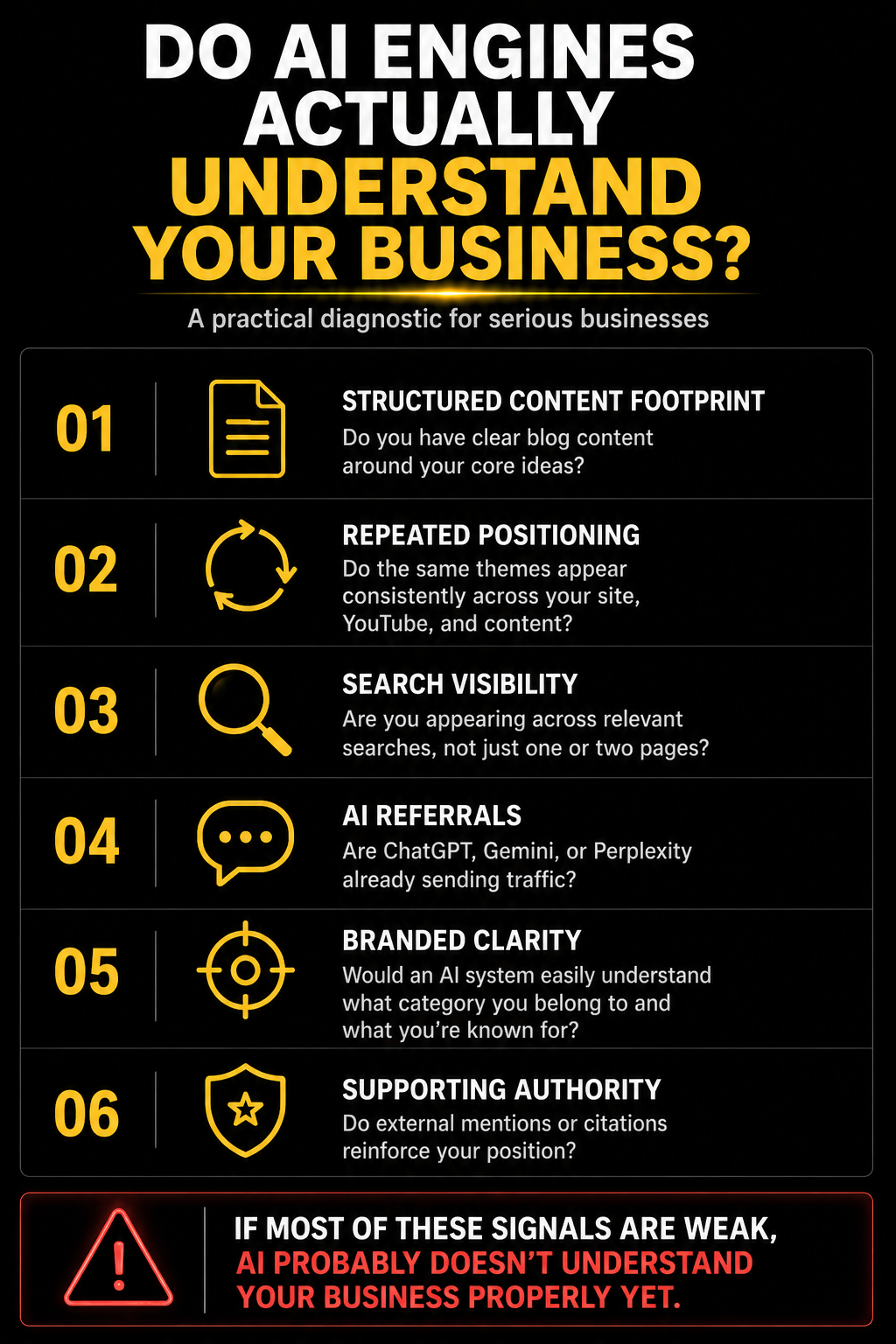
The diagnosis covers website structure, search visibility, AI citation frequency, listing consistency, content coverage, and authority signals (mapped across both buyer types).
Most recruitment firms discover that AI either cannot describe their specialism specifically enough to make a confident recommendation, or defaults to a handful of larger generalist names that have stronger overall entity signals, regardless of whether they are actually the most relevant for a specific brief.
Without this first step, every subsequent investment is directionally uncertain.
In a market where everyone claims to be a specialist, the firms that win in AI search are the ones that can prove it (through the consistency and specificity of how they describe themselves across every platform).
For a recruitment agency, specialism might be defined by:
For an executive search firm, specialism might be defined by:
This alignment does not require turning away mandates outside the positioning. It requires committing to a specific description that AI systems (and the HR directors and CHROs who rely on them) can latch onto as a clear, confident reason to include the firm in a shortlist.
Recruitment and executive search firms exist across a broader range of professional directories and accreditation registers than most appreciate (and are typically inconsistently described across all of them).
Relevant platforms include:
Each of these needs to describe the firm in consistent, aligned language (the same specialism, the same engagement model, the same sector focus, the same function expertise).
LinkedIn deserves particular attention for recruitment firms. It is both a primary business development channel and a heavily weighted source in AI-generated answers about recruitment and executive search. Individual consultant profiles (not just the firm page) contribute meaningfully to the firm's overall entity authority. A managing partner or practice lead who clearly describes their specialism on LinkedIn, publishes regularly, and accumulates engagement in their sector is building an entity signal that AI systems will use.
Most recruitment and executive search websites are built around the services the firm wants to describe, not the questions the buyer needs answered.
Structuring for AI means:
The FAQ page is particularly high-value for recruitment GEO. Questions like "how much does executive search cost in the UK?", "what is the difference between a headhunter and a recruitment agency?", "how long does a retained CFO search take?", and "how do I brief an executive search firm effectively?" are exactly what employers ask AI tools before their first briefing call.
Content built for GEO in recruitment leads with the questions buyers and candidates are actually asking (not with the firm's credentials or methodology).
For an executive search firm specialising in finance leadership:
For a specialist recruitment agency in the technology sector:
For candidate-facing content on any executive search or specialist firm site:
The goal is to become the source AI cites when employers are preparing a brief and when candidates are preparing for a search (before either of them has made contact with anyone).
APSCo's guidance on professional recruitment standards provides a useful benchmark for the accuracy and depth this content should reflect.
Publishing on the website is step one. Distribution across the platforms the firm's two buyer audiences actually use is what amplifies it.
For recruitment and executive search firms, distribution typically includes:
Each article becomes multiple pieces of distributed content. Each distribution touchpoint creates another opportunity for AI systems to encounter and remember the firm's specialism.
This is where the GEO framework accelerates (and where the competitive opportunity in UK recruitment and executive search is the most striking of any professional services sector).
Almost no UK recruitment agencies or executive search firms are producing strategic YouTube content. The recruitment YouTube space is dominated by career coaching content for candidates, US-based staffing industry commentary, and generic HR advice. UK search firms and specialist recruiters demonstrating their market knowledge, their process, and their sector expertise (for a client and candidate audience) are essentially absent.
YouTube creates structured, AI-readable authority content at scale.
A fifteen-minute video walking through what a retained executive search process actually involves (from mandate briefing through market mapping, long-listing, assessment, and offer management) creates more citeable, AI-readable, process-transparent content than most firms produce in an entire year of written marketing. The transcript becomes a rich, structured source for AI answers about how executive search works.
Process transparency builds the pre-mandate trust that shortens briefing cycles.
One of the most common friction points in executive search is that clients do not fully understand the process (what they are paying for, what happens at each stage, and what is expected of them). A firm whose YouTube channel walks through every stage of the search process in clear, honest terms reduces that friction before the briefing conversation takes place. The client who has watched the process explained on video arrives at the first call ready to engage rather than ready to interrogate.
Market insight content demonstrates the sector knowledge that clients cannot assess from a website.
The most commercially valuable thing an executive search firm can demonstrate is that it genuinely understands the talent market in its sector (who is moving, what candidates are looking for, what employers are competing on, and what the market will bear in terms of compensation and package). A video series offering market insight on the finance leadership market, the technology C-suite landscape, or the FMCG marketing talent pool demonstrates that knowledge in a way that no service page can replicate.
Named consultants on camera build the personal credibility that retained search relationships require.
Executive search is a high-trust, high-discretion service. Clients are sharing sensitive information about business strategy, succession planning, and leadership gaps. They are entrusting a consultant with one of the most consequential decisions their business will make. A managing partner or senior consultant who appears consistently on camera (discussing the market, explaining the process, sharing their thinking on leadership and talent) builds personal credibility before any meeting takes place.
The client who has watched six videos from the consultant before their first call already has a sense of that person's judgement, communication style, and market knowledge. The relationship begins further along. The trust is partly established. The engagement is more likely to proceed.
For candidate attraction, video is transformative.
Senior executives who are considering registering with a search firm want to understand who they will be working with. A brief, well-produced video from the managing partner explaining who the firm works with, what they specialise in, and what a candidate relationship looks like with the firm removes uncertainty and reduces the registration barrier dramatically. The firm whose consultants appear knowledgeable, credible, and approachable on camera attracts better candidates than the firm whose team exists only as headshots on a website.
Initial visibility signals (appearances in AI-generated answers about specialist recruiters in a given sector or function, more specific AI descriptions of the firm, increased inbound from better-matched clients and candidates) typically begin to emerge within 60 to 90 days of implementing the full framework.
The system builds in sequence. Each step strengthens the next. Within six months, most recruitment and search firms see meaningful improvements in how AI tools describe them and in the quality of inbound enquiries from both clients and candidates.
The compounding effect is particularly significant in executive search and specialist recruitment, where every improvement in AI visibility simultaneously attracts better clients, better candidates, and stronger PSL positions. The authority built today continues working for years (and every new piece of content, every new case study, and every new listing strengthens the foundation further).
The first-mover advantage is significant. In most function and sector combinations (retained CFO search in the UK, specialist legal technology recruitment, senior marketing leadership in FMCG) there is currently very little GEO competition. The firms that build AI visibility in their specialism first effectively own that space in AI-generated recommendations.
To learn more check our blog on How Long Does GEO Take
The consequences are quiet, cumulative, and difficult to attribute (which is precisely what makes them commercially dangerous).
A CHRO at a major UK retailer conducts a PSL review. They use AI to identify specialist executive search firms before issuing formal invitations. A firm that has held a position on that PSL for four years through strong relationship management is not named in the AI research. The CHRO identifies three new firms through AI-generated answers and invites them to pitch alongside the incumbents. The new entrants arrive with sharper apparent positioning. The incumbent's four-year relationship advantage is not enough to compensate.
A senior HR director at a private equity-backed technology business is briefing an executive search for a new Chief Revenue Officer. They want to approach three or four specialist firms. They use Perplexity to identify who is most credible in this space. One genuinely excellent firm (with a strong track record in exactly this type of search) does not appear in the AI answer. It does not receive a briefing invitation.
A Chief Technology Officer considering their next move researches which headhunters to register with. The firm most relevant to their profile does not appear. They register with two that do. The firm that was absent from AI loses the candidate relationship (and potentially the future introduction that follows).
None of these losses appear on a management report. None can be traced back to a specific cause. All of them are real, happening now, and compounding.
Recruitment and executive search firms have always won business through sector knowledge, consultant credibility, and the quality of relationships built over time.
GEO is how that knowledge and credibility becomes visible in the channels where the next generation of hiring managers, HR leaders, and senior candidates are forming their views (before they pick up the phone, before they brief anyone, before a mandate is placed).
The Tenacious 7-step framework gives UK recruitment agencies and executive search firms a clear, structured system to become visible, credible, and recommended in AI-generated answers (at the inbound enquiry stage, at the PSL review stage, and during the market research that precedes every significant hiring decision).
For firms that add YouTube to the strategy (walking clients through the search process, sharing market insight on camera, and building the personal credibility of their lead consultants) the effect compounds faster and across both sides of the market simultaneously. Better clients. Better candidates. Stronger relationships from the first conversation.
UK executive search and specialist recruitment YouTube is almost entirely uncontested. The firms that claim that space now will hold it for years.
The firms appearing in AI-generated answers the next time a CHRO reviews their PSL are building that position today.
If you want to understand where your firm currently stands in AI search (and what it would take to become the recommended answer the next time a hiring decision is forming) talk to the Tenacious team.
Related Reads
If you want to go deeper, these guides explain how the full AI visibility system fits together.
What Is GEO in 2026 and How Do You Get Cited in AI Answers?
This is the core definition guide for Generative Engine Optimisation and AI citations.
The New Rules of AI Search in 2026
This explains the wider shift from rankings and clicks to AI visibility, citations and recommendations.
How to Audit Your Website for AI Visibility in 2026
This gives you a practical checklist to find the gaps stopping AI systems from understanding or citing your brand.
Search Everywhere Optimisation: AI Visibility in 2026
This explains how to build visibility across Google, AI answers, LinkedIn, YouTube, Reddit, reviews, directories and trusted sources.
Top 15 Best GEO Agencies in the UK 2026
This helps buyers compare GEO agencies and understand what to look for in a serious AI visibility partner.
What is Generative Engine Optimisation (GEO) for recruitment and executive search firms?
GEO is the practice of optimising a recruitment or executive search firm's online presence so it appears (cited and recommended) inside AI-generated answers from tools like ChatGPT, Perplexity, and Google AI Overviews. For recruitment firms, this matters at multiple stages: when an employer is researching the market, when a PSL review is being prepared, when a mandate is being scoped, and when a senior candidate is identifying which firms to register with. Each of these moments is a commercial opportunity that GEO makes accessible.
Why is sector specialism so important for recruitment GEO?
Because AI systems cannot make a confident, specific recommendation based on generic positioning. A firm that claims to recruit across all sectors and all functions for all types of business gives AI nothing to work with. A firm that clearly and consistently positions itself as the specialist in, say, retained CFO appointments for FTSE 250 and private equity-backed businesses gives AI a specific, verifiable recommendation to make when an employer searches for that specialism. Sector and function specialism is the single most important GEO decision a recruitment or search firm can make.
How does GEO help executive search firms specifically as opposed to contingency recruiters?
Executive search firms face a specific positioning challenge in AI: unless the retained engagement model is clearly explained and consistently communicated, AI systems often cannot distinguish them from contingency recruiters. GEO for executive search firms involves explicitly explaining what retained search is, how it differs from contingency recruitment, and why it produces different outcomes (across the website, FAQ content, published articles, and all directory listings). This creates a clear AI-recognisable distinction that allows the firm to appear in searches specifically for retained or executive-level search, rather than competing in a much broader and more commoditised category.
Does GEO affect the candidate side of the business as well as the client side?
Yes (and this is one of the most commercially underappreciated dimensions of recruitment GEO). Senior executives and candidates in the market actively research which executive search firms and specialist recruiters are most credible in their function and sector before deciding who to register with. A firm with strong GEO visibility will receive proactive registrations from exactly the senior candidates it most needs to attract (reducing dependence on outbound sourcing and improving the quality of the candidate network simultaneously).
How does GEO interact with a firm's existing PSL positions?
GEO protects and strengthens PSL positions rather than replacing the relationship management that built them. When a client conducts a PSL review (and particularly when that review involves AI-assisted market research to identify firms worth inviting) a firm with strong GEO visibility will appear credible and well-positioned in the research phase, reinforcing rather than undermining the incumbent relationship. A firm with weak GEO visibility may find that newer entrants appear more compelling in AI research, weakening their position in the review even if the historical relationship has been strong.
Why is YouTube so underused by UK recruitment firms and what is the opportunity?
Most UK recruitment firms underestimate video because the sector has traditionally operated through personal relationships rather than public content. But employers researching a search firm before a briefing call, and candidates researching which firms to register with, are both looking for evidence of credibility and market knowledge that a website alone cannot provide. Video (particularly process explainers, market insight commentary, and consultant-led expertise pieces) answers those questions in a way that is both highly credible and highly AI-citable. The space is almost entirely unoccupied by UK firms, creating a significant first-mover opportunity.
What role does LinkedIn play in recruitment GEO and is it enough on its own?
LinkedIn is one of the most important distribution and entity-building channels for recruitment firms (and individual consultant profiles contribute meaningfully to AI entity signals in addition to the company page). However, LinkedIn activity alone is not sufficient for GEO. AI systems need to find consistent, structured information about the firm across multiple independent sources (website content, external directories, trade press coverage, accreditation registers, and review platforms) in addition to LinkedIn. GEO builds the full picture that LinkedIn alone cannot create.