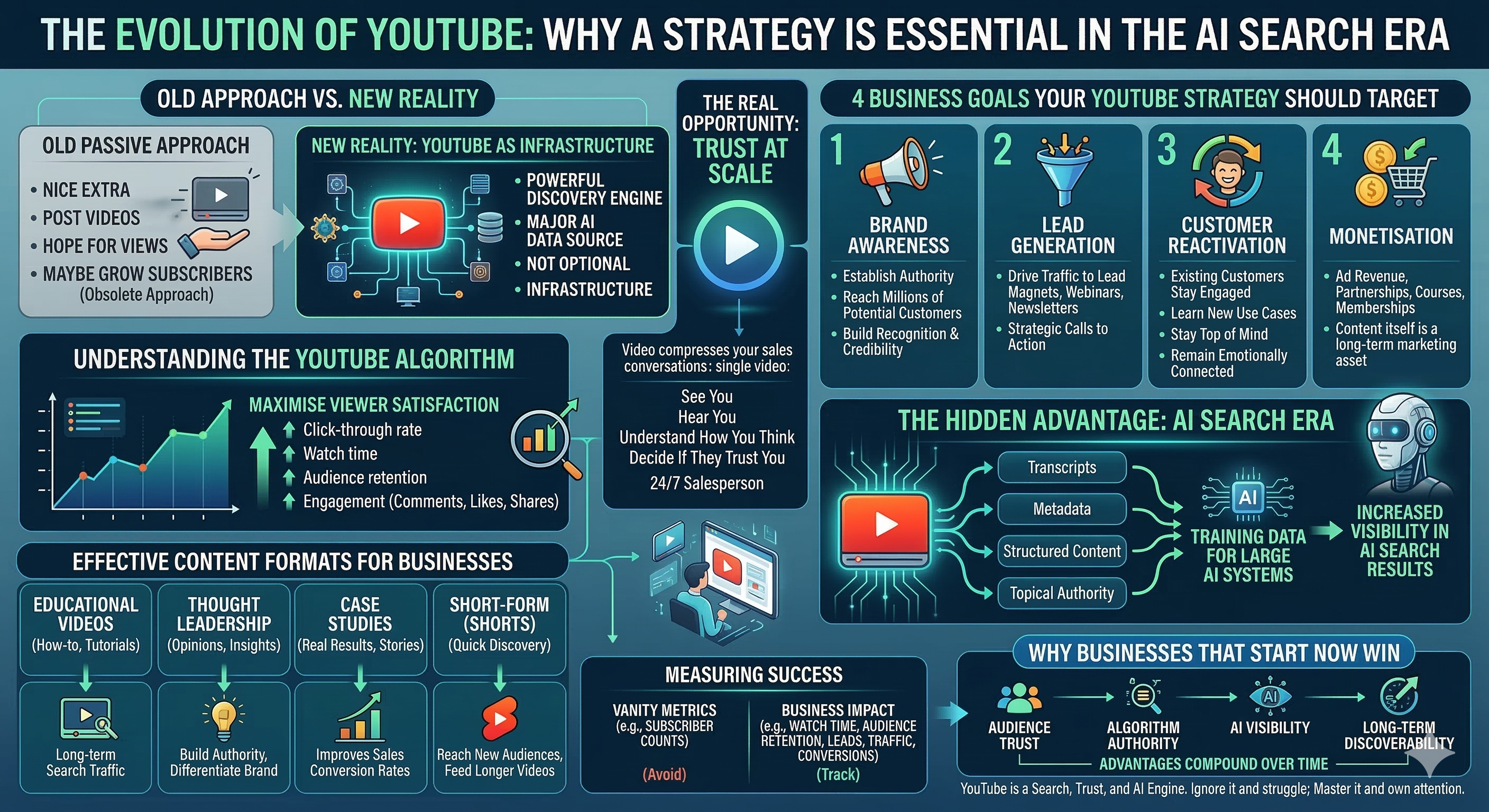
Most businesses still treat YouTube like a marketing experiment.
Post a few videos.
Hope for views.
Maybe gain a few subscribers.
But that approach is now outdated.
YouTube has evolved into one of the most powerful discovery engines on the internet, and increasingly one of the most important data sources used by AI systems to understand brands, expertise, and authority.
For businesses focused on long-term visibility, YouTube is no longer optional.
It is now a core pillar of search strategy.
YouTube has over 2 billion logged-in monthly users, making it the second largest search engine in the world.
But the real power of YouTube isn’t just reach.
It’s trust at scale.
Video allows potential clients to:
• see who you are
• understand your expertise
• hear your thinking
• decide if they trust you
This dramatically shortens the traditional sales cycle.
A single strong video can achieve what used to take multiple meetings, proposals and conversations.
In many cases, businesses find that prospects already trust them before the first call simply because they have watched their content.
One of the most overlooked benefits of YouTube is how it contributes to AI discoverability.
Every YouTube video automatically creates structured data that includes:
• transcripts
• captions
• timestamps
• metadata
• topic classification
This structured information helps AI systems understand:
Large language models increasingly reference content that contains clear topical authority signals.
Video transcripts are particularly valuable because they provide large volumes of contextual language data, which AI systems can easily interpret.
This means YouTube content can increase your chances of appearing in answers generated by platforms such as:
For companies looking to build long-term AI visibility, video content is becoming one of the strongest signals available.
Many companies approach YouTube incorrectly by focusing purely on views or subscriber counts.
Instead, a strategic channel should support four core business outcomes.
Publishing consistent, educational content positions your company as a recognised voice in your industry.
Over time, this builds authority that compounds.
When prospects repeatedly encounter your insights online, your brand begins to feel familiar long before they become a customer.
This type of authority cannot be achieved through advertising alone.
YouTube can act as a powerful lead generation engine when combined with the right calls to action.
Businesses commonly use videos to guide viewers toward:
Because viewers have already spent time engaging with your content, the leads generated through YouTube often convert at higher rates.
YouTube also plays a critical role in helping businesses support existing customers.
Content can include:
Customers who continue learning from your content are more likely to remain loyal and engaged.
Unlike social media posts that disappear quickly, YouTube videos can generate traffic for years.
High-quality educational content often continues attracting new viewers long after it is published.
This creates a library of evergreen assets that continue supporting marketing and sales efforts.
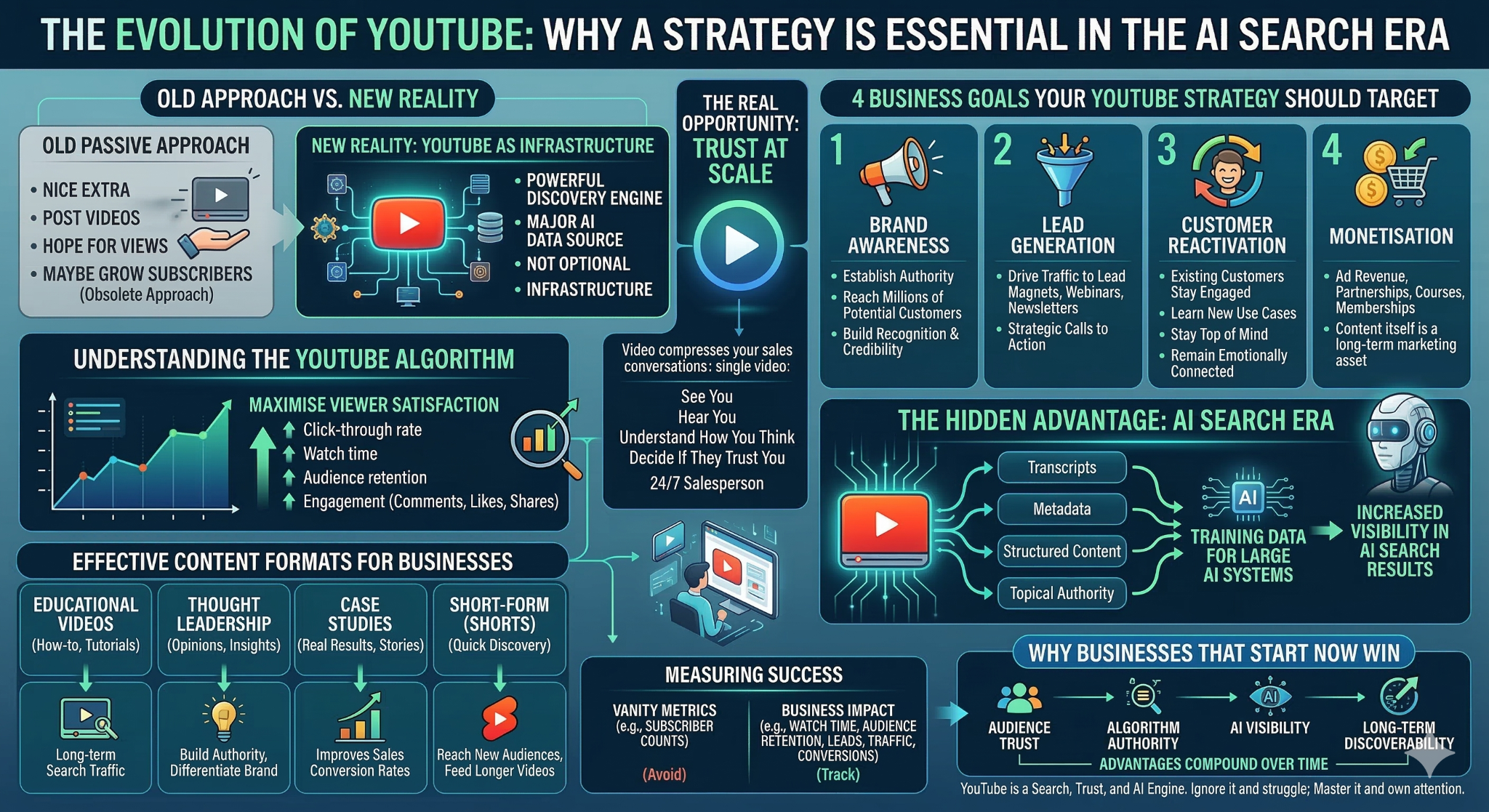
The YouTube algorithm is designed to maximise viewer satisfaction.
It prioritises content that keeps people watching and encourages further engagement.
The most important ranking signals include:
How often viewers click your video when it appears in search results or recommendations.
How long viewers spend watching your content.
The percentage of your video that viewers watch before leaving.
Comments, likes, shares and subscriptions generated by the video.
Videos that perform well in these areas are more likely to be recommended to wider audiences.
A strong YouTube strategy typically combines several types of content.
These videos answer questions that your target audience is actively searching for.
Examples include:
Educational videos often perform well in search and can attract consistent long-term traffic.
Opinion-driven content helps businesses differentiate themselves.
Sharing perspectives on industry trends or challenges allows your brand to become recognised as a leader rather than just a service provider.
Videos showing real results build credibility.
Prospective clients want to see proof that your approach works.
Case studies provide that reassurance.
Short videos help reach new audiences quickly and can introduce viewers to your longer content.
They are particularly useful for expanding reach and increasing brand exposure.
YouTube content can enhance your wider search presence in several ways.
Google often displays video results directly within search pages.
Businesses with strong video content can capture additional visibility beyond traditional text results.
YouTube videos frequently drive viewers toward company websites where they can explore services or resources in greater detail.
A single video can be repurposed into multiple assets including:
This allows businesses to maximise the value of every piece of content created.
| Strategic Pillar | The Obsolete Approach | The Modern AI-Era Strategy | Key Metrics & Focus |
|---|---|---|---|
| Overall Mindset | Treating YouTube like a "nice extra." | Building it as core business infrastructure. | Trust at scale; creating a 24/7 salesperson. |
| Primary Goal | Chasing viral views and subscriber counts. | Driving tangible business outcomes. | Lead generation, brand awareness, reactivation. |
| The Algorithm | Viewing it as an unpredictable mystery. | Designing content for viewer satisfaction. | Click-through rate, watch time, audience retention. |
| Content Formats | Posting random videos and hoping for the best. | Mixing formats strategically (Educational, Case Studies, Shorts). | Matching the video format to a specific business goal. |
| AI Integration | Ignoring video's role in the future of search. | Creating structured content to feed AI models. | Transcripts, metadata, and topical authority. |
| Measurement | Focusing purely on vanity metrics. | Tracking actual business impact. | Leads generated, website traffic, sales conversions. |
Many companies focus too heavily on subscriber numbers.
While subscribers are useful, they are not the most important indicator of success.
Businesses should track metrics that relate directly to outcomes.
These include:
Ultimately, the purpose of a YouTube strategy is not to create viral videos but to support business growth.
Despite the platform’s size, many industries still have relatively little high-quality educational content available.
This creates an opportunity.
Businesses that begin building video libraries today will gradually accumulate:
Because content remains discoverable for years, these advantages compound over time.
The future of digital visibility is moving beyond traditional search.
AI systems are increasingly responsible for how people discover businesses and information.
Companies that produce high-quality, structured content are far more likely to be recognised by these systems.
YouTube plays a crucial role in this shift.
By combining video content with strong SEO practices and clear topical authority, businesses can significantly improve their visibility across both search engines and AI platforms.
For organisations focused on long-term growth, YouTube is no longer just a marketing channel.
It is becoming a fundamental part of digital presence.
At Tenacious, we help businesses become visible across search engines, AI platforms and digital media through structured content strategies, authority building and scalable visibility systems visit www.tenaciousmarketing.co.uk
If you're ready to turn video into a long-term growth engine, speak to our team about launching a YouTube strategy designed for the AI era.
YouTube helps businesses build trust, authority, and visibility at scale. It is no longer just a content platform, it is a discovery engine and a major source of structured content that helps search engines and AI systems understand your brand, expertise, and relevance.
Yes. YouTube supports SEO, AEO and GEO by creating transcripts, metadata, captions, timestamps, and topical context. These signals help search engines and AI platforms better understand what your business does and which topics you are authoritative in.
Most businesses should publish a mix of educational videos, thought leadership, case studies, and short-form discovery content. That gives you a balance of search visibility, authority building, trust, and reach.
YouTube can generate leads by attracting the right audience, building trust before a sales conversation, and directing viewers to consultations, webinars, downloadable guides, newsletters, or product demos through clear calls to action.
The most important metrics are click-through rate, watch time, audience retention, website traffic, lead generation, and sales conversions. Subscriber count alone is not the best measure of business impact.
Video transcripts give AI systems large amounts of contextual language data to interpret. Along with captions, metadata, and topic classification, they make it easier for AI platforms to understand your business and increase the chance of your content being surfaced in AI-generated answers.