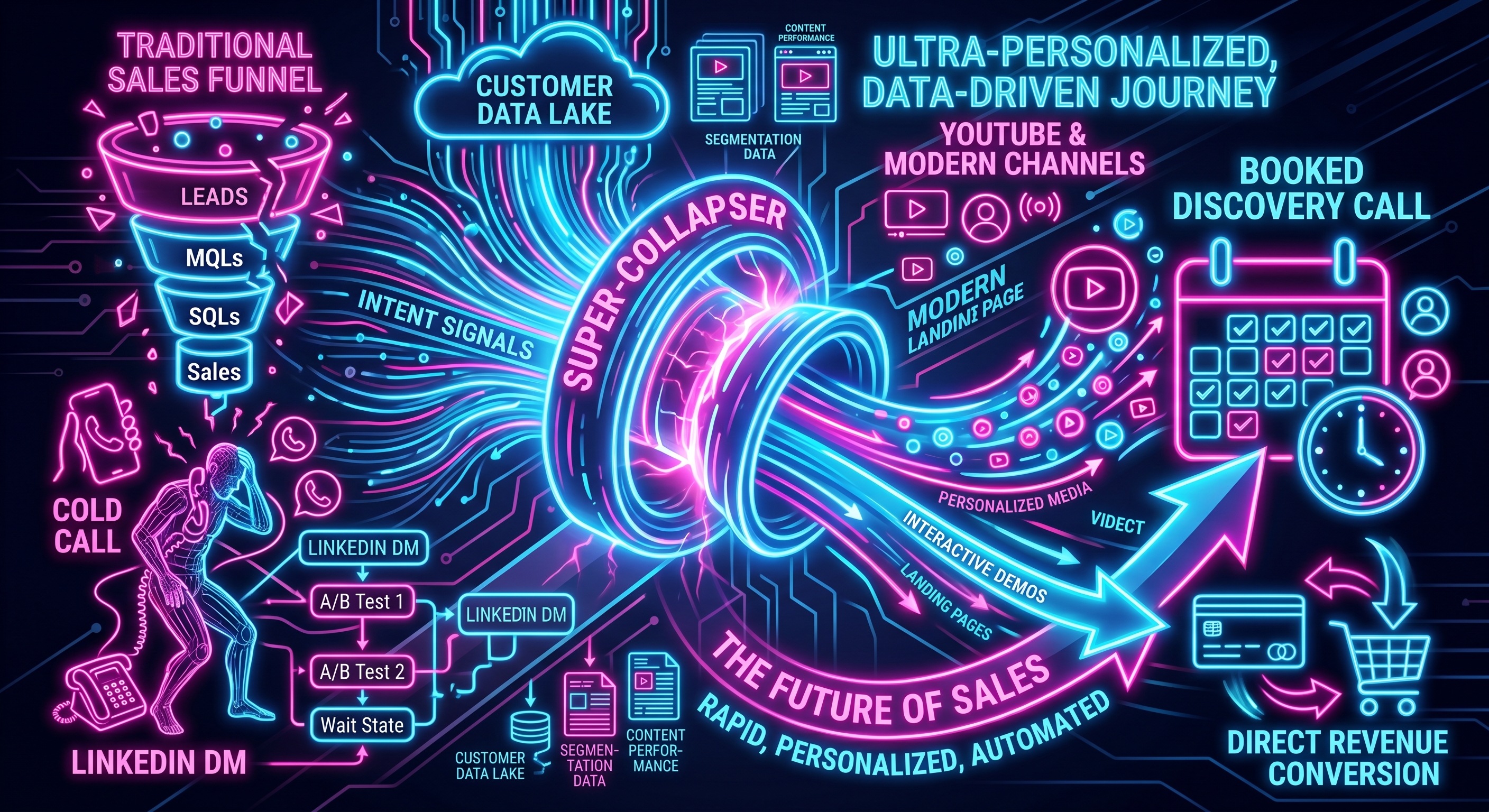
Most AI agency owners are trying to grow their business through cold outreach, LinkedIn DMs, and referrals. Those channels work (until they don't). They require constant effort, they cap out when your time caps out, and they produce leads who know almost nothing about you before you get on a call.
YouTube works the other way around.
A prospect who finds your channel, watches three or four of your videos, and books a discovery call has already spent hours with you before you've said a word to them directly. They've seen how you think. They've watched you build automations. They've heard you explain your process, your pricing logic, your results. By the time they fill in your intake form, they've already decided they want to work with you. The call is a formality.
This is what people mean when they talk about collapsing the sales funnel. YouTube doesn't just generate leads (it generates pre-sold leads). The data backs this up. Wyzowl’s 2026 video marketing research found that 85% of people have been convinced to buy a product or service after watching a video, showing why educational YouTube content can move prospects from awareness to buying intent before a sales call ever happens
And for an AI agency selling a high-trust, high-ticket service, that difference is enormous.
This is the complete launch checklist: what to set up, what to record, how to structure your content strategy, and how to turn a YouTube channel into your most reliable new business channel.
Before the checklist, it's worth being clear about why this opportunity is particularly strong right now (and why it won't stay this uncrowded for long).
AI automation is a fast-growing sector, but the content landscape on YouTube has a clear gap. There is a lot of content targeting other aspiring agency owners (tutorials on how to start an agency, how to price services, how to get clients). That content has an audience, but it's not the content that generates paying clients for your agency.
The content that generates paying clients (case studies showing real automations you've built, walkthroughs of how you solve specific business problems, demonstrations of what's possible with tools like Make.com, n8n, or custom GPTs) is significantly underproduced relative to demand.
Business owners who want to automate their operations are actively searching YouTube for evidence that someone knows how to do what they need. They are not finding many AI agencies demonstrating that capability in a clear, credible, trust-building way. The ones that do are consistently generating inbound at a volume that most agency owners can't achieve through any other single channel.
Launch now. The gap is real and it will close.
Before you record a single video, get these foundations right. Launching on a half-built channel wastes the momentum of your first few videos.
You do not need to spend £2,000 on a camera setup before you've published a single video. Here's what's sufficient to start:
This is where most AI agency channels go wrong. They either produce content that's too technical for potential clients to follow, too generic to demonstrate real capability, or too self-promotional to build the trust that converts.
The content strategy that works for an AI agency has a specific logic: demonstrate expertise, build trust, pre-qualify viewers, and create a body of content that does your selling for you (24 hours a day, in every time zone, to prospects you'll never meet until they book a call).
“I built this (automation) from scratch (here's exactly how)”
This is your primary content type and the engine of your channel's growth. You screen-record yourself building a real automation (a CRM workflow, a lead qualification bot, a content repurposing system, a customer support AI) and you explain every step as you go.
Why it works: It proves you can actually do what you say you can do. A business owner watching you build an automation that would save their team ten hours a week is not thinking "interesting tutorial". They're thinking "I need this person to build this for me". The tutorial is the sales pitch (it just doesn't feel like one).
Video ideas in this format:
"I built an AI lead qualification bot that books calls automatically (full build walkthrough)"
"How to automate client onboarding with AI: step-by-step build"
"I connected ChatGPT to a CRM and automated the entire follow-up sequence (here's how)"
"Building an AI-powered content repurposing system from scratch"
"How to build a customer support bot that escalates to a human when needed"
"Automating invoice processing with AI (the full workflow)"
"I built an AI meeting notes to CRM pipeline (complete tutorial)"
“I built this for a client (here's what it did for their business)”
Case study content. You walk through a real (or anonymised) client project: the problem they had, the automation you built, the result it produced. Specificity is everything here (vague claims don't convert, but "we automated a 12-step manual process that was taking their ops team 6 hours a week and reduced it to 20 minutes" is the kind of specific, credible result that makes a viewer pick up the phone).
Video ideas in this format:
"This automation saved my client 15 hours a week (here's exactly what I built)"
"How I helped a recruitment agency automate their entire candidate pipeline"
"A law firm was drowning in admin (here's the AI system I built to fix it)"
"My client was losing leads because of slow follow-up. We fixed it with AI."
“Here's how (concept or tool) actually works”
Content that explains AI concepts, tools, or strategies in plain, practical terms (aimed at business owners who are trying to understand what's possible before they commit to working with someone). This type of content builds the kind of trust that referrals build, but at scale. When a business owner has watched you explain AI automation in a way that's clear and jargon-free, they trust that you'll be able to communicate clearly with their team during a real project.
Video ideas in this format:
"What is an AI automation agency and what do they actually do?"
"n8n vs Make.com: which should you use for your business?"
"What ChatGPT can and can't do for your business (honest breakdown)"
"AI automation pricing explained: what does it actually cost?"
"The difference between a chatbot and an AI agent (and why it matters)"
"5 business processes you can automate with AI right now"
“Here's how I run my AI agency (the real version)”
Behind-the-scenes content that documents your process, your decisions, your mistakes, and your progress. This content is the most personal and the most trust-building. Viewers who follow your journey feel like they know you (and people hire people they feel like they know).
This doesn't mean oversharing or performing vulnerability. It means being honest about how you work, what you've learned, and what the business of running an AI agency actually looks like.
Video ideas in this format:
"How I structure an AI automation project from first call to delivery"
"My client onboarding process (how I run the first 30 days)"
"How I price my AI agency services (and why)"
"The tools I use to run my AI agency day to day"
"How I find and qualify new clients without cold outreach"
The order of your first ten videos matters. Here's a sequence designed to establish credibility quickly, give the YouTube algorithm enough data to start distributing your content, and create a body of work that converts viewers into booked calls.
Video 1 Channel Trailer / Who I Am and What This Channel Is
Introduce yourself, your agency, who you help, and what viewers will learn from your channel. Keep it under 90 seconds. This is the video people land on when they're deciding whether to subscribe (make it worth their time).
Video 2 Your First Tutorial Build (Medium Complexity)
Pick an automation that's impressive but not overwhelming (something a business owner would immediately recognise as valuable). Build it on screen, narrate every step, and explain the business problem it solves as you go. This is your proof-of-work video.
Video 3 "What Is an AI Automation Agency?" Explainer
Capture the search intent of business owners who are starting to explore this space. Explain what AI automation agencies do, who they work with, what a typical project looks like, and what to look for when choosing one. This video generates steady, consistent inbound traffic from people at the earliest stage of their buying journey.
Video 4 Client Result Case Study
Walk through a real or anonymised client project. Be specific about the problem, the solution, and the measurable outcome. If you don't have a client yet, use a project you've built speculatively (a fictional business scenario built to demonstrate real capability).
Video 5 Tool Breakdown or Comparison
Cover one of the primary tools in your stack (n8n, Make.com, Zapier, OpenAI API, a specific CRM integration) and explain how it works, what it's good for, and where it fits in a broader automation strategy. Tool comparison and review content performs well in search and positions you as someone who has genuine working knowledge, not just surface-level familiarity.
Video 6 Second Tutorial Build (Different Niche or Use Case)
Vary the audience or use case from Video 2 (if the first build was for e-commerce, this one could be for professional services or recruitment or finance). Expanding the range of your tutorials shows the breadth of your capability and gives YouTube more data about what kind of viewer your content attracts.
Video 7 "How I Structure My Projects" Process Video
Explain your end-to-end process: how you scope a project, what the onboarding looks like, how you communicate with clients during the build, and how you hand over and support after launch. This video pre-qualifies prospects by setting expectations and eliminating uncertainty (two of the biggest barriers to a first enquiry).
Video 8 “5 Automations Every [Specific Business Type] Needs”
Pick a niche and list five specific automations that would deliver real value to businesses in that sector. This format performs well in search, signals niche expertise, and generates enquiries from exactly the kind of clients you want to work with.
Video 9 Third Tutorial Build (More Advanced)
By Video 9 you have enough channel data to know which builds resonated most. Build something in that direction, but go deeper (more complex, more business value, more specific to a real operational problem).
Video 10 Honest Reflection or Q&A
Answer the questions you've been getting in comments, or give an honest reflection on what you've learned from launching the channel and running the agency. This content builds the personal connection that turns subscribers into clients (and it gives you feedback on what your audience actually wants to see next).
Traditional sales funnels look like this: awareness to interest to consideration to intent to purchase. Each stage requires effort from you (content, outreach, follow-up, calls, proposals). Most of the work happens before you've ever spoken to the prospect.
YouTube collapses this. Here's how.
A business owner searches for "how to automate my CRM with AI". They find one of your tutorial videos. They watch it through. They click your channel. They watch two more videos. They subscribe. Over the next three weeks they watch six more of your videos while they commute, while they cook dinner, while they're between meetings. They've now spent four or five hours with you. They understand how you think. They've seen you solve real problems. They trust you.
When they fill in your intake form, they're not starting from zero. They're not a cold lead who needs to be qualified, educated, and convinced. They already know what you do. They've already seen that you can do it. They've already decided that they want someone like you. The discovery call exists to confirm fit and agree terms (not to sell the concept).
This changes your close rate, your average deal size, and the quality of clients you attract.
YouTube is especially powerful at this stage of the journey. According to Google’s research with BCG, respondents said YouTube was 1.7x more likely to positively influence brand consideration and 1.6x more likely to positively influence purchase decisions than social platforms.
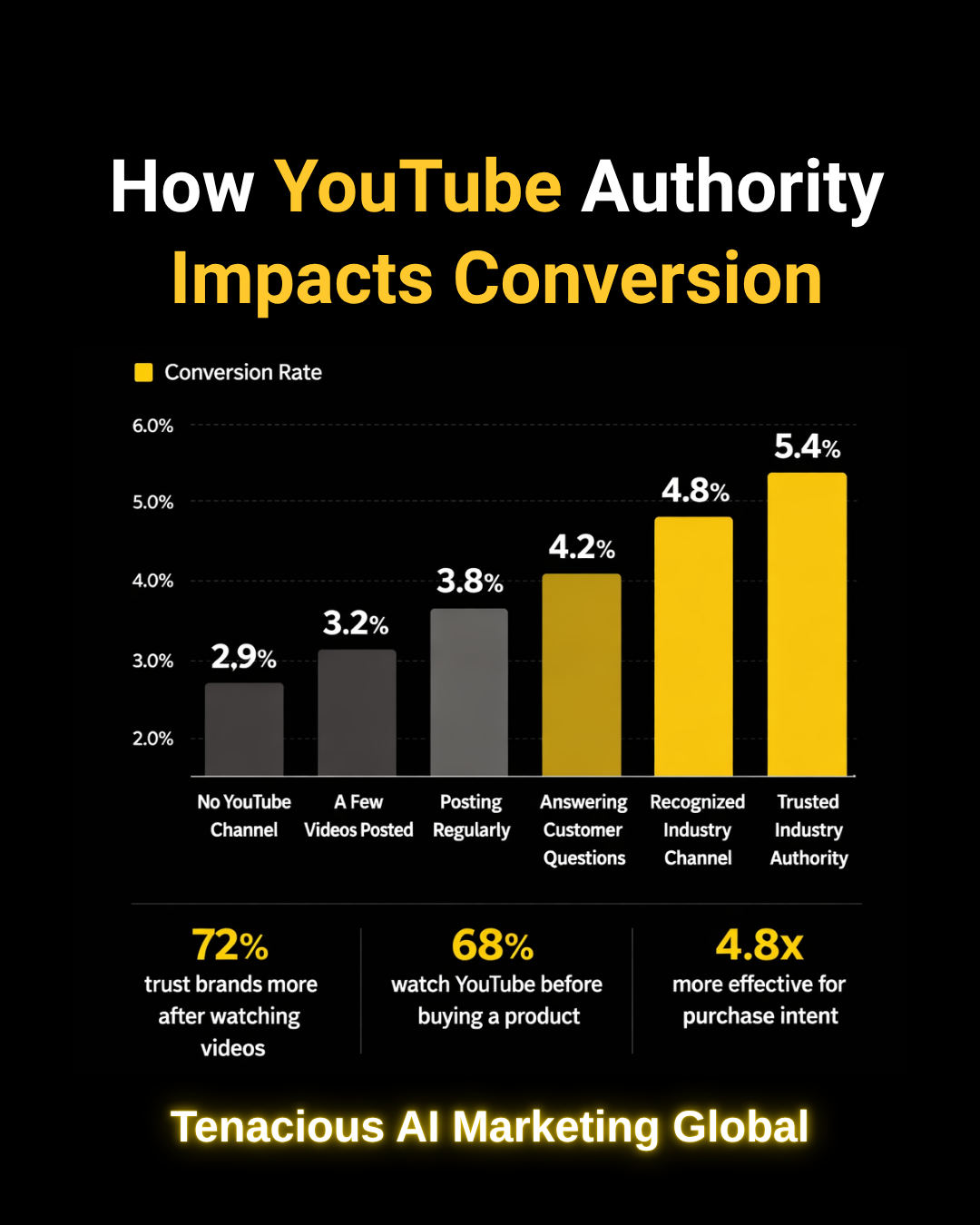
To make this work intentionally:
Put your booking link everywhere - In every video description. In every video's end screen. In every pinned comment. In your channel About section. In your bio across every platform. Make it impossible not to find.
Create a watching sequence - In your video descriptions, link to the next most relevant video for a viewer who wants to go deeper. Build playlists that group your content by audience type or use case (a playlist for e-commerce businesses, a playlist for professional services, a playlist for "how I run my agency"). A viewer who watches a playlist is a viewer who is seriously considering working with you.
Use your end screen calls to action strategically - Every video should end with a clear, specific instruction: "if you want to talk about building something like this for your business, the link to book a call is in the description". Not vague. Not "check out my channel". A specific invitation to the next step.
Make your intake form do the qualifying - Before your discovery call, ask every incoming enquiry: how did you find me? What videos have you watched? What's the problem you're trying to solve? What's your timeline and budget? A well-designed intake form turns a booked call into a pre-qualified conversation (you walk into the call already knowing whether there's a fit).
Publishing is not the same as distributing. The videos that grow a channel fastest are the ones that get seen by the right people in the first 48 hours after publication. Here's how to give every video the best possible start.
Post a clip on LinkedIn within 24 hours of publishing - A 60 to 90 second vertical clip from the video, captioned with a clear summary of what a viewer will learn, with a comment linking to the full video. LinkedIn organic reach is still significant for business and AI content (this is your most direct route to business owner eyeballs).
Share a clip on Instagram Reels or TikTok - AI automation content performs consistently on both platforms. Short clips of automations running, problems being solved, or insights being explained in 60 seconds reach audiences who won't find you via YouTube search.
Post in relevant communities - Reddit communities like r/Entrepreneur, r/automation, and r/AIAssistants, Slack groups for your niche, Discord servers for AI practitioners, and Facebook groups for business owners in your target sector. Don't spam (contribute genuinely, and share your content where it's directly relevant to a conversation that's already happening).
Email your list - If you have an existing email list from any other business activity, tell them about your YouTube channel and specifically about videos that are relevant to their situation. Early engagement from subscribers who already know you helps the YouTube algorithm understand that your content is worth distributing.
Engage in the first hour - Reply to every comment on every video in the first hour after publication. This signals to YouTube that the video is generating engagement, which influences how broadly it's distributed. Comments aren't just vanity (they're a distribution signal).
A channel that publishes once and then goes quiet does not grow. But you also don't need to publish daily. Here's a sustainable rhythm for an AI agency owner:
Weekly or fortnightly publishing - One video every one to two weeks is sufficient to build a body of content that compounds over time. Consistency matters more than frequency (a channel that publishes fortnightly for twelve months has more compounding advantage than one that publishes daily for a month and then stops).
Batch your recording - Record two or three videos in a single session rather than recording, editing, and publishing one at a time. This protects your publishing schedule when client work gets busy.
Plan three to four weeks ahead - Always have your next three or four video topics decided before you need them. A content pipeline takes the decision-making pressure out of each week and ensures you're being strategic rather than reactive about what you publish.
Review your analytics monthly - YouTube Studio gives you clear data on which videos are driving watch time, which are generating subscribers, and which are producing clicks through to your website or booking page. Use this data to make more of what's working and less of what isn't. After three to four months, your analytics will show you exactly which content types and topics your ideal clients are engaging with most.
Part of the advantage of running an AI agency is that you should be using AI throughout your own content production. Here's where it makes the biggest difference:
ChatGPT or Claude for scripting and outlines - Don't script your videos word-for-word (it produces stilted, unnatural delivery). Use AI to produce a structured outline with the key points you want to hit, in order. Then deliver it conversationally from that outline rather than reading a script.
Descript or Otter.ai for transcription - Every video you publish should have an accurate transcript (both for YouTube captions (which improve accessibility and retention) and for repurposing content into blog posts, LinkedIn posts, and email newsletters).
ChatGPT for metadata optimisation - Paste your transcript or outline into ChatGPT and ask it to generate five title options, a video description optimised for search, and a set of relevant tags. Then use TubeBuddy or VidIQ to check search volume for your chosen keywords before you publish.
Canva AI for thumbnail creation - Canva's AI tools can generate background images and design elements for thumbnails quickly. Build your template once, then update the image and text for each video (the whole process takes ten minutes once you have the system set up).
A YouTube channel is not a side project for an AI agency. It is the most powerful trust-building and lead-generation tool available to you (and it works compoundingly, producing returns long after the initial effort of creating each video).
The agencies that launch now, publish consistently, and build a body of content that demonstrates real capability will acquire clients their competitors never knew were looking. The ones that keep relying entirely on cold outreach and referrals will find themselves working harder for each new client as the market gets noisier.
The checklist above gives you everything you need to launch properly and build something that compounds over time.
For everything beyond this checklist (deeper dives on GEO strategy, AI tools, content production workflows, how to package and price your services, and the full picture of building an AI agency that generates consistent inbound) subscribe to the Build With Dean YouTube channel at youtube.com/@buildwithdean. It's where the ongoing training, podcasts, case studies, and how-to content live (and it's the best free resource available for AI agency owners who want to build something serious).
Related Reading
The State of AI Search in May 2026
Beyond the Search Bar: Why AEO Testing Is Now a Business Visibility Metric
Why YouTube Is Now Essential for Business Visibility in the AI Era
What Is GEO in 2026, and How Do You Get Cited in AI Answers?
The New Rules of AI Search in 2026
Search Everywhere Optimisation: AI Visibility in 2026
How to Audit Your Website for AI Visibility in 2026
Do I need to show my face on camera?
Yes (for this type of content, on-camera presence builds trust in a way that voiceover-only content does not). Business owners are considering handing a significant amount of money and operational responsibility to you. They want to see who they're dealing with. That said, your first videos don't need to be polished productions (a well-lit iPhone shot with good audio is entirely sufficient to start). The goal is genuine and credible, not cinematic.
How long should my videos be?
Tutorial and build content performs best at 15 to 30 minutes (long enough to cover a real project in genuine depth, short enough not to lose attention). Explainer and education content works at 8 to 15 minutes. Case study videos can range from 10 to 20 minutes depending on complexity. Don't pad any video to hit a length target. End when you've covered what you needed to cover. Viewer retention is a key algorithm signal (a 12-minute video that holds 65% retention outperforms a 25-minute video that holds 35%).
What if I don't have clients yet? What do I build tutorial content around?
Build real automations for hypothetical scenarios (a fictional recruitment agency, a fictional e-commerce business, a fictional law firm). The quality of the build and the clarity of the explanation are what matter, not whether the client in the video is real. Many successful AI agency channels were built entirely on speculative builds before the creator had a single paying client. The tutorial demonstrates capability; the capability attracts clients.
How long before YouTube generates meaningful inbound?
For most AI agency channels, meaningful inbound (regular enquiries from qualified prospects who have watched multiple videos) typically begins between month four and month eight, assuming consistent weekly or fortnightly publishing. The first three months are about building a body of content and letting the algorithm understand your audience. Don't measure success by leads in month one. Measure it by the quality of your content, the consistency of your publishing, and the growth trajectory of your watch time and subscriber count.
Should I focus on a niche or stay general?
Niche channels grow faster and convert better. "AI automation for recruitment agencies" will build a more engaged, more convertible audience than "AI automation for businesses". The trade-off is a smaller total audience (but a smaller, more targeted audience of people who are exactly your ideal clients is worth significantly more than a large general audience that doesn't convert). Pick a niche you have genuine knowledge of, or that you want to develop expertise in, and build your first twenty videos around that niche specifically.
Can I use AI to generate my video scripts?
Use AI to produce structured outlines and talking points, not complete scripts. Fully AI-generated scripts delivered to camera produce content that sounds robotic and lacks the specific, personal knowledge that builds trust. The most effective format is you, on camera, talking naturally from a structured outline that you've thought through properly. The research and structure can be AI-assisted. The delivery should be genuinely yours