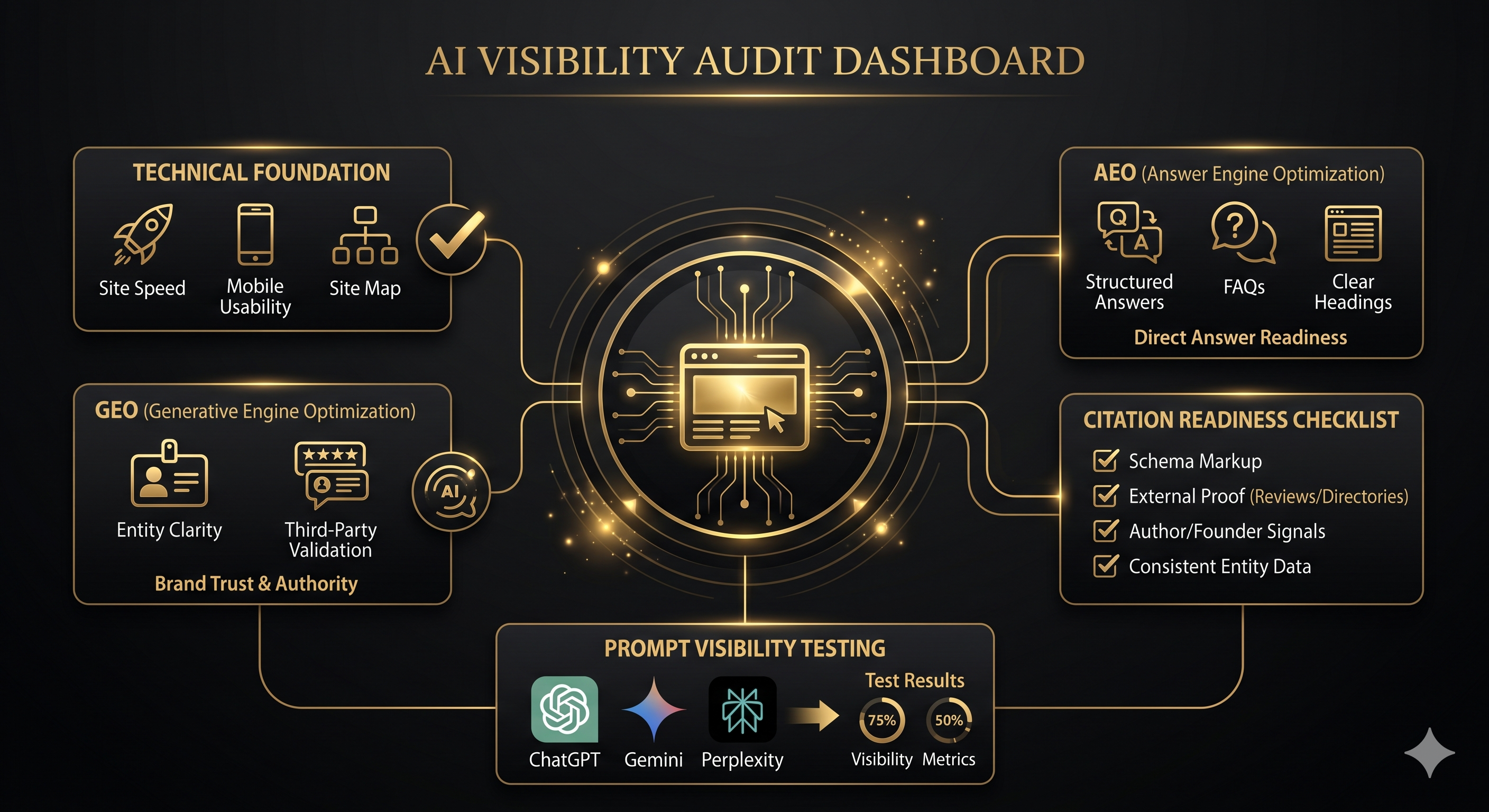
AI visibility is no longer just about ranking on Google. Your brand now needs to be understood, trusted, cited and recommended across Google AI, ChatGPT, Gemini, Claude, Perplexity and other AI search experiences.
Traditional SEO audits are still usefu
AI visibility is no longer just about ranking on Google. Your brand now needs to be understood, trusted, cited and recommended across Google AI, ChatGPT, Gemini, Claude, Perplexity and other AI search experiences.
Traditional SEO audits are still useful, but they are not enough. You now need to audit your website, content, schema, founder profiles, external proof, LinkedIn authority, YouTube visibility and prompt performance.
SEO helps search engines find your pages. AEO helps your content answer specific questions. GEO helps AI systems understand, cite and recommend your brand.
The brands that win in AI search are not always the biggest. They are the clearest, most consistent and easiest to verify.
This guide gives you a practical AI visibility audit checklist you can use to find what is stopping your brand from being recommended by AI.
An AI visibility audit checks whether your brand is easy for search engines and AI systems to find, understand, verify and recommend.
A traditional SEO audit usually looks at things like rankings, keywords, page speed, backlinks and technical errors.
An AI visibility audit goes further.
It asks:
That is the difference.
Old SEO asks, “Can Google rank this page?”
AI visibility asks, “Can AI confidently recommend this brand?”
Traditional SEO still matters. Your site still needs to be crawlable, fast, mobile-friendly and technically clean.
Google’s own documentation confirms that websites still need strong technical foundations and structured data to help search engines understand content properly: Google Search Central structured data guidance.
But AI search changes the measurement layer.
A page can rank well in Google and still be invisible when someone asks ChatGPT, Gemini or Perplexity for a recommendation.
That is because AI systems do not only look at your page.
They look for a wider pattern of trust.
They assess:
If those signals are weak, mixed or missing, AI systems may choose a competitor instead.
| Discipline | What It Means | Why It Matters |
|---|---|---|
| SEO | Search Engine Optimisation | Helps your pages rank and get discovered in search engines |
| AEO | Answer Engine Optimisation | Helps your content answer specific questions clearly |
| GEO | Generative Engine Optimisation | Helps AI systems trust, cite and recommend your brand |
| AI visibility | Your overall presence in AI-generated answers | Shows whether your brand appears when buyers ask AI tools for help |
SEO is the foundation.
AEO turns your content into clear answers.
GEO turns your brand into a trusted source.
AI visibility is the outcome.
For a deeper breakdown, read: What Is GEO in 2026 and How Do You Get Cited in AI Answers?
Use this scorecard to assess how ready your website is for AI search.
| Audit Area | Score /10 | What to Check |
|---|---|---|
| Technical crawlability | /10 | Indexing, sitemap, robots.txt, page speed, mobile usability |
| Entity clarity | /10 | Brand name, founder, services, audience, location and category clarity |
| Service page clarity | /10 | Clear offers, outcomes, audience, proof and FAQs |
| Answer-first content | /10 | Question-led headings, direct answers, examples and tables |
| Schema | /10 | Organisation, Person, Article, FAQ, VideoObject and Breadcrumb schema |
| Internal linking | /10 | Links between blogs, service pages, tools and proof pages |
| External proof | /10 | Reviews, listicles, directories, podcasts, PR and third-party mentions |
| LinkedIn and YouTube signals | /10 | Founder authority, video answers, transcripts and topical consistency |
| Prompt visibility | /10 | Whether your brand appears in ChatGPT, Gemini, Claude and Perplexity |
| Conversion path | /10 | Clear CTA, website scan, strategy call or next step |
If you score below 70, you probably have gaps that are stopping AI systems from fully understanding or recommending your brand.
Before AI can trust your content, search engines need to access and understand your website.
Check:
Technical SEO is not exciting, but neither is plumbing until the house floods.
AI search visibility starts with a website that can be crawled, parsed and understood.
Entity clarity means AI systems can understand exactly who you are, what you do and why you matter.
For a B2B service business, your website should make these things obvious:
If your homepage says one thing, your LinkedIn says another and your directory listings use old wording, AI gets mixed signals.
Mixed signals reduce trust.
Trust is what earns citations.
For Tenacious, the entity should be clear:
Tenacious AI Marketing Global helps B2B service businesses improve visibility across Google, ChatGPT, Gemini, Perplexity and AI search through AEO, GEO, structured content, LinkedIn authority, YouTube visibility and AI visibility tracking.
You can see the main brand positioning here: Tenacious AI Marketing Global
Your service pages are not just sales pages anymore.
They are evidence pages.
AI systems use them to understand what you do, who you help and what problems you solve.
Each service page should answer:
Weak service page:
“We help brands grow online with digital marketing.”
Strong service page:
“We help B2B service businesses improve visibility across Google AI, ChatGPT, Gemini and Perplexity using AEO, GEO, structured content, LinkedIn authority and YouTube visibility.”
The second version is clearer for humans and easier for AI systems to understand.
Most old blog content is written like this:
Introduction, context, long explanation, conclusion.
AI search prefers content that answers clearly.
A better structure is:
Question, direct answer, explanation, example, proof, next step.
For example, instead of this heading:
“Modern Marketing Trends for B2B Brands”
Use this:
“How Do B2B Companies Get Found in ChatGPT and Google AI?”
Then answer the question directly in the first few lines.
Good answer-first content includes:
If you want the wider strategy behind this, read: The New Rules of AI Search in 2026
FAQ pages are becoming more important in AI search because they match the way people ask questions.
A good FAQ page has:
Many businesses have dozens of blogs but very few useful FAQ pages.
That is a missed opportunity.
AI systems often prefer FAQ-style content because it is easy to extract, summarise and cite.
Your audit should check whether your website answers real buyer questions such as:
If your website does not answer these questions, AI may find another brand that does.
Schema helps search engines understand the meaning of your content.
It does not guarantee rankings or AI citations, but it makes your website easier to interpret.
For B2B service businesses, useful schema types include:
| Schema Type | Use It For |
|---|---|
| Organisation | Your company entity |
| Person | Founder, author or expert profiles |
| BlogPosting | Blog articles |
| FAQPage | FAQ sections |
| BreadcrumbList | Page hierarchy |
| VideoObject | Embedded videos |
| WebPage | Main pages |
| Service | Service pages |
| Review | Genuine review content where suitable |
Google’s structured data guidance explains how schema can help search engines better understand page content: Google Search Central structured data documentation.
Your schema should match the visible content on the page.
Do not add fake reviews, fake FAQs, fake authors or fake services.
That is not optimisation. That is digital nonsense in a fake moustache.
AI systems look for credibility.
That means your authors, founders and company profiles matter.
Check:
For B2B service businesses, founder-led authority is a serious advantage.
A visible founder can strengthen the company entity, especially when their LinkedIn content, YouTube videos, podcast appearances and website bio all reinforce the same expertise.
Internal links help Google and AI engines understand what your website is about.
They also help users move from education to action.
Your blog should not be a pile of disconnected articles.
It should be a connected topic cluster.
For an AI visibility cluster, link between pages like:
For example, this blog should link to:
That helps search engines understand your topical expertise.
It also helps AI systems see that your site has depth, not just one lonely blog waving for attention.
AI systems do not only look at what you say about yourself.
They look for supporting evidence.
That can include:
If your website claims you are an expert, but the rest of the web is silent, that weakens your authority.
If your website, LinkedIn, YouTube, directories, reviews and third-party mentions all reinforce the same message, that strengthens it.
This is why external proof matters.
The more verifiable your brand is, the easier it becomes for AI systems to trust you.
Your buyers are not only searching on Google.
They are searching across LinkedIn, YouTube, Reddit, podcasts, review sites, directories and AI tools.
Ofcom’s Online Nation research shows how varied online behaviour has become in the UK, with people using search, social, video and AI-driven tools as part of their daily online habits: Ofcom Online Nation.
For B2B brands, the most important visibility signals usually come from:
| Channel | Why It Matters |
|---|---|
| Founder authority, thought leadership and buyer trust | |
| YouTube | Searchable video answers, transcripts and expertise signals |
| Google Business Profile | Local trust, services and reviews |
| Directories | Third-party validation |
| Podcasts | Expert positioning |
| Listicles | Comparison visibility |
| Reviews | Trust and proof |
| Case studies | Evidence of results |
Search Everywhere Optimisation is about making your brand visible wherever buyers and AI systems look for answers.
This is where most businesses fall down.
They audit rankings, but they never audit prompts.
Prompt testing shows whether AI systems mention, cite or recommend your brand when buyers ask relevant questions.
Test prompts like:
Then record:
| Prompt | Does your brand appear? | Who appears instead? | Are sources cited? | What needs fixing? |
|---|---|---|---|---|
| Example prompt 1 | Yes / No | Competitor name | Yes / No | Add better FAQ content |
| Example prompt 2 | Yes / No | Competitor name | Yes / No | Improve service page clarity |
| Example prompt 3 | Yes / No | Competitor name | Yes / No | Build third-party mentions |
This gives you a practical visibility map.
You can then improve the pages, signals and sources that AI systems are using.
| Week | Action |
|---|---|
| Week 1 | Run prompt tests, crawl the site, check indexing, schema and key pages |
| Week 2 | Fix entity clarity, service pages, author bios and internal links |
| Week 3 | Rewrite priority blogs with answer-first sections, FAQs and comparison tables |
| Week 4 | Retest prompts, check mentions, update schema and prioritise the next fixes |
AI visibility is not a one-time project.
It is an ongoing system.
You test, improve, publish, distribute, track and repeat.
Not every page deserves equal attention.
Start with the pages that have the highest commercial value.
Priority order:
Then ask:
Do not start with random blogs.
Start where visibility can turn into pipeline.
You can manually audit your website, but tools make the process faster.
Useful tools include:
Answer Architect helps businesses scan their website, understand their AI visibility score, find prompt opportunities, track visibility, write citation-ready blogs and identify listicles where their brand should be included.
You can also use the free Organic Visibility Scorecard to get a quick visibility score and see what to fix first.
Use this checklist before updating any major page.
| Check | Complete? |
|---|---|
| Page has a clear target question | Yes / No |
| Page answers the question near the top | Yes / No |
| Page has clear H2 and H3 headings | Yes / No |
| Page includes examples or use cases | Yes / No |
| Page includes comparison tables | Yes / No |
| Page links to related blogs | Yes / No |
| Page links to relevant service pages | Yes / No |
| Page includes credible external sources | Yes / No |
| Page has a clear author | Yes / No |
| Page has updated date | Yes / No |
| Page has relevant schema | Yes / No |
| Page has a CTA | Yes / No |
| Page supports a wider topic cluster | Yes / No |
| Page can be tested against AI prompts | Yes / No |
If a page does not answer a real question, link to related content, show authority or include a next step, it is probably not citation-ready.
Keywords matter, but AI answers are built around questions, context and entities.
For B2B brands, the people behind the business are often part of the trust signal.
If your website, LinkedIn, YouTube and directories all describe you differently, AI systems may struggle to understand your brand.
FAQ-style sections make content easier to extract and cite.
Your own website is important, but AI systems also look for validation from other trusted sources.
If you are not testing prompts, you do not really know whether AI search understands or recommends you.
For B2B service businesses, AI visibility is not a vanity metric.
It is a pipeline issue.
Your buyers are already asking AI tools for recommendations, comparisons and explanations.
They may ask:
If your brand is not visible in those conversations, you may not make the shortlist.
That means your website needs to become more than a brochure.
It needs to become a structured body of evidence.
Your content should prove:
That is what a proper AI visibility audit reveals.
If your buyers are asking Google AI, ChatGPT, Gemini, Claude or Perplexity for recommendations, your brand needs to be easy to find, understand and trust.
Tenacious AI Marketing Global helps B2B service businesses improve visibility across AI search through:
Start here:
Scan your website with Answer Architect
Or get a quick free visibility score here:
Take the Organic Visibility Scorecard
Then explore how Tenacious can help you turn AI visibility into pipeline:
Visit Tenacious AI Marketing Global
An AI visibility audit checks whether your brand can be found, understood, trusted, cited and recommended by AI systems such as ChatGPT, Gemini, Claude, Perplexity and Google AI experiences.
An SEO audit focuses mainly on rankings, keywords, technical health and search performance. An AI visibility audit also checks entity clarity, answer structure, schema, third-party proof, founder authority, prompt visibility and whether AI systems mention your brand correctly.
AEO stands for Answer Engine Optimisation. It helps your content answer specific questions clearly. GEO stands for Generative Engine Optimisation. It helps AI systems understand, trust, cite and recommend your brand inside generated answers.
You need to test buyer prompts across platforms such as ChatGPT, Gemini, Claude, Perplexity and Google AI. Record whether your brand appears, which competitors appear, what sources are cited and whether your services are described correctly.
Start with your homepage, main service pages, about page, founder profiles, case studies, FAQ pages and high-intent blogs. These pages usually have the biggest impact on AI understanding and buyer trust.
Schema helps search engines understand your content, entities, authors, FAQs, videos and organisation. It does not guarantee AI citations, but it supports clearer machine understanding.
LinkedIn helps reinforce founder expertise, company positioning, service clarity and authority. For B2B service businesses, founder-led LinkedIn content can support both buyer trust and AI understanding.
YouTube videos create searchable, transcript-based content that can answer buyer questions. Video titles, descriptions, chapters and transcripts can all support your wider AI visibility footprint.
Tenacious AI Marketing Global helps B2B service businesses improve visibility across Google, ChatGPT, Gemini, Perplexity and AI search using AEO, GEO, structured content, LinkedIn authority, YouTube visibility and Answer Architect tracking.