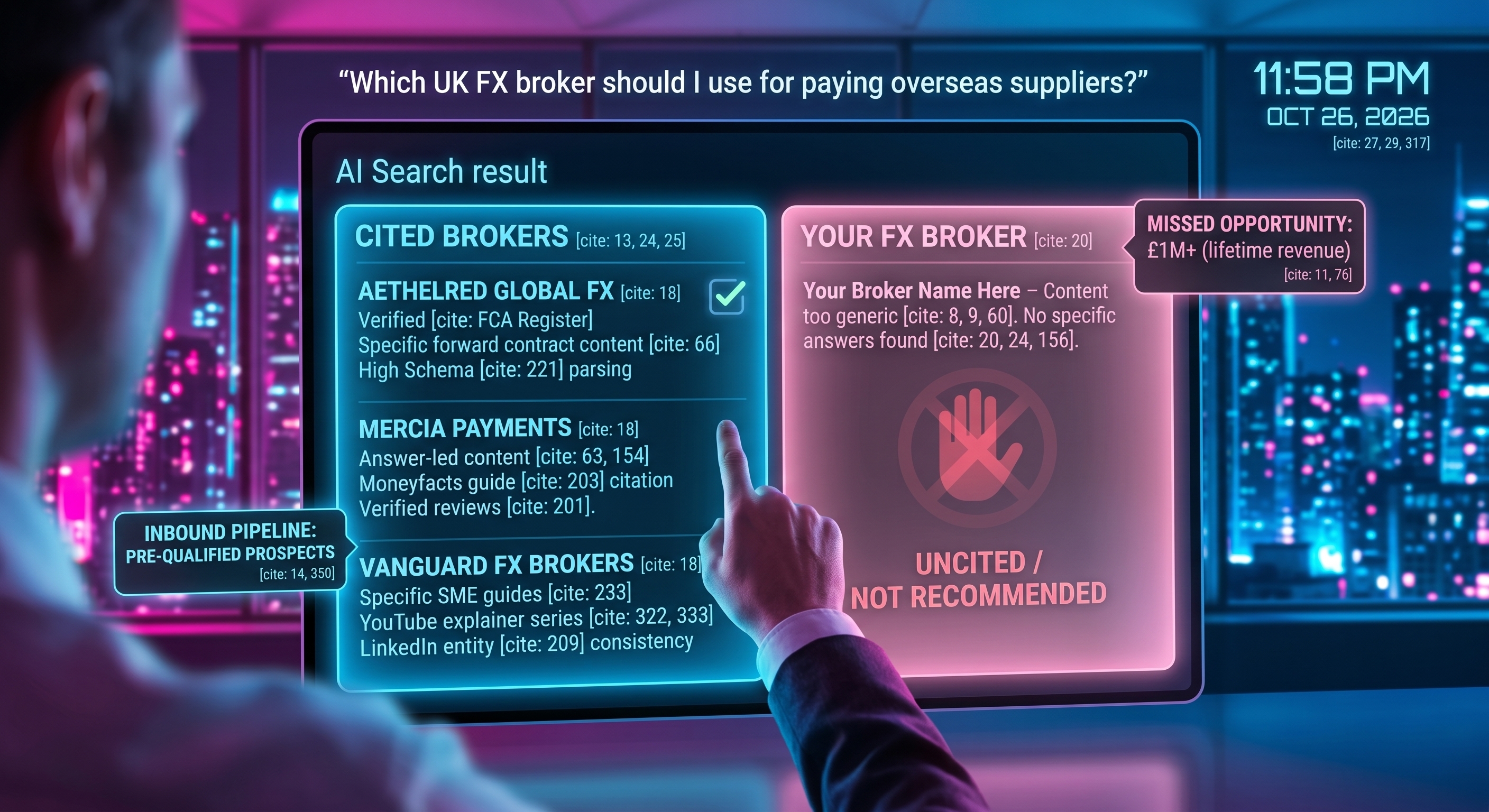
A finance director at a UK manufacturing business opens ChatGPT and types:
“Which FX broker should I use for paying overseas suppliers in euros and dollars?”
The answer comes back with three firm names. A short rationale for each. Links to their websites. The FD scans the response, clicks through to one of the named firms and books a call that afternoon.
Your firm is not mentioned. Not because your rates are worse or your service is inferior, but because the AI had nothing credible to draw on when it formed its answer.
This is the reality facing UK foreign exchange and currency brokers right now. The buyers who need your services, including finance directors, treasurers, importers, exporters, property investors and growing SMEs with international payroll, are increasingly starting their search not with a Google results page, but with an AI-generated answer.
In a sector where trust is everything, the firms that show up in those answers are not always the largest or the oldest. They are the ones that have given AI systems enough structured, credible and citable information to be recommended with confidence.
That is what Generative Engine Optimisation, known as GEO, is about. For FX brokers, it represents one of the most significant untapped commercial opportunities in the market today.
For a wider definition of GEO and AI citations, read What Is GEO in 2026 and How Do You Get Cited in AI Answers?.
Research from Gartner projects that traditional search engine volume will decline by 25% by 2026 as users shift towards AI-generated answers. For FX brokers, this shift is particularly significant because of the nature of the buying decision. Read Gartner’s search volume prediction.
Choosing an FX broker is not an impulse purchase. Whether a business is setting up a regular payment run for overseas suppliers, hedging currency exposure on a large contract, or a private individual arranging the purchase of a property in France or Portugal, the stakes are material.
Buyers take time to research. They ask questions. They compare options. They want to understand who they are dealing with before they hand over a large sum of money or sign an agreement.
That research process used to happen via Google, word of mouth or through a finance network. It is increasingly happening through AI tools. A finance director does not want fifteen results to trawl through. They want a trustworthy, synthesised answer that helps them make a shortlist quickly.
AI is giving them exactly that.
This matters commercially in a very specific way for FX brokers: the AI answer does not just influence who gets the first click. It determines who gets the first call.
Buyers who find you through an AI answer have already been told you are credible. They have already absorbed some context about what you do, and they arrive at your sales team with far more intent than a cold inbound from a Google ad.
The AI has done the pre-qualification for you, but only if you are in the answer.
If your website is full of claims AI cannot verify, if your listings are inconsistent or thin, if your content answers no specific buyer questions, you will not feature in those answers.
A competitor who has invested in GEO will.
For a wider view of how this search behaviour is changing, read The New Rules of AI Search in 2026.
Most sectors have GEO gaps because they have not thought about AI visibility yet. The FX sector has an additional problem: the messaging across the market is almost uniformly identical.
Visit ten different UK FX broker websites and you will read the same promises:
Competitive exchange rates.
No transfer fees.
Dedicated account manager.
Faster than the bank.
Authorised and regulated by the FCA.
The language is interchangeable. The claims are vague. The differentiation is invisible.
This is a serious problem for AI.
When an AI tool tries to determine which FX broker to recommend for a given buyer need, it needs citable, specific information to draw on. It needs to understand what a firm actually specialises in, who it works with, what its process looks like and why a particular type of buyer would choose it over another.
Generic messaging gives AI nothing to work with.
There is no claim in “competitive exchange rates” that an AI system can verify, contextualise or use to match your firm to a specific buyer’s need. It is the content equivalent of white noise.
The firms that win AI citations will be the ones that answer specific buyer questions with specific, useful content.
Not “we save you money versus your bank”.
But:
“Here is how hedging with a forward contract protects a UK importer paying in dollars over the next twelve months, and here is the kind of saving a business at your volume might realistically expect.”
There is a real opportunity here for FX brokers willing to invest in that kind of content. The bar, relative to what most firms are currently publishing, is not high.
Before getting into the framework, it is worth being clear about what is at stake, because this is not a cosmetic marketing exercise.
For FX brokers, the commercial value of being in AI answers is material.
Consider the B2B client picture. A UK SME importing from Europe and the US, moving £2 million per year in currency, is worth somewhere between £10,000 and £30,000 per year in margin depending on volumes and spreads.
Over a five-year relationship, which is entirely typical in commercial FX, that is a £50,000 to £150,000 client.
A mid-sized manufacturer moving £10 million per year sits at a different order of magnitude entirely.
Now consider the corporate end: a professional services firm, a private equity-backed business or a technology company managing multi-currency payroll and supplier payments. At £20 million or more per year in FX flows, a single client relationship can be worth seven figures in lifetime revenue to a specialist broker.
In the property purchase market, the picture is different but equally significant. A buyer purchasing a £600,000 property in Spain, completing over three to six months with multiple staged transfers, represents a single transaction worth several thousand pounds.
That same buyer may refer their solicitor. Their financial adviser. Their colleagues who are buying villas in the Algarve. The compounding referral value of a single well-handled property transfer is significant, and it starts with being the firm the buyer found when they searched for guidance.
The question GEO answers is simple:
When your ideal client types their question into an AI tool at the moment they are ready to make a decision, are you in the answer or not?
Right now, for most FX brokers, the answer is not.
The firms that change that in the next twelve months will acquire clients their competitors never knew were looking.
Understanding your buyer archetypes matters for GEO because AI tools surface content that matches specific search intent.
The FX buyer pool is not uniform, and different audiences ask very different questions. Knowing which questions your ideal clients are asking is the starting point for building a content programme that earns citations and feeds your sales team with genuinely warm inbound.
Finance directors and treasurers at UK SMEs are managing currency exposure on trade payables or receivables. They are asking:
“Which FX broker should I use for paying overseas suppliers in euros?”
“How do I protect my business from currency fluctuations?”
“What is the difference between a spot rate and a forward contract?”
“How much does it cost to transfer money internationally for a business?”
“What are the risks of using my bank for international payments?”
“How do I set up a regular international payment for my business?”
“Is there a better alternative to using my bank for currency exchange?”
Import and export businesses are dealing with invoice currency mismatches and margin risk. They ask:
“How do I lock in an exchange rate when I receive a large export order?”
“Should I invoice in pounds or euros as a UK exporter?”
“What is currency hedging and does my business need it?”
“How does a forward contract work for a UK importer?”
“What happens to my margins if the pound falls against the dollar?”
“How do I manage FX risk on a long-term supply contract?”
Property buyers purchasing overseas are making one of the largest financial decisions of their lives and are often unaware that specialist FX brokers exist. They ask:
“How do I transfer a large sum to buy property in Spain?”
“What exchange rate will I get when buying a house in France?”
“Is it safe to use a currency broker for a property purchase?”
“How do I transfer €400,000 to complete on a property purchase in Portugal?”
“Should I fix my exchange rate now or wait when buying abroad?”
“What is a currency broker and how is it different from a bank?”
“How much can I save by using an FX broker instead of my bank for a property transfer?”
Expats and internationally mobile individuals managing salaries, pensions or regular payments ask:
“Best way to transfer my salary from the UK to Spain each month”
“How do I receive my UK pension overseas cheaply?”
“Which is cheaper, Wise, Revolut or a currency broker?”
“How do I set up a regular international payment to my overseas account?”
Business owners and directors often begin with comparison-style research:
“Best FX broker for UK businesses 2026”
“FX broker vs bank for international payments, which is better?”
“Which UK currency brokers are FCA regulated?”
“How do I know if my FX broker is legitimate?”
Each of these questions represents a buyer at a specific stage of their journey. Each one is also an opportunity for an FX broker that has published a clear, structured answer to that question to be cited in the AI response.
When your sales team receives an inbound from someone who has found your content through an AI recommendation, the conversation starts from a fundamentally different place than a cold call.
For more on turning buyer questions into visibility assets, read How to Audit Your Website for AI Visibility in 2026.
Generative Engine Optimisation is the practice of making your business visible, trusted and citable inside AI-generated answers, not just ranked on a traditional search results page.
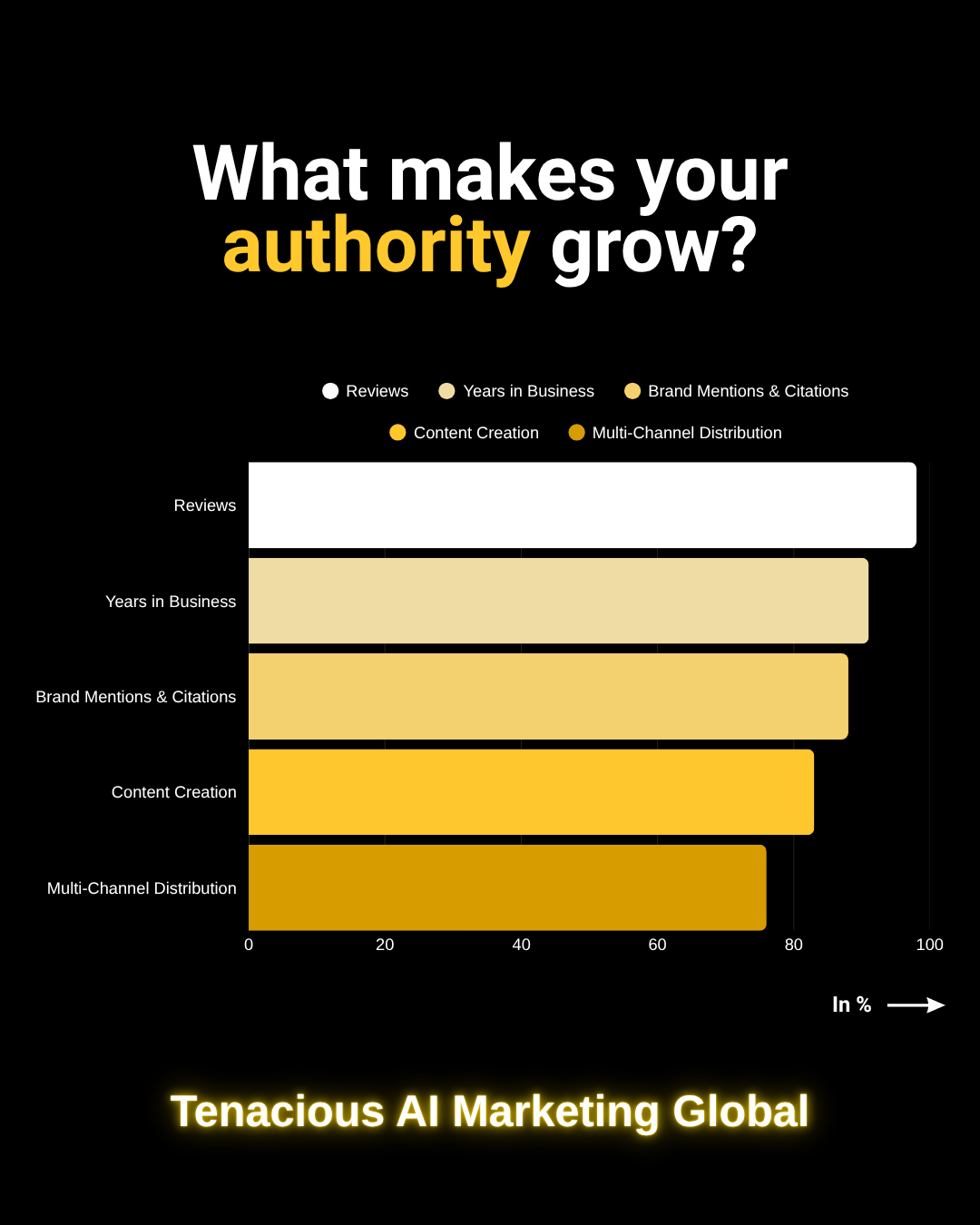
When someone asks ChatGPT, Perplexity or Google AI Overviews a question about FX brokers, the AI draws on a range of signals to decide which businesses to include in its answer.
Those signals include:
The quality and structure of your website content
How consistently your business is described across third-party directories and review platforms
Whether authoritative sources reference you
Whether your content directly and specifically answers the kinds of questions buyers are asking
GEO is not SEO with a new name.
SEO is about ranking for keywords. GEO is about being trusted enough, documented enough and specific enough to be cited inside a synthesised answer that replaces the search results page entirely for a growing proportion of buyers.
For FX brokers, GEO has three particular dimensions that make it more important here than in many other sectors.
AI systems are cautious about financial services recommendations, and rightly so.
FCA authorisation is a significant trust signal, but only if it is clearly communicated, accurately described and consistently referenced across your digital presence.
The FCA Financial Services Register is a public record of firms and individuals that are or have been authorised by the FCA or PRA. Check the FCA Financial Services Register.
Firms that are authorised but have not structured their content around that authorisation will lose ground to competitors who have.
The firms that get cited in AI answers are those that have made a clear, specific, answerable case for who they serve and how.
Vague claims about competitive rates cannot be cited.
Specific content explaining how a UK exporter can use a forward contract to protect margin on a dollar-denominated contract can be.
Specificity is the currency of AI citation.
AI tools are essentially matching buyer questions to the best available answers.
If you have not published content that answers the specific questions your ideal clients are asking, you cannot feature in those answers, regardless of your brand recognition or how long you have been operating.
At Tenacious Marketing, we use a seven-step framework to build AI visibility for businesses.
Here is how it applies to foreign exchange and currency brokers, and what it produces at each stage.
Step | What It Involves | Outcome for the FX Broker |
| 1. Diagnose | Audit current AI and search visibility | Understand where you appear, where competitors win and which buyer questions are open |
| 2. Align | Reframe messaging around buyer questions | Make your offer easier for AI and buyers to understand |
| 3. Standardise Listings | Fix directories, profiles and entity signals | Build consistency across FCA, Google, reviews, comparison sites and LinkedIn |
| 4. Structure the Website | Improve service pages, FAQs, schema and regulatory trust signals | Make the website easier for AI to parse, verify and cite |
| 5. Publish Content | Create answer-led content for real buyer questions | Earn AI citations and feed the sales team with warmer inbound |
| 6. Distribute | Share content across LinkedIn, email, advisers, PR and sector channels | Increase AI encounter frequency and third-party trust |
| 7. Amplify | Launch and grow a YouTube channel | Build trust, education and AI-readable authority at scale |
Before you can improve your AI presence, you need to understand it.
The diagnosis begins with running the searches your ideal clients are running in ChatGPT, Perplexity, Google AI Overviews and Gemini.
For an FX broker, that means testing questions like:
“Which FX broker should a UK business use for paying overseas suppliers?”
“Best currency broker for buying property abroad as a UK buyer”
“How do UK businesses protect against currency risk?”
“Is [your firm name] regulated by the FCA?”
“What is the difference between using an FX broker and a bank?”
Map what comes back.
Do you appear?
In what context, and with what description?
Are competitors named that you would not expect?
Are comparison sites or aggregators dominating the answers?
Are there questions where no broker is being cited at all, leaving the field open?
This diagnostic gives you a clear picture of your current gap. It also identifies where the first-mover opportunity is greatest, including the specific questions where publishing a well-structured answer could put you in front of buyers who currently find nobody.
Most FX broker websites lead with the offer: rates, service, regulation and team.
AI tools, like real buyers, are looking for content that matches their question, not content that leads with the provider’s features.
The alignment step is about reorienting how you describe your business.
Not:
“We offer competitive rates and a dedicated account manager.”
But:
“Here is how UK businesses reduce the cost and risk of international payments, and here is what to look for when choosing the right partner.”
At this stage, you also define your audience clarity.
Are you primarily a B2B broker focused on SMEs with trade flows? A specialist in property purchase transfers? A provider for expats with ongoing payment needs? A firm that works with corporate treasuries on structured hedging programmes?
Clarity of specialism matters for GEO because AI tools match businesses to specific queries. A firm that tries to be everything to everyone is harder for AI to recommend than a firm that clearly serves a defined audience.
This clarity does not mean turning away business. It means your content strategy addresses each audience specifically, so that when a finance director asks about commercial FX and a property buyer asks about overseas purchase transfers, your content answers both questions well rather than producing a generic answer that serves neither.
AI tools build a picture of a business from every place it appears online.
Inconsistency creates noise.
Consistency builds trust.
For FX brokers, the key listings to audit and standardise include:
FCA Financial Services Register: your entry here is one of the most heavily weighted signals for any regulated financial services business. Your firm name, registered address, authorisation number and stated permissions must be consistent with every other mention of your business online. Any discrepancy creates a trust gap AI systems notice.
Google Business Profile: your registered address, phone number and business description must be accurate, complete and consistent.
Trustpilot and Feefo: review platforms carry significant weight in AI answers about trust and credibility. Active, recent and thoughtfully responded reviews matter. The volume and recency of reviews is a signal AI tools weigh when assessing whether to include you.
Moneyfacts: a key comparison and information source in UK financial services. Moneyfacts describes itself as an independent source of impartial, accurate and whole-of-market product data for the UK retail financial industry. Visit Moneyfacts Group.
CompareForexBrokers.com and FXcompared.com: specialist comparison platforms AI may reference when forming answers about FX broker selection.
Smart Currency Business: a sector-specific resource with weight for property-linked FX searches.
Which?: high-authority consumer publication. A mention or presence here carries significant citation weight.
LinkedIn Company Page: especially important for B2B brokers. AI draws on LinkedIn for company-level information and third-party validation.
Your own website: consistent NAP, meaning name, address and phone number, across every page. Your authorisation number should be clearly displayed and linked to your FCA register entry.
The goal is not to be listed in more places indiscriminately. It is to ensure every mention of your business tells the same, accurate and consistent story, so AI can build a coherent picture of who you are, what you do and who you serve.
AI tools read websites differently from people.
They are looking for clear signals:
What does this business do?
Who does it serve?
What problem does it solve?
Can it be trusted?
For FX brokers, this means implementing relevant schema markup.
The most important schema types for your sector are:
FinancialService, with areaServed, hasCredential for FCA authorisation and sameAs links to your FCA register entry and key profiles. This is the primary type for a regulated FX business.
FAQPage, one of the most directly citable schema types available. Structured Q&A can be lifted and referenced in generated answers.
Organization, including name, URL, logo, contact information, social profiles and founding date.
BlogPosting or Article, applied to all content pieces with clear author, datePublished and about properties.
You should also create a dedicated About page that clearly explains what you do, who you serve, how long you have been operating, your FCA authorisation number linked to the register and what your client process looks like.
This page is often the primary reference point AI tools use when asked to describe your business. Most FX broker about pages are written for investors or prospective employees. Rewrite yours for the AI that is going to describe you to a prospect.
Build clear service pages for each audience segment.
A page specifically for SME currency management.
A page for property purchase transfers.
A page for international payroll.
Each should answer the specific questions that buyer type asks, not generic content repurposed for everyone, but content that speaks directly to the problem that audience is trying to solve.
Display your FCA authorisation prominently and linkably.
Not in a grey-text footer.
On your homepage, your about page and your service pages.
Linked to your FCA register entry.
Clearly stated with your full authorisation number.
This is not just good compliance practice. It is one of the most important GEO signals available to a regulated financial services firm.
This is where most FX brokers have the greatest gap, and the greatest opportunity.
It is also where GEO makes the most direct difference to your sales team’s day-to-day.
When a prospect arrives at your sales team having found your content through an AI recommendation, two things are already true:
They trust you more than a cold prospect would.
They understand the topic better than they would if they had arrived cold.
The educational work has been done. Your dealer or account manager is not starting from scratch explaining what a forward contract is. They are having a conversation with someone who already understands the concept and wants to know if your firm is the right one to help them use it.
Moneyfacts has a useful public guide explaining that forward currency contracts can help businesses lock in an exchange rate and transfer date ahead of time, which can support cost planning and cashflow certainty. Read Moneyfacts’ guide to forward currency contracts.
The content that earns AI citations is not promotional. It is genuinely useful. It answers the specific questions buyers are asking at each stage of their decision.
Here is what that looks like in practice, mapped to the buyer questions identified earlier.
For finance directors and treasurers at SMEs
“What is a forward contract and how does it help UK businesses manage currency risk?”
“Spot rate vs forward rate: which should a UK importer use?”
“How to pay overseas suppliers in euros without losing money on the exchange rate”
“How much can a UK business save by using a specialist FX broker instead of its bank?”
“How do I set up a regular international payment run for my business?”
For import and export businesses
“How do UK businesses hedge currency exposure on a large export contract?”
“Should I invoice overseas customers in pounds or in their local currency?”
“How to protect your profit margin from currency movements on international orders”
“What is a currency option and when does it make sense for a UK exporter?”
For property buyers
“How to buy property abroad: the complete guide to international money transfers for UK buyers”
“When should I fix my exchange rate when buying property overseas?”
“Using a currency broker for a property purchase in Spain, how it works step by step”
“How do I transfer a large sum overseas safely and legally?”
“What happens to my transfer if the pound moves between exchange and completion?”
Trust and regulatory content for all audiences
“What does FCA authorisation mean for an FX broker, and what protection does it give you?”
“What happens if an FX broker goes out of business, is my money protected?”
“How to tell if an FX broker is legitimate: what to check before you transfer”
“FX broker vs bank: which is better for international payments?”
Each piece of content should be structured clearly, with a direct answer near the top, supporting explanation below and a concise FAQ section that captures natural follow-up questions.
Content written this way is significantly more likely to be surfaced and cited by AI tools. And when it is cited, the prospect who arrives at your firm has already absorbed the substance of that answer.
The sales conversation is warmer, shorter and more likely to convert.
For a wider explanation of this content system, read Search Everywhere Optimisation: AI Visibility in 2026.
Publishing content is not enough on its own. Distribution is what gives it the reach and signals AI tools need to weight it appropriately.
For FX brokers, the most relevant distribution channels are:
LinkedIn: the primary network for reaching finance directors, treasurers, CFOs and business owners. Long-form posts that draw on your published content, direct answers to questions you see in your network and sharp commentary on currency market developments all build authority signals. A question like “the pound just dropped 2%, here is what that means for your supplier payments and what to do about it” earns significant engagement from the exact audience you are trying to reach.
Trade and sector publications: getting quoted in, or contributing to, publications that serve your target audiences, including accountancy titles, import/export trade press, property investment publications and expat media, generates third-party references that carry significant weight with AI tools. If an article in Accountancy Age quotes your head of treasury on currency risk management for SMEs, that reference exists in AI training data and raises your credibility as a source.
Accountant and adviser networks: accountants, financial advisers, solicitors and mortgage brokers are significant referral sources for FX business, both B2B and property. Content distributed to those networks, and relationships with firms who can point their clients your way, builds both referral volume and the kind of third-party authority signals GEO depends on.
Email to existing clients: your existing client base is your most engaged audience. Distributing content to them keeps you front of mind, positions you as a source of genuine expertise and generates the forwards and shares that extend your content’s reach into new networks.
Guest content and expert commentary: contributing to financial media, property investment publications or expat content platforms places your expertise in front of audiences at the moment it is most relevant. It also generates the authoritative third-party mentions that help AI tools recognise your firm as a credible voice in the category, not just in your own content, but in other people’s.
YouTube is the most underutilised channel in the FX broker market. It is also, right now, the single biggest content opportunity available to any FX firm willing to move.
Here is the situation.
Foreign exchange is genuinely confusing to most buyers. They know they are losing money somewhere in the process. They do not understand what a forward contract is, whether they need one, what the difference is between a spot rate and a forward rate, or why their bank’s exchange rate looks different to the one they see on Google.
They want someone to explain it to them clearly, without jargon, without a sales pitch and in a way that actually helps them make a decision.
They are searching for that explanation on YouTube.
They are not finding it from most FX brokers.
The space is dominated by generic personal finance channels, fintech comparison content and occasional academic explainers. The specialist, regulated UK FX broker who shows up on YouTube and explains how a forward contract protects a UK importer, in plain English, in three minutes, is the only firm in the room.
That is a remarkable position to occupy, and it is available right now.
YouTube content carries additional GEO weight because:
Google indexes and surfaces YouTube videos directly in AI-augmented search results. A video that answers a specific question can appear above traditional results in a Google AI Overview.
A video that ranks for a specific buyer question becomes a citation source in its own right, referenced across AI tools that draw on Google’s index.
Video content builds personal trust with viewers in a way that text alone cannot. In a sector where trust is the primary purchase driver, seeing a real dealer explain the mechanics of a forward contract is far more convincing than reading a web page.
YouTube transcripts are indexed and drawn on by AI tools as content sources, meaning a well-structured video generates both video and text citation signals simultaneously.
YouTube is the world’s second largest search engine. Entirely separate from the Google AI visibility benefits, your content reaches buyers who begin their research there.
For more on the role of video in AI visibility, read Why YouTube Is Now Essential for Business Visibility in the AI Era.
The most effective format is educational, led by a real person from the firm, such as a dealer, director or head of treasury, who speaks clearly and without jargon.
The production does not need to be elaborate. A clean background, good audio and a confident explanation is all it takes. The content does the heavy lifting.
Eight to ten videos covering the concepts buyers are most confused about:
“What is a forward contract? Explained in 3 minutes for UK businesses”
“Spot rate vs forward rate: which should you use?”
“What is currency hedging, and does my business actually need it?”
“How does a currency broker make money?”
“FCA-regulated FX brokers: what it means and why it matters”
“What happens to my money between the transfer and the completion?”
“What is a limit order and when should I use one?”
“The real cost of using your bank for international transfers”
“Paying overseas suppliers: how to stop losing money on the exchange rate” for importers
“Buying property abroad: how the currency transfer works, step by step” for property buyers
“Managing international payroll: what UK businesses need to know” for HR and finance teams
“How to hedge currency risk as a UK exporter” for exporters
“How to tell if an FX broker is legitimate: 5 things to check”
“What client money protection means for your transfer”
“Why we are different from your bank”
Monthly or quarterly currency market updates, such as “What the pound’s movement means for your business payments this month”, positioned for business owners who want context, not trading signals.
The firms that launch YouTube now, in a market where most competitors have no channel at all, will own this territory.
AI tools will cite those videos.
Buyers will find them and trust them.
The compounding commercial effect, including more views, more citations, more inbound and better-quality leads, builds over twelve to twenty-four months in a way that no paid campaign can replicate.
This is the question that matters most for any FX broker with a sales-led growth model, and it is worth answering directly.
A prospect who has found your firm because an AI tool cited your content in response to their specific question has already been pre-qualified.
They were searching for exactly what you offer.
They found a credible answer from you.
They arrived at your website or called your number with a specific question in mind.
That is a fundamentally different starting point from a referral introduction, a cold email response or a click from a Google ad.
When your content has already explained what a forward contract is, how hedging works, what the FCA register means and why specialist brokers outperform banks, your dealers and account managers spend less of the first call on education and more on qualification and relationship-building.
The client already understands the category.
The conversation moves faster.
The buyer who researches via AI and finds you is often invisible to the rest of the market.
They did not fill in a form on a comparison site.
They did not respond to a LinkedIn ad.
They asked an AI tool a question, got your content cited and came to you directly.
Your competitors have no idea the conversation happened.
That kind of invisible competitive advantage compounds over time.
When a prospect arrives having read a specific piece of your content, your team knows what question they were asking, what they understood before they called and what they are most likely to be considering.
That context allows for a more relevant, more tailored first conversation, which converts at a higher rate.
Content that earns citations does not just reach direct buyers.
It reaches accountants, advisers, solicitors and mortgage brokers who are conducting their own research on behalf of clients.
An accountant who finds your content cited in an AI answer to “best FX broker for SMEs with international suppliers” is now positioned to refer their clients to you, without you ever having cold-called them.
FX broker relationships tend to be ongoing. A business that onboards for international payments typically stays for years, moving increasingly larger volumes as trust builds.
A high-value client represents not just the first transaction, but a stream of revenue across their tenure.
Consider what consistent AI invisibility costs over time.
If five finance directors per month use AI to research FX options, find three named firms and book with one of them, and none of those five ever find you, that is not five lost leads.
Over twelve months, it could be sixty buyer conversations you were never part of, each representing a client relationship worth five to ten years of revenue.
At corporate volumes, a £10 million per year FX client means a single missed relationship is a seven-figure lifetime revenue gap.
Not a lost meeting.
A seven-figure gap, compounding annually while your competitor retains and grows that relationship.
The brokers who ignore GEO now will not notice the impact immediately. Leads will still come through existing channels. But over the next twelve to twenty-four months, as AI-assisted research becomes the default starting point for financial decisions, the firms that built AI visibility early will find themselves consistently shortlisted.
The firms that did not will find themselves consistently absent, not losing pitches, but never being invited into them.
The property market tells an equally important story.
A buyer arranging a £600,000 transfer to complete on an overseas property, who then refers their financial adviser, their solicitor and their colleagues who are buying in the same development, can create significant lifetime value.
The cost of not being in the answer when they searched is the entire chain.
This is the most common objection we hear from regulated financial services firms, and it is worth addressing directly.
GEO does not require you to make performance claims, guarantee returns or produce content that creates compliance problems.
The content that works best for AI citation is the kind that compliance teams are most comfortable with: educational, factual, explanatory and clearly positioned as information rather than advice.
Content that explains what a forward contract is, how currency risk works, what the FCA register is or what to consider when choosing an FX broker for a property purchase is informational content that any well-run, FCA-authorised firm can publish without issue.
The key is to write content that genuinely educates rather than content designed to make promises.
That happens to be exactly the kind of content AI tools trust and cite most readily.
Compliance rigour and GEO effectiveness are, in this case, genuinely aligned. The most cautious, most accurate, most clearly informational content is also the most likely to be cited.
If your compliance team is the reason you have not published much content to date, GEO is actually an easier conversation than most.
You are not asking permission to make bold claims.
You are asking permission to explain how forward contracts work.
GEO is not a one-month campaign. It is a structured, cumulative programme.
But the timeline to meaningful results is shorter than many FX brokers expect.
In the first thirty to sixty days, completing the diagnosis, standardising listings and fixing entity inconsistencies produces the foundational layer AI tools need to build a coherent picture of your business.
This work alone can move the needle for firms that currently have significant inconsistencies across their digital presence, particularly around FCA register alignment and Google Business Profile accuracy.
Over months three to six, as structured content begins to accumulate, you start to appear in AI answers for specific buyer questions, initially the more niche or long-tail ones, then progressively the higher-volume ones as the body of content grows and distributes.
By months nine to twelve, a consistently executed programme produces clear, measurable improvement in AI visibility, demonstrated by running the same diagnostic searches from Step 1 and comparing what has changed.
Which questions now surface your content?
Which queries name you alongside competitors?
Which buyer questions are you now the primary cited answer for?
For FX brokers who move now, the competitor landscape is relatively uncrowded in terms of AI-optimised content.
That first-mover advantage is available, but it will not be available indefinitely.
The buyers who need what UK FX brokers offer, including businesses managing currency risk, property buyers making large international transfers, importers and exporters handling complex payment flows, are increasingly starting their research with an AI tool rather than a search engine.
The AI tools they use will recommend the firms that have given them something credible to work with: clear entity signals, structured website content, specific buyer-question-led articles, credible third-party references and a YouTube presence that demonstrates genuine expertise in plain English.
The FX market is full of firms saying the same things.
The opportunity to stand apart by actually answering the questions your ideal clients are asking, in formats AI can parse, cite and recommend, is real, meaningful and not yet crowded.
The firms that move on this in the next twelve months will acquire clients their competitors never knew were looking.
The ones that do not will be consistently absent from the conversations that determine who gets the call.
If you want to understand where your firm currently stands in AI search, and what a structured GEO programme would look like for your business, speak to the Tenacious team for a no-obligation AI visibility conversation.
Related Resources
What Is GEO in 2026 and How Do You Get Cited in AI Answers? - to know the core details about Generative Engine Optimization
The New Rules of AI Search in 2026 - talks about everything from rankings and clicks to AI visibility, citation, and more
How to Audit Your Website for AI Visibility in 2026 - if you want to check where your GEO game falls and what needs to be changed, then this guide covers it all
Search Everywhere Optimisation: AI Visibility in 2026 - this guide helps you build visibility across Google, AI answers, LinkedIn, YouTube, Reddit, reviews, directories, and trusted sources.
Top 15 Best GEO Agencies in the UK 2026 - if you want to choose a GEO agency for your AI visibility needs, we have shortlisted 15 GEO agencies for you.
Yes, though the content strategy differs significantly. Business buyers, including finance directors, treasurers and importers, ask operationally framed questions about currency risk management, payment processes and cost control.
Consumer buyers, including property purchasers and expats, ask trust and process-focused questions: is it safe, how does it work, what rate will I get?
An effective GEO programme addresses both audiences with separate, tailored content rather than trying to serve both with the same messaging. The two audiences often have entirely different questions and entirely different reasons to trust you. Both deserve their own content, and both represent significant revenue opportunity.
Comparison site listings are one element of Step 3 in the framework. They contribute to your entity signals.
But GEO goes significantly further.
Comparison sites provide a listing. They do not demonstrate expertise, answer specific buyer questions or build the kind of structured, answer-led content that earns citations in AI-generated responses.
Your comparison site presence is the floor, not the ceiling.
A broker who is listed on FXcompared but has no content answering buyer questions will be outperformed in AI answers by a broker who has published a dozen clear, well-structured articles on topics their clients care about.
FCA authorisation is a necessary trust signal, but it is not a sufficient one on its own.
Thousands of firms are FCA authorised.
What matters for GEO is whether that authorisation is clearly communicated, consistently referenced across your digital presence and linked to your FCA register entry in a way AI systems can verify and parse.
Many authorised firms have their FCA number buried in a website footer and mentioned inconsistently elsewhere.
Clear, prominent, consistent communication of your regulatory status, including on your About page, your service pages and within relevant content, is a GEO fundamental.
Often more so than for larger firms.
Regional and specialist brokers have a clearer story to tell. They serve a specific type of client, understand a specific set of problems and can speak to those problems with a specificity that generic national providers cannot match.
AI tools are looking for that kind of clarity.
A smaller broker that clearly articulates its specialism, such as currency management for UK food and drink exporters or property purchase transfers for buyers in southern France, can consistently outperform a generic competitor in AI answers for those specific buyer queries.
The playing field is more level than you might expect.
That is one of its primary commercial advantages.
GEO-driven inbound is organic. It comes from AI citations of your content, not from paid placements.
The investment is in content creation and distribution, which compounds over time. A blog published in month three continues to generate citations and inbound in month eighteen.
A Google ad stops the moment you stop paying.
For FX brokers with sales teams that can handle inbound well, GEO is one of the highest-leverage investments available because the cost of acquisition falls over time while the quality of inbound typically rises.
SEO aims to rank on a traditional search results page. GEO aims to be cited inside an AI-generated answer, which increasingly replaces the results page entirely for research-stage queries.
The tactics overlap in some areas, including structured content, authoritative links and technical site health, but differ significantly in emphasis.
GEO prioritises entity consistency, answer-led content structure, schema markup and third-party citation signals in ways traditional SEO does not.
For financial services buyers making high-stakes decisions, the AI answer is becoming the primary first touchpoint, and that requires a different strategy, executed alongside rather than instead of conventional SEO.
Start with the diagnosis and listing standardisation, meaning Steps 1 and 3.
Understanding your current AI visibility gap costs little compared with the value of the insight, and standardising your entity signals, particularly your FCA register entry, Google Business Profile and major review platforms, is high-leverage work that does not require significant content production.
From there, a focused content programme of one well-structured article per month, built around the specific buyer questions your sales team hears most often, produces compounding returns over six to twelve months that justify expanding the programme.