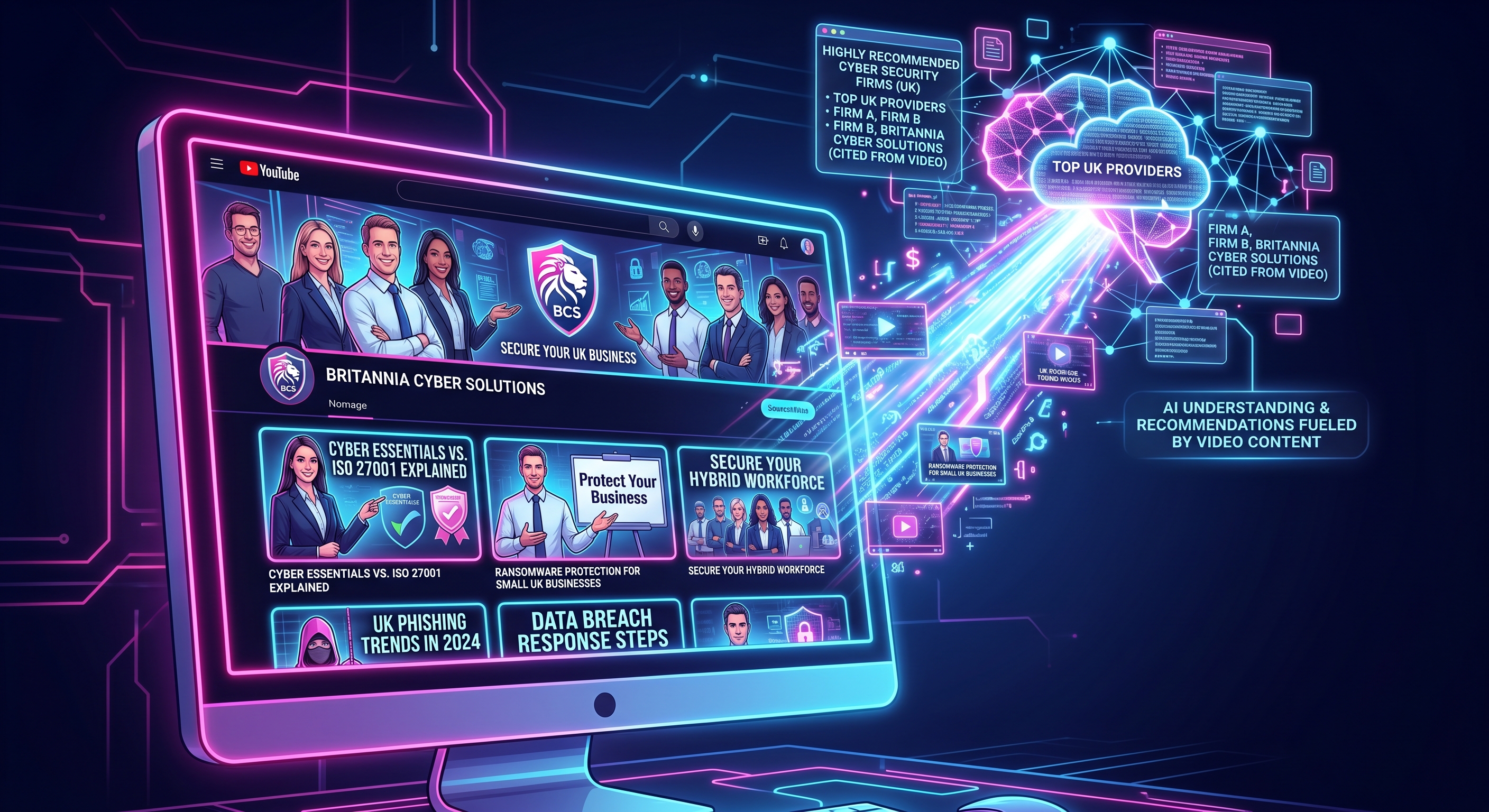
A CEO reads about a ransomware attack on a business similar to theirs.
They don't call their IT manager. They open ChatGPT and type: "What kind of cyber security firm do I need to protect a business like mine?"
Or the IT director is preparing a board recommendation. They use Perplexity to compare managed SOC providers in the UK before putting three names forward.
Or a finance director sees a Google AI Overview explaining what Cyber Essentials Plus actually covers (and one firm is referenced as a trusted resource).
In every one of those moments, a shortlist is forming.
The cyber security firms that appear in those AI-generated answers are in the conversation. The ones that don't are being passed over before the prospect has spoken to anyone.
This is not a future risk. It is happening now, across UK businesses, every day.
And most cyber security firms have no strategy to address it.
Generative Engine Optimisation (GEO) is the practice of making your firm visible, trustworthy, and citable in AI-generated search answers. For cyber security firms (where trust is everything and differentiation is scarce) it may be the most important marketing investment available right now.
This article explains what GEO is, why it matters specifically for UK cyber security businesses, and how the Tenacious 7-step GEO framework gives you a clear system to build that visibility.
Traditional SEO is about ranking on a results page.
The goal is to appear in Google's top ten for terms like "penetration testing UK" or "managed SOC provider London." You optimise keywords, build backlinks, improve technical site health, and compete for clicks.
GEO is about being cited inside the answer.

When someone asks ChatGPT "what is the difference between Cyber Essentials and ISO 27001?" or asks Perplexity "which cyber security firms in the UK specialise in financial services?" (the AI doesn't return a list of links). It constructs an answer. And inside that answer, it selects the firms and sources it considers authoritative, clear, and trustworthy.
The selection criteria are different from traditional SEO. AI systems build answers from:
A cyber security firm could have strong SEO and still be completely invisible in AI-generated answers (because the two disciplines require different approaches).
GEO is not a replacement for SEO. But for B2B service firms where the buying journey involves significant online research, it is now equally important. In cyber security, where buyers are often anxious, non-technical, and looking for reassurance, being the firm AI recommends carries significant weight.
The shift in research behaviour is already well underway.
Gartner predicts that traditional search engine volume will decline by 25% by 2026 as AI tools become the primary way people discover information and make decisions.
In cyber security, this shift is particularly pronounced. The buying journey is research-intensive by nature, and AI tools are increasingly used to:
This is especially true at the executive level. A CEO or finance director who has been alarmed by a news story about a cyber attack will often use an AI tool to self-educate before involving their IT team. A CISO preparing a supplier comparison will use AI to form initial impressions before issuing a more formal request.
The buyers doing this research are forming views. They are building shortlists. And if your firm is not visible in those conversations, you are not on the list.
Cyber security is one of the most technically credible and genuinely undifferentiated sectors in UK B2B services.
Most firms are excellent at what they do. But AI systems cannot evaluate technical competence. They evaluate clarity, consistency, and structured authority signals.
And on those measures, most cybersecurity firms perform poorly.
The common gaps:
Undifferentiated positioning - Almost every cybersecurity firm in the UK describes itself as a "trusted partner" offering "end-to-end security solutions." When AI systems encounter this language across dozens of firms, they cannot distinguish one from another (and often don't recommend any of them specifically).
Technically-written content - Most cybersecurity blogs and service pages are written by technical people for technical audiences. They are accurate but not accessible. AI systems prioritise content that clearly answers the questions buyers are actually asking (not content that demonstrates technical depth to peers).
Missing entity signals - AI systems need to understand a firm as a distinct entity with a clear specialism, sector focus, geography, and team. Most cybersecurity firms have not built this clarity deliberately across the web.
No structured data - Without schema markup (particularly FAQPage, LocalBusiness, and Service schema) AI systems have to work much harder to interpret what your firm does. In a crowded market, many don't bother.
Thin or absent FAQ content - The questions prospective clients are asking AI tools ("how much does a penetration test cost?", "do I need Cyber Essentials if I already have ISO 27001?", "what does a SOC actually monitor?") (are rarely answered clearly on cybersecurity websites).
The result: firms with genuine expertise and strong client results remain invisible at the moment the shortlist is being built.
This is the framework Tenacious uses to turn businesses from invisible to recommended.
Applied to a UK cyber security firm, it looks like this:
| Step | What It Involves | Outcome for the Firm |
|---|---|---|
| 1. Diagnose | Audit current AI and search visibility | Understand where you stand and where competitors are being recommended |
| 2. Align | Define and unify the firm's positioning | Clear specialism AI can understand, trust, and describe accurately |
| 3. Standardise Listings | Update 25(50 directories and profiles | Consistent entity signals across the web |
| 4. Structure the Website | Improve service pages, FAQs, and schema | A website AI can read, extract from, and cite with confidence |
| 5. Publish Content | Strategic blogs answering real buyer questions | Content that earns citations and builds topical authority |
| 6. Distribute | Share across LinkedIn, GBP, PR, and industry channels | Increased frequency of AI encounter |
| 7. Amplify | Launch and grow a YouTube channel | Accelerated authority, trust, and citation across all platforms |
Before building anything, you need to understand where the firm stands right now.
This means asking: when a potential client uses ChatGPT, Perplexity, or Google AI Overviews to find a firm like yours (do you appear?). What do they say about you? Are competitors being cited in your place?
The diagnosis covers website structure, search visibility, AI citation frequency, business listing consistency, content coverage, and authority signals.
Most cyber security firms discover that AI systems cannot clearly describe their specialism (even when the firm has a strong track record and excellent client reviews). The problem is not credibility. It is clarity.
Without this first step, everything that follows is guesswork.
AI systems piece together an understanding of your firm from multiple sources simultaneously. When those sources describe you in vague, inconsistent, or interchangeable language, the result is ambiguity (and ambiguous firms are not recommended).
Cyber security positioning is particularly prone to this problem. Too many firms describe everything they do, for everyone, everywhere. AI systems cannot make a confident recommendation on that basis.
Alignment means agreeing on:
This isn't about narrowing the firm's actual offering. It is about giving AI systems (and prospective clients) a clear reason to choose you over a generic alternative.
Cyber security firms exist across a wide range of directories and platforms (some general, some sector-specific).
These include:
Each of these needs to describe the firm in consistent, aligned language (the same specialism, the same positioning, the same description of who it serves).
This step is often completed in a single focused day by an administrator working from a prepared brief. The impact on AI entity signals is disproportionate to the effort involved.
The website is the central source AI systems return to when forming an answer about your firm.
For a cyber security company, this means:
Cyber security websites are often technically well-built but strategically underperforming. The gap is almost always in the question-answering content. A FAQ page that clearly addresses "How much does penetration testing cost in the UK?", "What is the difference between Cyber Essentials and ISO 27001?", and "How do I know if my business needs a SOC?" becomes one of the most citable assets on the site.
Content built for GEO leads with questions, not keywords.
For a cyber security firm, this means publishing articles that answer what buyers are actually asking (including buyers who are not technical):
The goal is not just traffic. It is to create clear, structured, accurate answers that AI systems can extract, trust, and recommend.
Eight to twelve well-structured articles create a foundation of citeable authority that compounds over time. The NCSC's guidance on cyber security for organisations sets a useful benchmark for the clarity and accuracy standard this content should meet.
Publishing content on the website is step one. Distribution is what makes it compound.
AI systems build trust from multiple sources. The more consistently a firm's expertise and positioning appear across the web, the more confidence AI has in recommending it.
For cyber security firms, distribution typically includes:
Each blog becomes multiple pieces of distributed content. Each distribution touchpoint creates another opportunity for AI systems to encounter and remember the firm.
This is where the GEO framework accelerates significantly.
YouTube is step seven of the Tenacious GEO framework (and for UK cyber security firms, it is arguably the most underused growth lever in the entire market).
More on this in the next section.
Most UK cyber security firms have no YouTube presence worth noting. This is both a competitive gap and a significant opportunity.
YouTube is the world's second-largest search engine. But for GEO purposes, its value goes deeper than reach.
Every video automatically generates transcripts, captions, metadata, timestamps, and topic classifications. These give AI systems large volumes of clear, contextual language about your firm's expertise and specialism. A fifteen-minute video explaining what a SOC actually monitors (in plain English) (creates more citeable, AI-readable content than most firms publish in an entire quarter of blogging).
Most cyber security video content is technical and peer-facing. It is made by practitioners for practitioners. But the buyers who commission cyber security work (CEOs, finance directors, operations leaders, board members) (are often not technical). They are searching for someone who can explain complex risks clearly and confidently.
The firm whose partner or senior consultant appears on camera explaining ransomware, phishing attacks, or data breach obligations in straightforward terms will be the firm that earns trust before the first call. Legal YouTube was described as "almost entirely untapped" (UK cyber security YouTube is even more so).
AI systems are not just recognising brand mentions. They are building an understanding of the people, expertise, and authority behind a firm. A lead consultant who regularly publishes educational video content (explaining threat scenarios, compliance questions, incident response processes) (creates the kind of human, verifiable authority signal that AI trusts and cites).
Cyber security is a long sales cycle category. Buyers are cautious, procurement processes are slow, and trust takes time to build. A prospective client who has watched four or five videos from a firm's technical lead before making contact already understands the firm's approach, values, and expertise. They arrive ready to buy rather than ready to evaluate.
When a YouTube channel is organised into clear playlists (penetration testing, managed SOC, incident response, compliance guidance, sector-specific content) (AI systems can identify topical expertise at a glance). Each playlist becomes a distinct cluster of authority that AI can cite and recommend with confidence.
Launching YouTube is not a views play. It is a long-term authority investment that strengthens every other step in the GEO framework simultaneously.
GEO is a long-term investment (but it produces results faster than most firms expect).
Initial visibility signals (appearances in AI-generated answers, improved AI descriptions of the firm, increased content citations) (typically begin to emerge within 60 to 90 days of implementing the full framework).
The system builds in sequence. Each step strengthens the next. Within six months of a properly implemented GEO strategy, most firms see meaningful improvements in how AI systems describe and recommend them (and in the quality and volume of inbound enquiries).
The compounding effect is what gives GEO its long-term value. Authority built today continues working for years. Unlike paid advertising, it does not stop when the budget does.
Cyber security firms that begin building now will have a structural advantage over competitors who start twelve months later. The market is still early. The window to become the default AI recommendation in a specialism or sector is still open (but it will not stay open indefinitely).
The risk is not theoretical.
A potential client (a finance director whose company has just suffered a phishing incident) (asks an AI tool which cyber security firms in their region specialise in incident response for financial services businesses). The AI generates an answer. If your firm has not built the signals required to appear in it, you are not shortlisted. The prospect contacts someone else.
You never knew the enquiry existed.
This pattern will repeat with increasing frequency as AI search usage grows. The firms that build their GEO foundation early will compound their advantage at the expense of the ones that wait.
There is also a positioning risk. In a market this undifferentiated, the first firm in a specialism to build strong AI visibility effectively owns that space in AI-generated recommendations. If a competitor builds that position before you, displacing them requires significantly more effort.
Visibility in AI search is not something that can be purchased quickly. It is built through consistent, structured effort over time. The firms that start now are the ones AI will be recommending in two and three years. The ones that wait will look back at this period and understand what they missed.
Cyber security firms win business because of trust, expertise, and clarity.
GEO is how that trust gets built in the channels where the next wave of clients is already looking.
The Tenacious 7-step framework gives cyber security firms a clear, structured system to become visible, credible, and recommended in AI-generated search answers. It is not a campaign. It is a long-term visibility infrastructure (built once, compounding indefinitely).
And for the firms that launch YouTube alongside it (committing to consistent, expert-led video content that explains complex security topics in clear, accessible language) (the effect compounds faster than any other single channel in the market).
UK cyber security YouTube is almost entirely uncontested. The firms that claim that space now will hold it for years.
If you want to understand where your firm currently stands in AI search (and what it would take to become the recommended answer) talk to the Tenacious team.
Related Reads
The State of AI Search in May 2026
Beyond the Search Bar: Why AEO Testing Is Now a Business Visibility Metric
Why YouTube Is Now Essential for Business Visibility in the AI Era
What Is GEO in 2026, and How Do You Get Cited in AI Answers?
The New Rules of AI Search in 2026
Search Everywhere Optimisation: AI Visibility in 2026
How to Audit Your Website for AI Visibility in 2026
GEO is the practice of optimising a cyber security firm's online presence so it appears (cited and recommended) inside AI-generated search answers from tools like ChatGPT, Perplexity, and Google AI Overviews. It focuses on being recommended by AI systems at the moment a buyer is forming a shortlist, not just appearing in traditional search results.
SEO focuses on ranking in traditional search results through keywords, backlinks, and technical site optimisation. GEO focuses on entity clarity, structured question-answering content, consistent signals across multiple platforms, and building the kind of authority that AI systems trust enough to cite. Both matter (but they require fundamentally different approaches).
Cyber security buyers are research-intensive and trust-dependent. They spend significant time online before making contact with any provider. AI tools have become a core part of that research process (and firms that appear in those AI-generated answers benefit from an implied credibility that is difficult to replicate through advertising). Additionally, the cyber security market is highly undifferentiated: firms that can explain their specialism clearly are disproportionately rewarded.
Not strictly (but they help). Accreditations like CREST membership and NCSC Cyber Advisor or Assured Service Provider status are recognised signals of credibility that AI systems can cross-reference across multiple sources. They also appear in respected directories that form part of the entity-building process in the Tenacious GEO framework. Firms with accreditations should be listing and referencing them consistently.
Because the gap between what buyers need and what cyber security YouTube currently offers is enormous. Most technical cyber security content is aimed at practitioners, not at the CEOs, finance directors, and operations leaders who actually commission the work. A cyber security firm that produces clear, accessible, expert video content (explaining threats, compliance obligations, and buying decisions in plain English) (will stand out significantly). Those video transcripts also create large volumes of structured, AI-readable content that directly improves citation potential.
The framework follows the same seven steps: diagnose, align, standardise listings, structure the website, publish answer-led content, distribute, and amplify with YouTube. For cyber security firms, each step is tailored to the specific context (including CREST and NCSC directories, practice-area FAQ content, LegalService and Service schema, sector-specific content clusters, and YouTube structured around buyer-facing explanations of key topics).