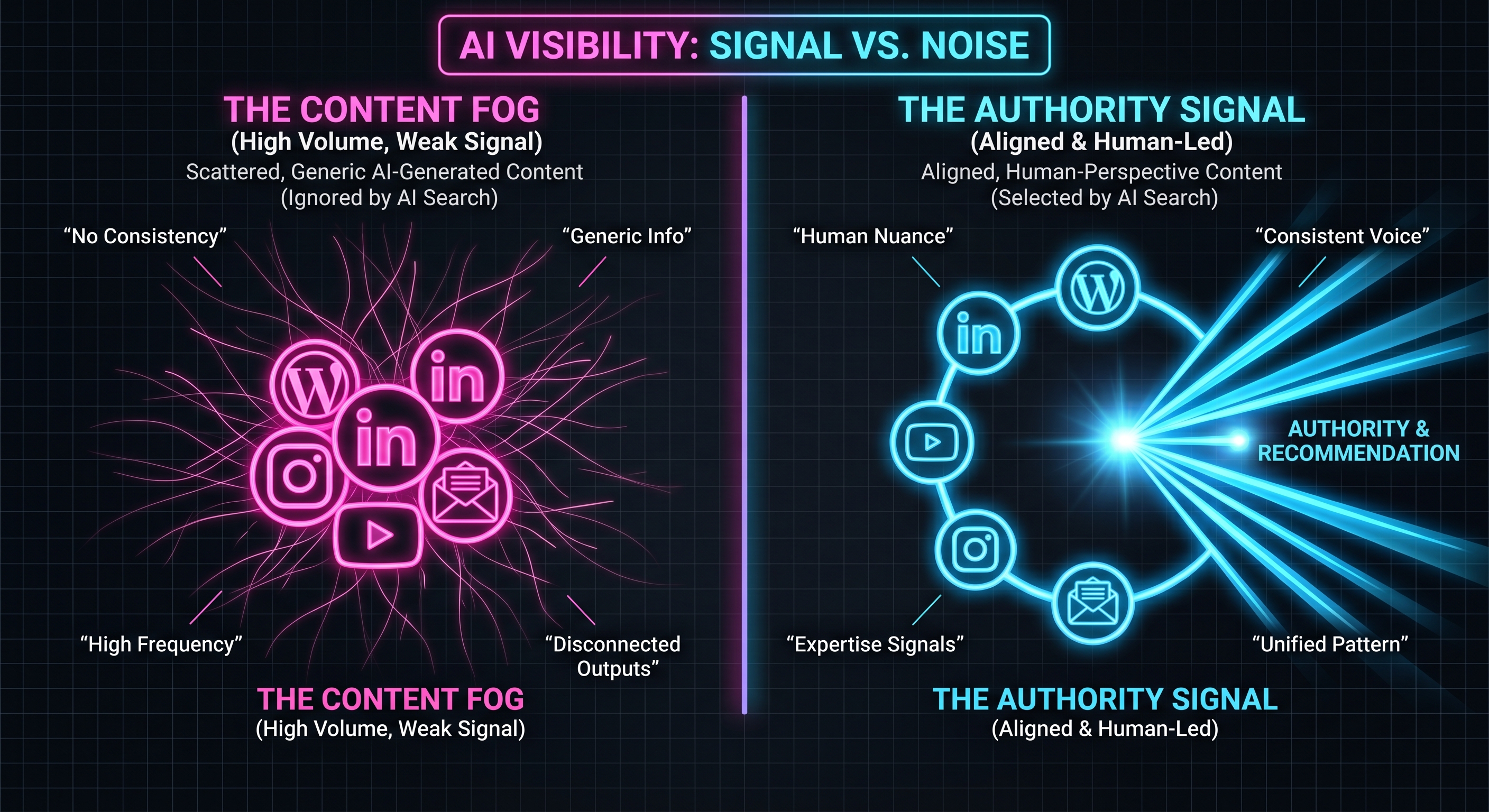
You can publish AI content across every platform and still be invisible.
Right now, many businesses are doing exactly that.
More output. More activity. More AI-generated content.
And yet: they’re still not being recommended in AI answers.
Because AI-generated content alone does not create the signals AI systems use to select sources.
So the issue isn’t content.
It’s the signal your content creates.
AI has made content production effortless.
You can now:
It feels like progress.
But visibility hasn’t changed.
Because: AI search doesn’t reward how much you publish.
It evaluates whether your content creates a clear, consistent signal that it can trust.
The problem isn’t that businesses are using AI.
It’s how they’re using it.
Content is typically created like this:
Each piece exists.
But they don’t connect.
So instead of reinforcing one clear message, they create multiple weak signals.
And weak signals don’t get selected.
This is exactly what most AI-generated content creates: disconnected outputs instead of a unified signal.
You think in terms of platforms:
AI doesn’t.
It looks for patterns across everything.
It evaluates:
If that pattern is unclear, AI cannot confidently use you as a source.
A common reaction is:
“We’ll just publish across more platforms.”
So businesses expand to post content on several platforms like LinkedIn, Instagram, and more.
But without a clear system:
So instead of strengthening your presence, you dilute it.
This is why simply scaling AI-generated content across platforms does not improve visibility.
It amplifies inconsistency instead of strengthening authority.
| Content Type | What Most Businesses Do | Why It Fails | What Actually Works |
| Blogs | Publish AI-written articles at scale | Generic, lacks structure and depth | Question-led, structured answers with clear positioning |
| LinkedIn Posts | Post frequently using AI captions | Inconsistent messaging, surface-level insights | Reinforce core ideas and expertise consistently |
| Short-Form Video | Create quick AI-scripted clips | Lacks depth, no supporting context | Answer specific questions clearly and repeatedly |
| Long-Form Video | Occasional, unstructured uploads | No clear strategy or topic alignment | Planned, topic-focused content that builds authority |
| Social Media (IG/Facebook) | Repurpose generic content everywhere | No connection to broader narrative | Content that supports and reinforces key topics |
| Website Content | Publish without internal structure | Hard for AI to interpret and extract | Structured content with a clear hierarchy and linking |
There’s one thing most AI-generated content strategies remove: the human behind the content.
When everything is:
What disappears is:
And that’s exactly what AI systems look for when deciding what to select.
Because AI doesn’t just evaluate information.
It evaluates:
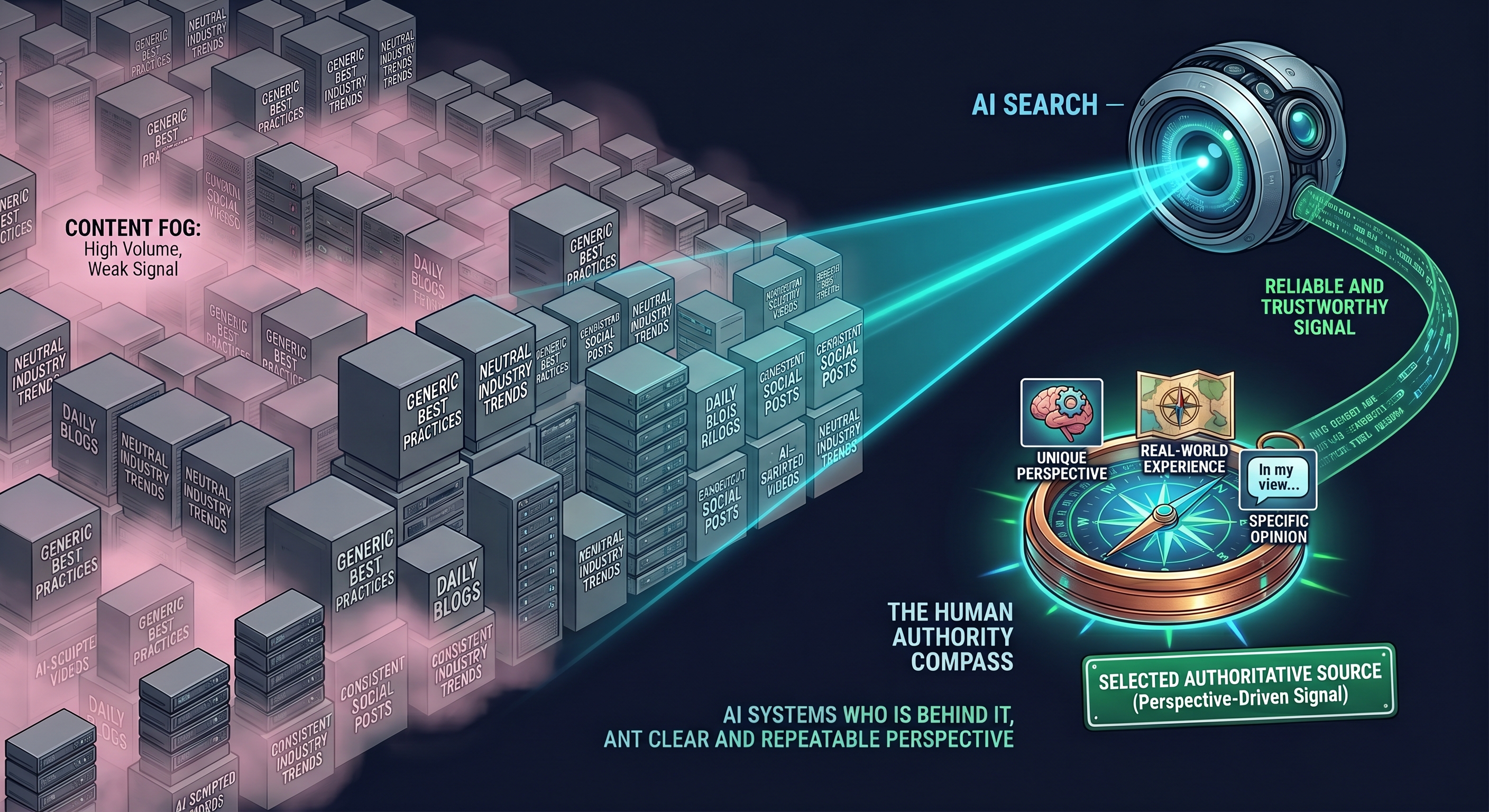
AI systems are trained on human knowledge.
So when your content:
It becomes:
less valuable than content with a clear human perspective
This is why:
consistently perform better.
Not because they’re louder.
But because they’re: more identifiable, more consistent, and more trustworthy.
This doesn’t mean abandoning AI tools.
It means using them differently.
The human element shows up as:
So instead of:
You create: content that can only come from you.
And that’s what makes it:
This is what separates AI-assisted content from AI-generated content that gets ignored.
AI visibility comes from one thing: a clear, consistent, and human signal across all content.
That means:
So instead of separate pieces of content, you create:
a connected system of signals.
Now your:
And AI systems can clearly understand:
This is what Generative Engine Optimisation (GEO) is built around.
Not producing more content, but aligning signals so AI systems can understand, trust, and select your business.
Content is what you publish.
Signals are what AI systems interpret.
And those signals are built through:
Without those, your content never becomes a signal AI systems can trust.
Most businesses are trying to scale:
But the real leverage is in signal alignment.
This is the shift from traditional content marketing to Generative Engine Optimisation.
From publishing content to engineering the signals AI systems rely on.
Because in AI search:
Which means: the clearest and most human signal wins, not the highest volume of AI-generated content.
If you’re publishing AI-generated content across platforms but still not being recommended, the issue isn’t output.
It’s the lack of a clear, consistent, and human signal.
At Tenacious AI Marketing, we help businesses turn scattered AI content into structured visibility systems that AI platforms can understand, trust, and select. Contact us to get started!
Because AI systems don’t reward volume or frequency. They prioritise clear, consistent, and trustworthy signals.
Only if the content reinforces a consistent message. Without alignment, multi-platform content weakens your signal.
Because it tends to be generic and lacks perspective. AI systems select content that is clear, distinct, and useful.
It looks for patterns of clarity, consistency, and authority. Disconnected or generic content reduces trust and selection.
It’s the presence of real opinions, experience, and perspective. This is what makes content more trustworthy and recognisable.
Yes, but they should support execution, not replace thinking. The core message must come from the business itself.
Building a connected, consistent, and human content system. Visibility comes from alignment, not just activity.