.jpg)
In the first 90 days of a YouTube channel launch, the most critical result is the creation of a verified, machine-readable "Entity" in the Google Knowledge Graph.
Success is not measured by subscriber growth, but by "AI Citation Readiness", evidenced by appearing in Google AI Overviews, and "Funnel Compression," where the 7:11:4 rule is leveraged to turn anonymous viewers into pre-sold inbound leads within three months.
Most founders approach a YouTube launch with the wrong scoreboard. They look at TreDigital or Roy Bretton and think success is defined by hitting 1,000 subscribers or qualifying for AdSense.
If you are a B2B founder, that is the "Creator Trap." You are not an entertainer chasing pennies; you are a business owner building Revenue Infrastructure. In the first 90 days, your channel's primary job is to act as a Video Verification Strategy.
It exists to prove to the world, and more importantly, to the AI "Answer Engines", that you are a trusted authority who should be recommended on the AI Tender List.
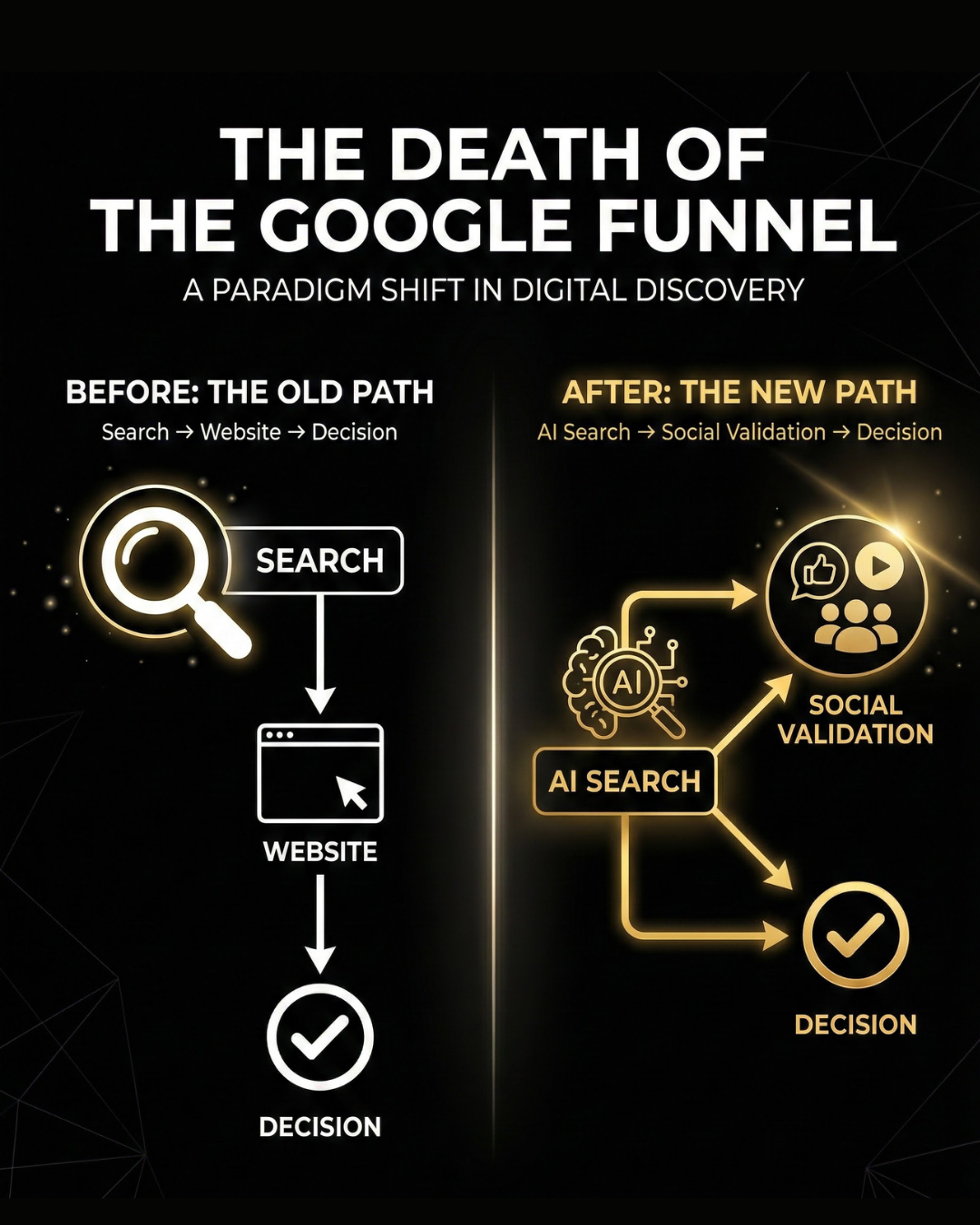
At Tenacious AI Marketing, we have analyzed 90-day launch data across dozens of B2B niches. The results are clear: the businesses that win are those that stop chasing "views" and start engineering Trust Signals.
Dean Whitby often speaks about the 7:11:4 Rule, a fundamental marketing law that states a prospect needs 7 hours of content, 11 touchpoints, and 4 different locations before they are ready to buy a high-ticket service.
In the old world, achieving 7 hours of consumption took 6 to 12 months of nurturing. In the 90-day YouTube launch model, we collapse that timeline.
By day 90, your channel isn't just a "social media account." It is a Funnel Compressor that turns cold prospects into inbound leads who arrive at sales calls saying, "I've seen enough; how do we start?".
If your 90-day report focuses on "Subscriber Growth," you are missing the revenue impact. Subscribers are a lagging indicator; Entity Authority is a leading indicator.
In 90 days, your goal is to see your brand appearing in Google AI Overviews (AIO) and Perplexity citations.
According to Xponent21 (Nov 2025), Google AI Overviews now appear in 60.32% of all search queries.
If you spend 90 days building a channel and the AI isn't citing you, you have failed the launch. You have built a channel for humans in a world governed by machines.
Success in the first three months is being the "Recommended Option" when someone asks a chatbot for a specialist in your niche.
This is the AI Tender List. The AI acts as a filter, removing everyone who lacks "Multimodal Proof". By day 90, you should be "in the room" for deals you didn't even know existed.
Most founders start by filming. We start by Verifying.
In the first 30 days of your 90-day launch, you must fix the Identity Gap. If your YouTube channel is called "Build with Dean" but your website says "Tenacious AI Marketing Global," the AI gets confused.
This confusion leads to Brand Hallucination, where the AI thinks you are two different people or, worse, ignores you entirely.
Watch Dean break down how to stop being an "Invisible Expert" and start building the multimodal identity that AI search engines actually recommend and follow the below action plan.
The Action Plan:
Once the foundation is set, Month 2 is about Machine-Readable Authority.
Competitors like TreDigital focus on "CTR" (Click-Through Rate). While CTR matters for the YouTube algorithm, Retrieval Readiness matters for the Revenue Engine.
AI models do not watch your video for entertainment. They scrape your Transcript to understand the semantic depth of your content.
The Tenacious Approach:
By Month 3, your YouTube channel stops being "content" and starts being Infrastructure.
One 15-minute video per week creates 20+ Revenue Touchpoints.
This is how we achieve the "11 touchpoints" of the 7:11:4 rule without the founder spending 40 hours a week on social media.
The Multiplication Workflow:
BrightEdge (2025) reveals that since the rollout of AI Overviews, YouTube citations have increased by 25% in AI-generated answers.
By Day 90, you are not just "on YouTube." You are a dominant presence in the AI search results.
AdSense is Noise. Sponsorships dilute your positioning.
If you sell a $10,000 service, one lead generated by an AI citation is worth more than 10 years of YouTube AdSense revenue.
At Tenacious AI Marketing Global, we measure success in Win-Rate Inflation. If your close rate goes from 20% to 40% because your prospects watched your 90-day library before the call, you have achieved a massive ROI that no "subscriber count" can capture.
Most founders think YouTube equals AdSense.
That’s small thinking.
A properly engineered channel is not a content play, it is a Revenue Multiplier Engine.
Here are the revenue streams most B2B businesses fail to calculate.
When you answer every major buyer objection publicly before a prospect speaks to sales, you collapse the sales funnel.
Your videos answer:
• Pricing objections
• Delivery concerns
• Case studies
• Competitor comparisons
• Risk reversal questions
• Implementation detail
By the time someone books a call, the persuasion phase is over. The call becomes confirmation.
This is Funnel Compression in action.
Sales cycles shorten. Close rates double. Revenue per lead increases. CAC drops.
This is the highest ROI revenue stream of all because it amplifies every existing marketing channel.
Recent buyer behaviour studies show that consumers are up to 9x more likely to buy when referred by an LLM compared to traditional search.
Why?
Because the AI has already filtered the shortlist.
Large language models are increasingly surfacing:
• YouTube videos
• Social content
• Expert commentary
• Multimodal sources
When your videos include clean .SRT or .TXT transcripts, they become parsable knowledge assets. AI engines do not “watch” your video, they ingest the transcript data.
That transcript becomes:
• Entity reinforcement
• Semantic depth proof
• Authority training data
And when ChatGPT, Gemini, or Perplexity cites you, you are no longer competing. You are pre-selected.
That citation alone can outperform years of paid ads.
Once you build a niche B2B audience, other businesses will pay to access it.
This is not influencer marketing fluff.
This is:
• Co-branded expert interviews
• Sponsored deep dives
• Product integrations
• Strategic partner features
If you serve founders, SaaS tools want your audience.
If you serve IT leaders, cybersecurity vendors want your audience.
If you serve marketers, platforms like HubSpot or Ahrefs want your audience.
You become media infrastructure inside your niche.
And the more authority you build, the higher the sponsorship premium.
Affiliate revenue should never feel random.
It should feel aligned.
If you run an IT consultancy:
• Partner with firewall providers
• Microsoft 365 resellers
• Cloud infrastructure platforms
If you run a marketing agency:
• HubSpot
• Ahrefs
• VidIQ
• Analytics or CRM platforms
You create educational videos around real implementation use cases.
When someone clicks your tracked link and buys, you get paid.
The key difference?
You are not “promoting products.”
You are solving real problems and monetising the solution pathway.
That revenue compounds over time because your videos continue working years after upload.
YouTube is increasingly enabling structured ad slot resale inside creator inventory.
That means:
• Pre-roll placements
• Mid-roll sponsor inserts
• Integrated ad segments
And those slots can be resold repeatedly.
Think television advertising, but niche and hyper-targeted.
Revenue potential is not five figures.
It is not six figures.
It can scale to seven or eight figures for the right category and audience density.
And unlike traditional TV, your distribution is global from day one.
The biggest revenue stream is the one you cannot forecast.
The investor who watches quietly.
The acquisition offer.
The board position.
The joint venture.
The keynote invitation.
The strategic partnership.
When you build visible authority, serendipity increases.
Who sees your content tomorrow could change the trajectory of your company.
That does not happen to invisible brands.
It happens to entities that dare to build publicly.
If you only measure YouTube by subscriber count or AdSense, you are playing the wrong game.
The real revenue streams are:
This is not content creation.
This is building owned media infrastructure that feeds your sales engine, trains AI to recommend you, and creates compounding revenue pathways most competitors will never see.
Build it properly once.
And it pays you for a decade.
A 90-day YouTube launch is not a "content experiment." It is a Revenue Protection Strategy.
As Gartner (2026) predicts, traditional search volume is dropping as users migrate to AI bots.
If you are not on YouTube, you are invisible to those bots. You are missing the citations, the multimodal proof, and the trust signals required to survive the AI Tender List.
Don't be a ghost. In 90 days, you can build the Visual Moat that protects your brand for a decade.
Is your brand invisible to the machine? Get a Free AI Visibility Audit from Tenacious AI Marketing.
How many subscribers should my YouTube have after 90 days?
Subscriber counts are a vanity metric in a B2B revenue strategy, as success is actually defined by "Shortlist Inclusion" and being cited by AI engines like Perplexity and Gemini. A channel with 100 high-intent subscribers who are ideal buyers is far more valuable than a 10,000-subscriber channel with no business intent.
Does YouTube help my brand rank in AI search engines (GEO)?
Yes, YouTube is a primary authority input for the Knowledge Graph because AI models like Gemini "listen" to transcripts and analyze video frames to verify expertise. Strategically optimized videos and clean transcripts now account for approximately 25% of all citations in AI Overviews.
What is the "7:11:4 Rule" and why does it matter for my launch?
The 7:11:4 Rule states that a prospect needs 7 hours of content, 11 touchpoints, and 4 locations to trust a high-ticket brand. A 90-day YouTube launch allows you to build a library that prospects can "binge-watch," collapsing the sales cycle from months to days by meeting these trust thresholds automatically.
Does YouTube generate B2B leads for high-ticket services?
Yes. When structured correctly, YouTube increases inbound lead quality by compressing the sales funnel. Prospects consume hours of expertise before booking a call, which increases trust and improves close rates.
Can YouTube improve close rates and shorten sales cycles?
Yes. When buyers watch multiple long-form videos before speaking to sales, objections are handled in advance. Sales calls become confirmation conversations rather than persuasion conversations, often doubling close rates.
How does YouTube help with AI search visibility?
AI engines ingest transcripts, analyze semantic depth, and verify entities across platforms. Clean transcripts, structured data, and consistent brand positioning increase your chances of appearing in AI Overviews and LLM-generated recommendations.
How do I get my business cited by ChatGPT or Gemini?
To increase citation likelihood:
• Publish long-form expert contentUpload clean SRT or TXT transcripts
• Embed videos with structured data
• Maintain consistent entity naming across website and social profiles
• Build multimodal authority signals
Citations occur when AI models can verify identity, expertise, and cross-platform consistency.
Is subscriber growth important for B2B YouTube ROI?
Subscriber count is a secondary metric. AI citation readiness, inbound lead quality, and win-rate improvement are stronger indicators of commercial impact in the first 90 days.
Can YouTube create revenue beyond direct leads?
Yes. Established niche channels can generate revenue from strategic affiliate partnerships, paid collaborations, sponsored integrations, and structured ad inventory inside videos