.jpg)
In 2026, a personal brand is the prerequisite for Generative Engine Optimization (GEO) because AI models (ChatGPT, Gemini, Perplexity) prioritize entities over keywords.
A personal brand establishes the verifiable E-E-A-T (Experience, Expertise, Authoritativeness, and Trustworthiness) that Large Language Models (LLMs) require to cite you.
Without a recognized personal identity, your content lacks the "Information Gain" and trust signals necessary to be chosen as a primary source in AI-generated answers.
For decades, many of the best minds in business stayed behind the scenes. But in 2026, the "Best Kept Secret" is a recipe for business extinction. We are no longer just optimizing for a search engine; we are optimizing for Answer Engines.
When a potential client asks an AI, "Who should I hire for AI revenue infrastructure?", the AI doesn't browse a list of links. It synthesizes a single, authoritative answer.
If you haven't built a personal brand that the AI can verify, you don't exist in that answer. At Tenacious AI Marketing, we’ve seen that the shift from "Blue Links" to "AI Citations" is the biggest hurdle for founders today.
Generative Engine Optimization (GEO) is the technical process of making your brand "findable" by AI. But AI models are built to be skeptical. To avoid hallucinations, they look for entities, real people with real footprints.
A corporate blog might be well-written, but a personal brand offers Signal Depth. When you use our GLOW Strategy (Generate Light, Open Waves), you aren't just posting content; you are creating a frequency of authority that AI crawlers can't ignore.
They see your LinkedIn engagement, your YouTube videos, and your industry citations, and they conclude: "This is a trusted source."
To succeed today, you need to understand how the "visibility currency" has shifted.
| Feature | Traditional SEO | 2026 GEO |
| Primary Goal | Ranking in the top 10 "Blue Links." | Being the cited answer in an AI response. |
| Success Metric | Click-Through Rate (CTR) to the website. | Mention Frequency & AI Sentiment Score. |
| Content Type | Keyword-rich blogs & landing pages. | Factual "Snippets," FAQs, & Expert Video. |
| Authority Signal | Backlinks from other websites. | Personal Brand Entity & Cross-Platform Proof. |
| User Intent | User seeks information to browse. | User seeks a direct solution or recommendation. |
In a world full of AI-generated noise, authenticity is your only moat. Industry leaders agree; Dean Whitby, our founder, was recently featured by AMA Phoenix, sharing how professional 'presence' is becoming the ultimate differentiator for leaders in 2026.
However, most UK businesses are currently missing the mark. The data shows a massive "Implementation Gap" that is leaving the door wide open for founders who take their personal brand seriously.
According to the LOCALiQ UK 2026 State of Digital Marketing Report, while 50% of UK businesses are now utilizing AI in their marketing, a staggering 70% have still not budgeted for specific AI-search technologies or GEO.
This means most companies are using AI to create noise, but almost none are optimizing to be the source of the answer.
Leaders are starting to pivot: 25.7% of marketers have officially shifted their priority to developing authoritative content for AI citations.
To get cited by AI in 2026, you need to move from "content creator" to "Authority Entity." Here is how we do it:
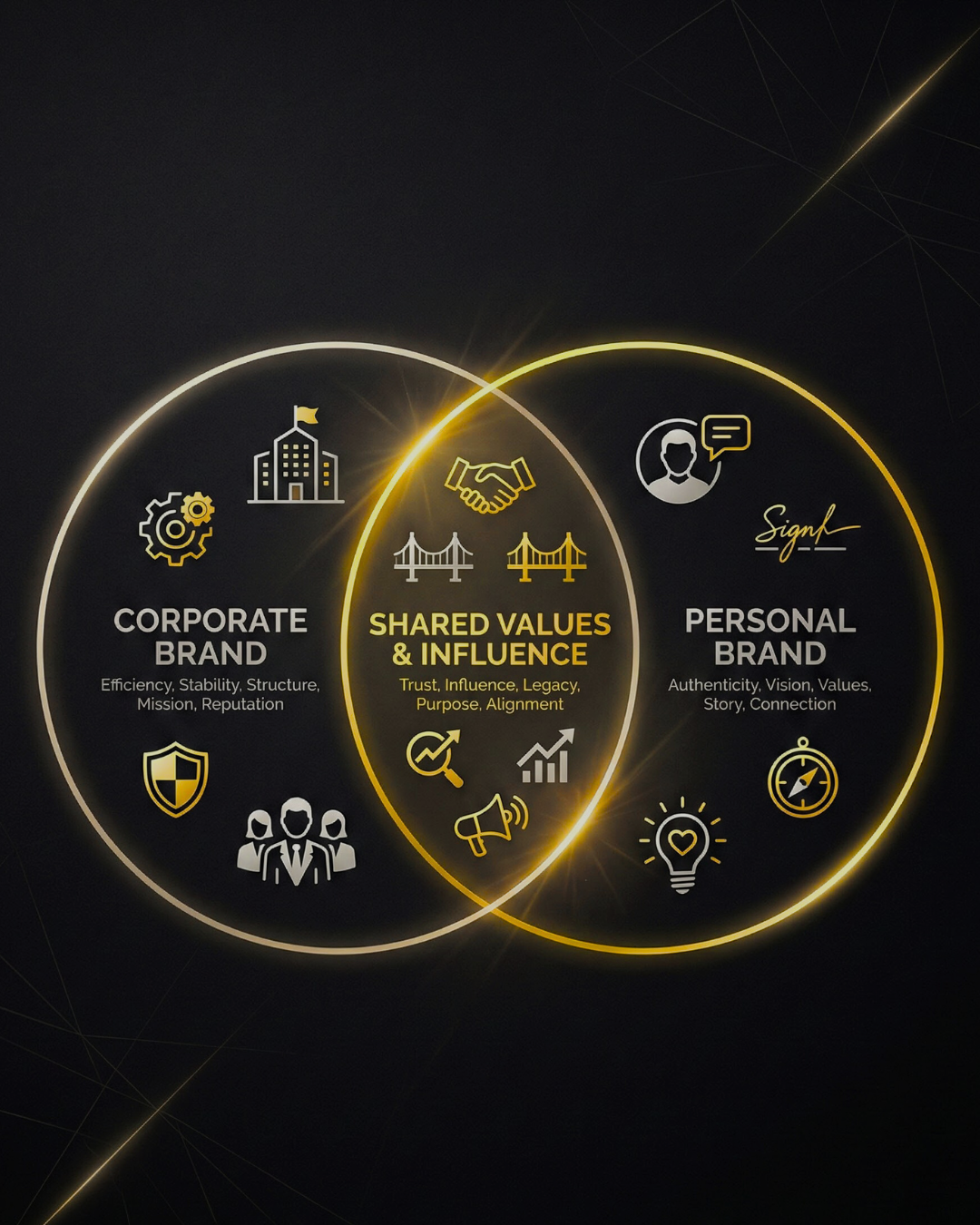
A personal brand is the first GEO step.
But it is not the final one.
AI does not evaluate you in isolation. It evaluates the network around you.
Generative engines think in graphs, not posts. They map relationships between entities and assess whether those relationships are consistent, reinforced, and commercially credible.
If your personal brand exists without a structural connection to your wider business ecosystem, you build visibility, but not dominance.
Here’s what AI is actually looking for:
• A Person entity, you
• A Company entity
• Service entities
• Product entities
• Platform entities, YouTube, LinkedIn, Website
• Third-party citations and media mentions
• Structured schema connecting everything
When these are semantically linked, AI sees confidence.
When they are fragmented, AI sees risk.
To move from “visible” to “recommended,” your ecosystem should look like this:
Person → Founder of → Company
Company → Offers → Services
Services → Solve → Specific Problems
Videos → Demonstrate → Expertise
LinkedIn → Reinforces → Authority
Website → Structurally connects → All entities via schema
External media → Validates → Credibility
When that structure is aligned across platforms, AI models conclude:
This is a verified authority cluster.
That is when citations increase.
That is when shortlist inclusion happens.
Your personal brand builds trust signals.
Your company builds commercial weight.
Your services build topical authority.
Your schema builds machine clarity.
Together, they form what we call Entity Density.
The higher your entity density, the easier it is for AI to:
• Verify you
• Understand you
• Recommend you
This is why isolated personal branding is not enough.
And why isolated corporate SEO is no longer sufficient.
GEO dominance happens when both are engineered together.
Your personal brand is the anchor entity.
But it must be connected to your wider business architecture.
Influence without structure is noise.
Authority with entity architecture is generative visibility at scale.
If you want AI engines to cite you, shortlist you, and recommend you, you must build the ecosystem, not just the profile.
If you aren't a recognized entity in 2026, you're an outlier. A personal brand is no longer a vanity project; it is the API for your reputation. It is the foundation that allows generative engines to trust you, cite you, and ultimately, send you business.
Stop Being the "Best Kept Secret" - Let's Make You In-Demand
Ready to transform your expertise into a revenue-generating infrastructure? At Tenacious AI Marketing, we specialise in helping founders move from invisible to cited.
Book Your Free AI Visibility Audit Today. Let's see if the AI engines actually know who you are, and how we can make you the only answer they give.
How do AI engines verify that I’m a real authority?
AI engines verify authority by cross-referencing entities across platforms. They look for consistent naming, structured data, media mentions, LinkedIn authority, video transcripts, and semantic alignment between your personal brand and company.
Authority is not claimed. It is triangulated.
What is an “entity” in GEO?
An entity is a clearly identifiable person, company, service, or concept that AI models can distinguish and map inside a knowledge graph.
GEO works when your person entity, company entity, and service entities are structurally connected and consistently reinforced across the web.
Does schema really affect AI citations?
Yes. Schema provides machine-readable clarity that helps AI engines understand relationships between entities.
Without structured data, AI must infer meaning. With schema, you remove ambiguity, which increases citation confidence.
Why are AI engines prioritising people over brands?
AI models are built to reduce hallucination risk. People provide accountability, traceability, and experience signals.
Corporate content without a visible human expert lacks depth and “Information Gain,” making it less citation-worthy.
Can a company rank in AI search without a founder-led personal brand?
It is possible, but significantly harder.
AI engines prefer accountable expertise. Companies that connect their brand to a visible subject matter expert have stronger citation probability than faceless corporate pages.
What platforms matter most for building an AI-ready personal brand?
High-trust platforms include:
• YouTube for long-form authority
• LinkedIn for professional validation
• Your website for structured schema clarity
• Industry publications for third-party credibility
The goal is not volume. It is cross-platform consistency.
What is the biggest GEO mistake founders make?
Treating GEO like updated SEO.
Publishing more blogs without entity structure does not increase AI citation likelihood.
Authority density and entity connectivity matter more than content volume