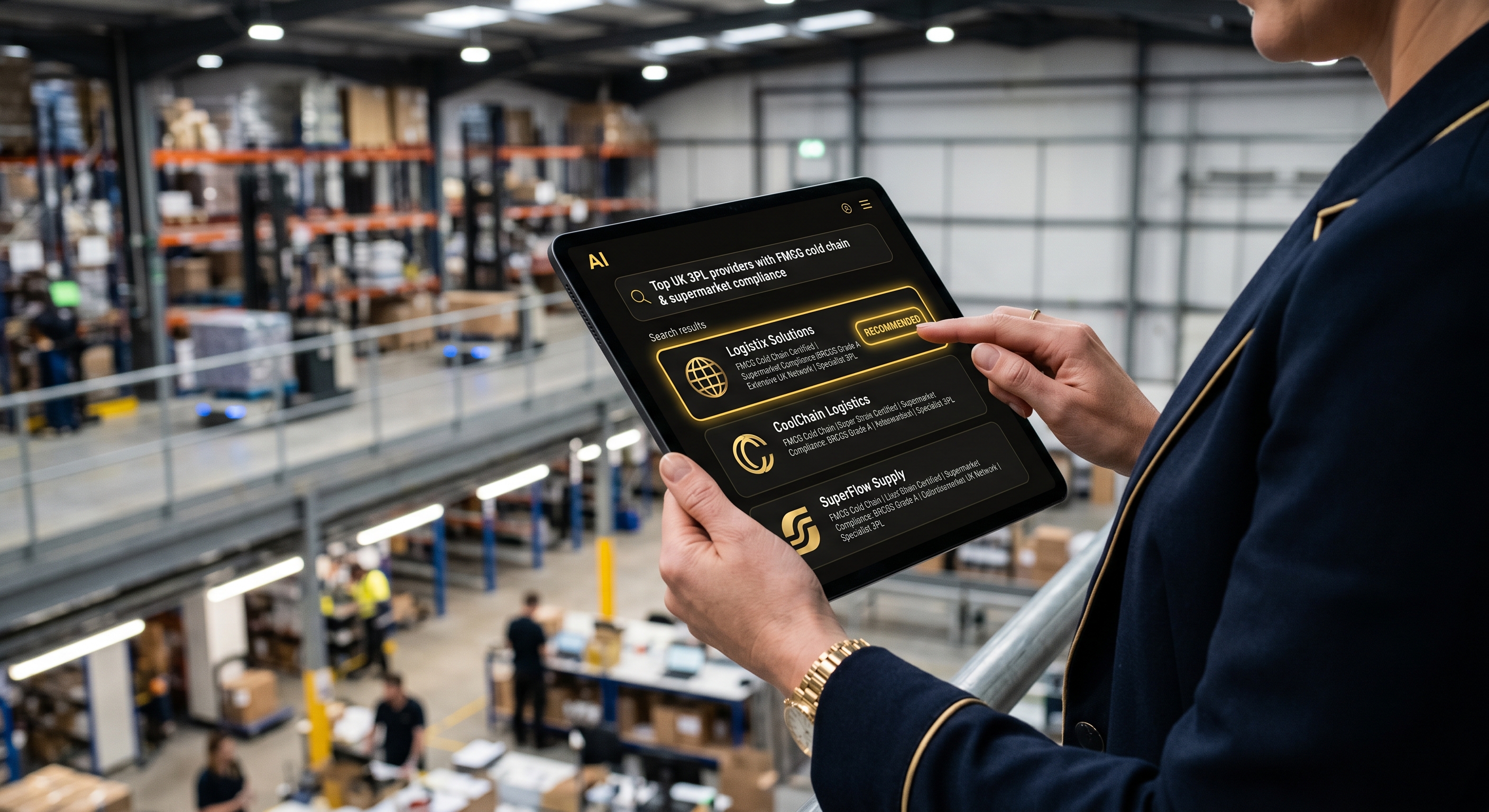
A supply chain director at a mid-size FMCG brand has outgrown their current 3PL. Volume has grown, their retailer compliance requirements have become more complex, and the cold chain capability they need for their new chilled range is not something their existing partner can provide.
They are not ready to issue an RFP. Not yet. First, they want to understand the market.
They open ChatGPT and ask: "Which UK 3PL providers specialise in ambient and chilled FMCG distribution with proven experience across major grocery retailers?"
The AI constructs an answer. It identifies the providers it considers authoritative, relevant, and clearly matched to the requirement.
The businesses that appear in that answer get onto the longlist. The ones that don't are not considered (not because they lack the capability, but because the AI cannot find clear evidence of it).
Or a supply chain consultant, brought in by a major retailer to evaluate their distribution network, uses Perplexity to research contract logistics providers with relevant sector experience before conducting formal interviews.
Or an e-commerce operations director at a fast-growing retail brand asks a Google AI Overview to explain the difference between a 3PL and a fulfilment centre, then asks a follow-up question about which UK providers offer integrated returns management with Shopify-native technology.
In every one of those moments, a shortlist is being built.
The logistics firms that appear in those AI-generated answers get the conversation. The ones that don't are absent from a process that could represent years of high-value contract revenue.
This is happening right now. Across UK retail and FMCG. In every category where brands are evaluating their supply chain partnerships.
And most UK logistics firms (3PLs, fulfilment providers, cold chain specialists, contract distributors) have no strategy to appear in it.
Generative Engine Optimisation (GEO) is the practice of making your business visible, trustworthy, and citable in AI-generated search answers. For logistics firms serving retail and FMCG, where long-term contracts define annual revenue and relationship-based selling is increasingly insufficient to reach new clients, it is one of the most urgent commercial investments available.
This article explains what GEO is, why it matters specifically for logistics businesses in the retail and FMCG space, and how the Tenacious 7-step GEO framework gives you a clear system to build that visibility before your competitors do.
Traditional SEO focuses on appearing in search results.
A 3PL targets "ambient warehouse UK." A fulfilment provider optimises for "e-commerce fulfilment services." A cold chain business competes for "chilled logistics UK."
That approach still has value. But it addresses only the buyers who already know what they are looking for and are actively searching.
GEO addresses something different and, for logistics businesses, arguably more important: the research phase that happens before a formal search or procurement process begins.
When a supply chain director uses an AI tool to understand which 3PL providers have credible FMCG experience, they are not clicking through search results. When a procurement team uses ChatGPT to map the UK cold chain logistics market before scoping an RFP, they are reading an AI-generated answer. When a supply chain consultant evaluates contract logistics options for a retail client, they are using AI to build their initial view of the market.
GEO is the discipline of ensuring your business is consistently present in those answers.
It works by building:
For logistics firms whose target clients are operations directors and supply chain procurement teams at major retailers and FMCG brands, GEO is not a marketing experiment. It is a pipeline infrastructure.
Gartner predicts that traditional search engine volume will decline by 25% by 2026 as AI tools become the primary way people discover information and make decisions.
In logistics procurement (a high-value, high-complexity buying decision) the research phase has always been extensive. AI tools have made that research faster, broader, and more AI-dependent.
The specific ways buyers and influencers in retail and FMCG supply chains are now using AI include:
Market mapping before an RFP - Before a formal process is issued, operations directors and supply chain teams use AI to understand who the credible players are in a specific logistics niche (FMCG cold chain, grocery retailer compliance, e-commerce returns, pallet network operators, or bonded warehouse provision). The businesses that appear in those AI-generated market maps are the ones invited into the formal process.
Supply chain consultant research - Many major retailers and FMCG brands use specialist supply chain consultants to advise on logistics partner selection. Those consultants use AI tools to build their initial market view before conducting primary research. A logistics firm that is not visible in AI-generated answers to a consultant's research questions may not make it onto the longlist they present to the client.
Retailer compliance research - Buyers and supply chain managers at FMCG brands use AI tools to understand which 3PLs have experience managing retailer-specific compliance requirements (Tesco's GNFR processes, M&S's supply chain standards, Waitrose's vendor management expectations). Logistics firms that have produced content explaining these requirements in the context of their own operations are far more likely to be cited.
Technology and integration evaluation - Operations directors evaluating logistics partners increasingly use AI to understand which providers use specific warehouse management systems, which TMS platforms they operate, and which e-commerce integrations they support. A 3PL whose technology stack is clearly documented and explained in accessible content is far easier for AI to describe and recommend than one whose capabilities live only in a capabilities deck.
Post-incident research - When a brand's current logistics partner underperforms (a missed OTIF target, a retailer fine, a fulfilment failure during a peak period) the operations director often turns to AI to research alternatives quickly. Being visible in that moment of urgency is disproportionately valuable.
In every one of these scenarios, the output is a shortlist. And the logistics firms on that shortlist are the ones with structured, consistent, authoritative AI visibility.
Logistics is one of the most genuinely undifferentiated sectors in UK B2B services when viewed through the lens of AI.
The vast majority of 3PLs, fulfilment businesses, and contract logistics providers describe themselves in almost identical terms: "a trusted logistics partner offering flexible, scalable, end-to-end supply chain solutions." The language is interchangeable. AI systems cannot build a confident recommendation on that basis.
The common gaps are structural:
Generic positioning across the board - When every logistics firm claims to offer the same breadth of services with the same commitment to partnership, AI cannot make a meaningful distinction. Firms that clearly define their specialism (FMCG cold chain, grocery retailer compliance, e-commerce returns at scale, bonded warehouse for spirits and tobacco) are the ones AI can actually describe and recommend with confidence.
Capability buried in sales materials - Most logistics firms have detailed capabilities (specific WMS platforms, track record with named retailers, cold store temperature ranges, particular compliance expertise) that exist in presentations, case studies, and the heads of their BD team. None of it is structured in a way that AI systems can find and extract.
Absent question-answering content - The questions buyers and supply chain consultants are asking AI tools ("which 3PLs in the UK have experience with Tesco ambient compliance?", "what cold chain capabilities do I need to distribute chilled products through a major UK grocery multiple?", "how does a shared-user 3PL differ from a dedicated contract logistics operation?") are almost never answered on logistics firm websites.
Inconsistent or thin directory presence - Logistics UK, UKWA, BIFA, RHA, the Cold Chain Federation (logistics firms are typically members of some of these bodies but listed inconsistently across them). AI systems see that inconsistency and respond with reduced confidence.
No strategic video content - In an industry where operational capability is highly visual (warehouse scale, pick and pack processes, cold storage facilities, vehicle fleet, technology interfaces) almost no UK logistics firms are producing strategic video content. The proof of capability that would most rapidly build trust exists nowhere buyers can easily find it.
The result: capable, accredited, well-resourced logistics businesses remain invisible during the research phase that determines whether they are included in an RFP (and the contracts go to firms that are simply easier for AI to describe).
It is worth pausing on what is actually at stake.
A logistics contract with a mid-size FMCG brand (say, a growing challenger brand distributing ambient grocery products to a mix of multiples and independents) might be worth £1.5 to £3 million per year. Contracts of this type typically run for three to five years. The total contract value of a single win is £5 to £15 million.
A contract logistics arrangement with a major retailer (managing distribution for a clothing or homewares category, for example) might be worth £10 to £30 million per year. A five-year term represents £50 to £150 million in contracted revenue.
Missing one of these contracts because the firm was not visible in the AI-assisted market research that preceded the RFP is not a missed lead. It is a structural revenue gap.
And the nature of logistics contracts makes the compounding effect particularly significant. These are not transactional relationships. They are deep operational partnerships, often renewed. Winning one client in this sector means not just the initial contract (it means the relationship, the renewals, and the referrals that follow).
For a logistics firm whose target clients are retail and FMCG businesses, the financial argument for investing in GEO is not marginal. It is direct, quantifiable, and urgent.
This is the framework Tenacious uses to turn businesses from invisible to recommended.
Applied to a UK logistics firm operating in the retail and FMCG space, it looks like this:
| Step | What It Involves | Outcome for the Business |
|---|---|---|
| 1. Diagnose | Audit current AI and search visibility | Understand exactly where you stand, where competitors appear, and which buyer research journeys are missing you |
| 2. Align | Define and unify the firm's positioning | A clear, specific description of specialism, sector experience, and operational capability that AI can describe confidently |
| 3. Standardise Listings | Update 25(50 directories, trade body profiles, and accreditation registers | Consistent entity signals across every platform a buyer or consultant might consult |
| 4. Structure the Website | Improve service pages, FAQs, technology pages, and schema | A website AI can read, extract operational detail from, and cite with confidence |
| 5. Publish Content | Strategic articles answering real buyer and consultant questions | Content that earns citations at both the inbound and RFP pre-qualification stage |
| 6. Distribute | Share across LinkedIn, trade press, industry channels, and Google Business | Increased frequency of AI encounter across the platforms supply chain professionals use |
| 7. Amplify | Launch and grow a YouTube channel | Accelerated operational credibility, trust, and citation across all platforms |
Before building anything, you need to understand where the firm stands today.
When a supply chain director uses ChatGPT to research 3PLs with FMCG cold chain experience (do you appear?). When a supply chain consultant asks Perplexity to map UK contract logistics providers with grocery retailer compliance capability (are you named?). When an e-commerce operations manager asks a Google AI Overview which UK fulfilment providers integrate natively with Shopify (does your business come up?)
The diagnosis covers website structure, search visibility, AI citation frequency, listing consistency across industry platforms, content coverage, and authority signals.
Most logistics firms discover that AI systems have a vague or generic understanding of their capability (even when the firm has deep, demonstrable sector experience). The gap is almost always in how that experience is structured and communicated, not in the experience itself.
AI systems build their understanding of a business from multiple sources simultaneously. In logistics, where almost every firm uses identical positioning language, the firms that cut through are the ones with specific, consistent, differentiated positioning.
For a logistics firm serving retail and FMCG, alignment means being explicit about:
This specificity is what enables AI to make a confident recommendation. Vague positioning makes it impossible.
UK logistics firms serving retail and FMCG typically have a presence across a mix of trade bodies, accreditation schemes, and industry databases (but inconsistently described across all of them).
Relevant platforms include:
Each of these needs to describe the business in consistent, aligned language (the same specialism, the same sector focus, the same operational capabilities). Many logistics firms are listed on several of these platforms with descriptions written at different times by different people. The inconsistency costs them in AI visibility.
The logistics firm website is often the largest untapped GEO asset in the business.
Most logistics websites are built to impress clients who are already engaged (with imagery of warehouses, vehicle fleets, and team members). They are rarely structured to answer the questions a buyer asks during the research phase.
Structuring for AI means:
The FAQ page, in particular, is a high-value asset in logistics GEO. Questions like "what temperature range do your chilled facilities cover?", "how do you manage Tesco GNFR compliance?", "what is the difference between a shared-user and dedicated contract logistics operation?", and "what WMS platforms do you operate?" are exactly what buyers and consultants are asking AI tools during the research phase.
Content built for GEO in logistics leads with the questions buyers and consultants are actually asking (not with operational features the firm wants to promote).
For a 3PL serving FMCG brands, this means articles answering:
For a fulfilment provider serving e-commerce retailers:
The goal is not just inbound traffic. It is to be the source AI cites when a supply chain director asks exactly these questions (at the moment a market map is being built and a longlist is being formed).
Eight to twelve well-structured, question-led articles create a foundation of citeable authority that compounds over time. Logistics UK's guidance on supply chain best practice provides a useful benchmark for the accuracy and depth this content should reflect.
Publishing on the website is step one. Distribution across the platforms supply chain professionals actually use is what amplifies it.
For logistics firms serving retail and FMCG, distribution typically includes:
Each article becomes multiple pieces of distributed content. Each touchpoint creates another opportunity for AI systems to encounter and remember the firm.
This is where the GEO framework accelerates (and where the competitive opportunity in logistics is the most significant of any sector in this series).
Almost no UK logistics firms are producing consistent, strategic YouTube content. The logistics YouTube space is dominated by industry media, general supply chain education, and driver recruitment content. Firms demonstrating their actual operational capability (at scale, on camera) are essentially absent.
YouTube creates structured, AI-readable operational content at scale.
Every video generates transcripts, captions, metadata, timestamps, and topic classifications. A fifteen-minute warehouse tour explaining the pick and pack operation for a major grocery retailer account (walking through goods-in, storage configuration, pick methodology, despatch compliance, and returns processing) creates more citeable, AI-readable, operationally credible content than most logistics firms produce in an entire year of written marketing.
Operational video answers the questions buyers are asking AI tools.
A cold chain logistics firm that publishes a video explaining their temperature monitoring infrastructure, their cold store zone configuration, their HACCP compliance process, and their cold chain reporting capability is answering exactly the kind of question a FMCG supply chain director might ask an AI tool when evaluating providers. That video's transcript becomes citable content. That firm becomes the answer AI returns.
Video builds the trust that wins at RFP stage.
In logistics, the question "can this firm actually handle our operation?" is as important as "do they have the right capability on paper?" A supply chain director who has watched a video of your team managing a complex multi-temperature retail distribution operation already has confidence in your capability before the RFP conversation begins.
An operations director at a growing FMCG brand who has seen your warehouse management system in action, watched your team handle a peak trading period, and seen your onboarding process explained step by step does not need to spend three months of RFP due diligence establishing the basics. They already trust the operation.
Named operational leaders on camera create powerful entity signals.
AI systems build understanding from the people behind a business, not just the brand name. A head of operations or commercial director who regularly appears on camera (explaining their approach to retailer compliance, demonstrating their technology stack, walking through a customer onboarding process) creates a human, verifiable authority signal that AI platforms trust and cite.
Structured playlists allow AI to map operational specialisms clearly.
A YouTube channel organised into playlists by service type (ambient 3PL, cold chain, e-commerce fulfilment, returns management, retailer compliance) and by content type (operational walkthroughs, technology demonstrations, client case studies, buyer guides) allows AI systems to identify specific expertise quickly and cite it confidently.
YouTube collapses the due diligence phase of the sales cycle.
A logistics RFP process is long, resource-intensive, and expensive for both parties. A prospect who has already spent time watching the firm's operational content arrives at the RFP meeting having already completed a significant portion of their due diligence. The RFP conversation becomes shorter, more specific, and more likely to convert.
Initial visibility signals typically begin to emerge within 60 to 90 days of implementing the full framework.
The system builds in sequence (each step creating the foundation for the next). Within six months of a properly implemented strategy, most firms see meaningful improvements in how AI systems describe and recommend them. The quality and source of inbound enquiries shifts (from cold, generic contact to better-qualified prospects who have already done their research and are contacting you specifically).
The compounding effect is what makes GEO particularly valuable in a sector defined by long-term contract relationships. Authority built today continues working for years. A logistics firm that builds strong AI visibility in FMCG cold chain or grocery retailer compliance over the next twelve months will hold a structural advantage over competitors that start later (because the content library grows, the entity recognition deepens, and the AI recommendation compounds with every piece of new content added).
In the UK logistics market right now, the competitive window is still open. In most specific service and sector combinations (FMCG cold chain in a specific region, e-commerce returns for high-SKU retail brands, bonded warehousing for spirits and beverages) there is almost no GEO competition. The firm that builds that position first effectively owns it in AI-generated answers.
The consequences play out quietly (which is what makes them dangerous).
A supply chain director at a major health and beauty brand issues a logistics RFP. Six firms are invited. Four of them appeared in the AI-assisted market research the director conducted three weeks earlier. Two of them did not (their names came from a personal recommendation).
The two firms that came from a recommendation are already at a disadvantage entering the process. The supply chain director has had three weeks to build familiarity with the other four through their content, their case studies, and their online presence.
Your firm was not in the original AI research. You were not on the initial longlist. You were never invited to tender.
You did not know the contract existed until you saw a competitor announce it on LinkedIn.
This pattern will repeat with increasing frequency as AI adoption in supply chain procurement grows. The firms that build their GEO foundation now will appear on longlists their competitors are missing. They will enter RFP conversations with better-informed prospects. They will win contracts at a higher rate (not because they are more capable, but because they were visible at the moment the decision was forming).
Logistics firms serving retail and FMCG have always won business through operational excellence, relationship depth, and the trust that comes from consistent delivery.
GEO is how that operational excellence becomes visible in the channels where the next generation of supply chain decision-makers are already looking (before they issue an RFP, before they brief a consultant, before they make a single call).
The Tenacious 7-step framework gives logistics businesses a clear, structured system to become visible, credible, and recommended in AI-generated answers at the inbound enquiry stage and at the pre-qualification research stage where the most significant contract decisions are now being shaped.
For firms that add YouTube to the strategy (walking buyers through real operations, demonstrating technology, and putting genuine expertise on camera) the effect compounds faster than any other channel. And in a market where almost no UK logistics firm is using video strategically, the competitive ground is still wide open.
The firms appearing in AI-generated supply chain research six months from now are building that position today.
If you want to understand where your business stands in AI search (and what it would take to become the recommended answer the next time a retail or FMCG brand researches their logistics options) talk to the Tenacious team.
Related Reading
If you want to go deeper, these guides explain how the full AI visibility system fits together.
What Is GEO in 2026 and How Do You Get Cited in AI Answers?
This is the core definition guide for Generative Engine Optimisation and AI citations.
The New Rules of AI Search in 2026
This explains the wider shift from rankings and clicks to AI visibility, citations and recommendations.
How to Audit Your Website for AI Visibility in 2026
This gives you a practical checklist to find the gaps stopping AI systems from understanding or citing your brand.
Search Everywhere Optimisation: AI Visibility in 2026
This explains how to build visibility across Google, AI answers, LinkedIn, YouTube, Reddit, reviews, directories and trusted sources.
Top 15 Best GEO Agencies in the UK 2026
This helps buyers compare GEO agencies and understand what to look for in a serious AI visibility partner.
Together, these guides form the Tenacious AI Visibility Framework: understand the shift, define GEO, audit your current gaps, build Search Everywhere authority and track whether AI systems are starting to cite and recommend your bran
GEO is the practice of optimising a logistics business's online presence so it appears (cited and recommended) inside AI-generated answers from tools like ChatGPT, Perplexity, and Google AI Overviews. For logistics firms serving retail and FMCG, this matters at two stages: the inbound enquiry stage, when a buyer actively searches for a provider, and the pre-RFP research stage, when supply chain directors and consultants use AI to map the market before a formal process begins.
Traditional SEO focuses on ranking in search results for specific search queries ("ambient 3PL UK" or "cold chain logistics"). GEO focuses on being cited and recommended inside AI-generated answers to research questions (the questions buyers ask when they are mapping the market and forming a view before they start a formal supplier search). Both are valuable, but they address different stages of the buyer journey and require different approaches.
Because most logistics firms describe themselves in nearly identical terms (trusted partner, end-to-end solutions, flexible capacity). AI systems cannot make a confident recommendation based on interchangeable positioning. The firms that AI can describe specifically and confidently (with a clear sector specialism, defined operational capability, and consistent signals across multiple platforms) are the ones that get recommended.
Any logistics specialism serving retail or FMCG where there is a long pre-RFP research phase benefits significantly. This includes ambient and chilled 3PL, cold chain and frozen logistics, FMCG contract distribution, e-commerce fulfilment, managed returns and reverse logistics, bonded warehousing, co-packing and secondary packaging, and pallet network operations. The longer the contract term and the higher the annual value, the greater the financial impact of GEO invisibility.
Supply chain consultants are a significant buyer archetype that most logistics firms underestimate. Major retailers and FMCG brands regularly engage consultants to advise on logistics partner selection (and those consultants use AI tools to build their initial market view before conducting primary research). A logistics firm that is not visible in AI-generated answers to a consultant's research questions may not make it onto the longlist they present to the client, regardless of how strong the firm's actual capabilities are.
Because logistics is a highly visual, operationally complex sector (and almost no UK firms are using video to demonstrate their capability). A warehouse tour, a WMS demonstration, a walk-through of a retailer compliance operation, or a case study of a complex peak trading deployment answers the "can they actually handle our operation?" question faster than any brochure or capabilities deck. Video transcripts also create large volumes of structured, AI-readable operational content that directly improves citation potential in AI tools.
In logistics, where contracts with retail and FMCG clients run for three to five years and annual contract values regularly reach seven and eight figures, missing a single contract opportunity due to AI invisibility can represent tens of millions in contracted revenue over a contract lifetime. The risk is compounded by the fact that missed opportunities are largely invisible (the firm does not know it was absent from the research phase, does not receive a rejection, and has no visibility of what it lost).