For a long time, the search was relatively simple.
The relationship between rankings and visibility was largely linear.
Today, that relationship is becoming more complicated.
Google recently confirmed that AI Overviews now reach more than 2.5 billion users every month. At the same time, research from Semrush has shown that AI-generated search experiences frequently surface sources beyond the highest-ranking organic results.
In other words, ranking well still matters.
But ranking well no longer guarantees visibility.
A business can hold strong organic positions and still find competitors being cited more frequently in ChatGPT, Perplexity or Google's AI-generated answers.
It can generate traffic while remaining largely absent from the conversations influencing buying decisions.
This shift is forcing businesses to rethink how they evaluate search agencies.
The question is no longer simply:
Which agency can help us rank?
Increasingly, the question is:
Which agency can help us remain visible wherever people search, ask, compare and research?
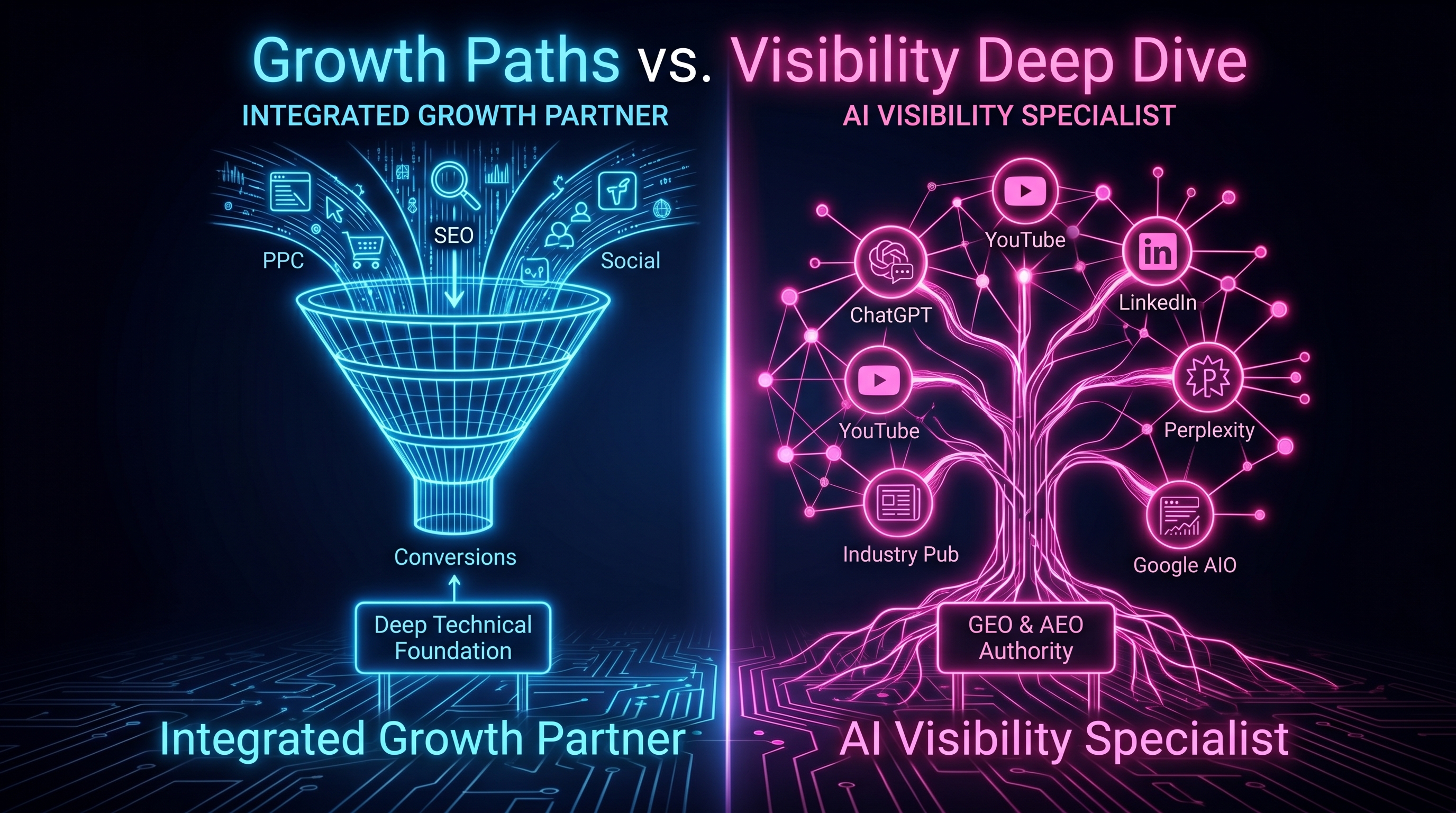
That is what makes the comparison between Polaris and Tenacious AI Marketing particularly interesting.
Unlike many agency comparisons, this isn't a comparison between a broad marketing agency and a search specialist.
However, they approach the future of search from slightly different directions.
For years, rankings acted as the scoreboard for SEO.
Businesses measured success through:
Those metrics remain important.
However, they no longer tell the full story.
Research from Ahrefs found that more than 96.55% of pages receive no organic traffic from Google.
At the same time, search behaviour is becoming increasingly fragmented.
People are discovering information through:
The challenge is no longer simply getting found.
It's being surfaced, cited and trusted wherever people seek answers.
That distinction sits at the heart of this comparison.
Historically, SEO focused on helping businesses become more visible within search engines.
Today, the search journey often starts somewhere else.
Someone may:
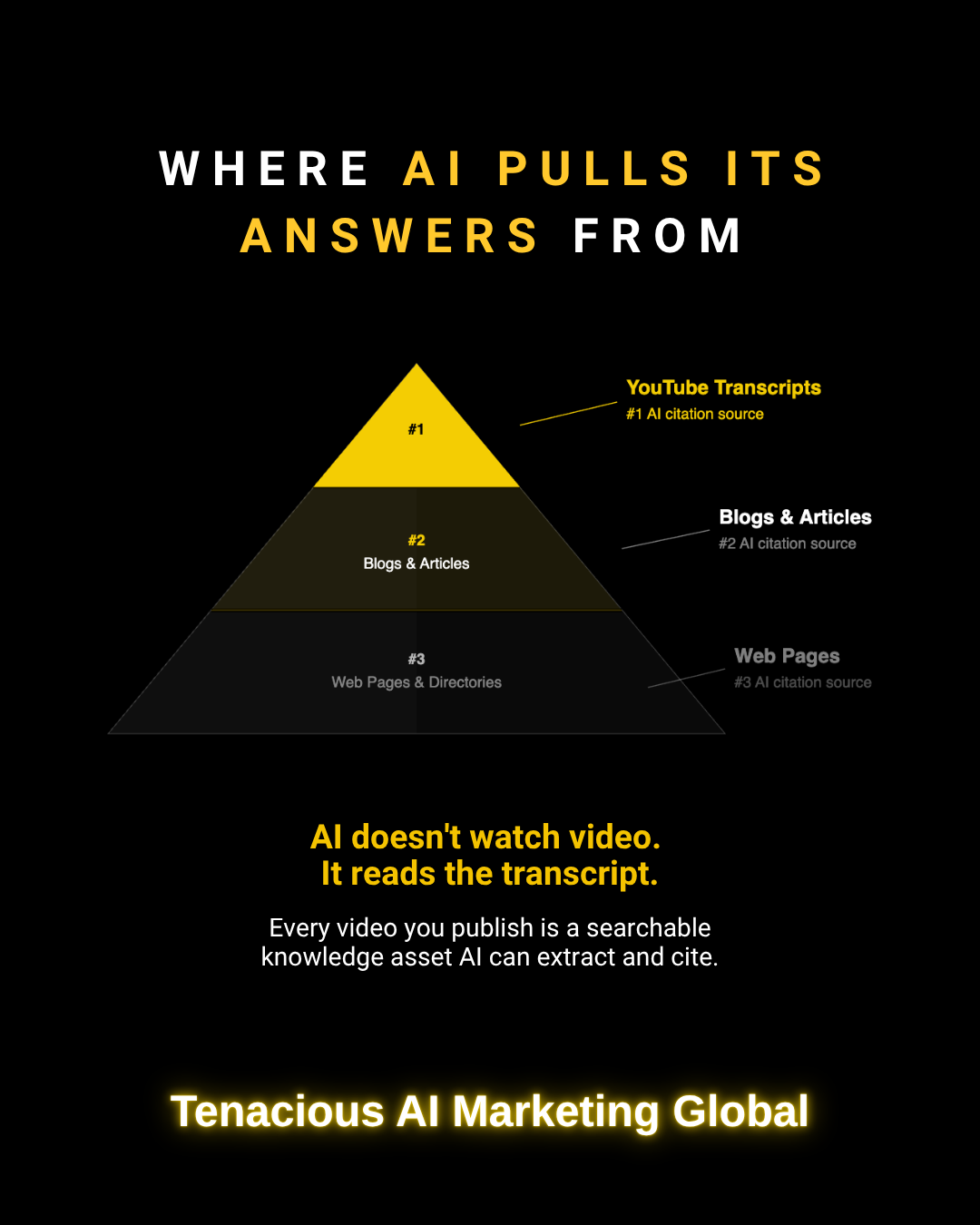
As a result, visibility is becoming broader than rankings alone.
Businesses increasingly need to understand:
Both Polaris and Tenacious AI Marketing recognise this shift.
The difference lies in how they respond to it.
Tenacious AI Marketing starts from a slightly different premise.
The agency's belief is that businesses rarely have a traffic problem.
More often, they have a visibility problem.
Search no longer begins and ends with search engines.
People discover expertise through:
As a result, Tenacious AI Marketing treats visibility as an ecosystem rather than a channel.
Its approach combines:
to help businesses strengthen discoverability across modern search environments.
Rather than focusing solely on rankings, the agency focuses on becoming the answer.
That means helping businesses improve the signals that influence:
Tools such as Answer Architect help businesses understand where competitors are being cited, which questions matter most and where visibility opportunities exist across AI search environments.
Alongside this, the Organic Visibility Scorecard helps businesses understand how visible they are across modern search environments, highlighting opportunities linked to AI visibility, discoverability, authority signals and search readiness.
The objective is not simply to improve search performance.
It is to increase the likelihood that a business becomes a trusted answer wherever discovery happens.
Polaris has built a strong reputation around organic search performance.
Its expertise spans:
One of Polaris' biggest strengths is its depth.
The agency has spent years helping businesses improve technical search performance, strengthen content ecosystems and compete in highly competitive search environments.
More recently, Polaris has expanded heavily into AI Search Optimisation and GEO.
Its approach focuses on helping brands improve visibility across platforms such as:
Alongside traditional SEO, Polaris works across areas including:
One of the more interesting aspects of Polaris' approach is its emphasis on visibility within AI-generated answers rather than simply rankings alone.
The agency regularly discusses how authority signals, citations, structured content and surfaced expertise influence whether brands appear across modern AI search environments.
For businesses looking to strengthen both traditional search performance and visibility across emerging AI search platforms, the overlap between SEO and GEO is likely to be one of Polaris' strongest areas.
This is where the conversation becomes more interesting.
Historically, strong rankings usually meant strong visibility.
If your business appeared near the top of Google, you had a good chance of being discovered.
Today, that relationship is becoming less predictable.
A business can rank well and still find competitors being surfaced in:
That doesn't mean rankings no longer matter.
They do.
But increasingly, they represent only one layer of visibility.
Businesses are beginning to ask questions that traditional SEO reporting wasn't designed to answer:
These are visibility questions rather than ranking questions.
Read a practical next step is How to Audit Your Website for AI Visibility in 2026, which helps assess whether your content, schema, internal links and authority signals are ready for AI-powered discovery.
And they're becoming more important as search continues to evolve.
This is perhaps the clearest distinction between Polaris and Tenacious AI Marketing.
Polaris helps businesses strengthen visibility primarily through stronger search performance
Tenacious AI Marketing helps businesses strengthen visibility through a combination of search performance, authority building, discoverability and AI visibility.
Both approaches have value.
The better fit depends on how a business defines success.
One of the reasons this comparison is more nuanced than many others is because both agencies have embraced AI search.
This isn't a case of one agency focusing on SEO while the other focuses on GEO.
Both understand that search is changing.
The difference lies in where they place their emphasis.
| Capability | Tenacious AI Marketing | Polaris |
| SEO | Part of a broader visibility strategy | Core service offering |
| Technical SEO | Yes | Strong focus |
| Site Migrations | Not a primary focus | Strong focus |
| GEO | Yes | Yes |
| AI Search Optimisation | Yes | Yes |
| AEO | Yes | Included within AI Search initiatives |
| AI Visibility | Core focus | Strong focus |
| AI Discoverability | Core focus | Strong focus |
| Entity Optimisation | Yes | Yes |
| Citation Visibility | Strong focus | Strong focus |
| Authority Building | Strong focus | Strong focus through SEO, Digital PR and GEO |
| Founder Visibility | Strong focus | Not prominently featured |
| Search Everywhere Optimisation | Yes | Not publicly referenced |
| Digital PR | Not a primary service focus | Strong focus |
| Content Marketing | Visibility-focused content systems | Core service offering |
| AI Visibility Measurement | Answer Architect, Organic Visibility Scorecard and visibility assessments | GEO reporting, AI visibility analysis and AI search initiatives |
The table highlights an important point.
There is far more overlap between these agencies than many businesses might expect.
The real distinction is not whether they understand AI search.
The distinction is how they believe visibility should be built.
If technical SEO sits at the centre of your growth strategy, Polaris is likely to be a strong contender.
The agency has extensive experience across:
These disciplines remain critical.
No amount of AI visibility strategy can compensate for weak technical foundations, poor crawlability or ineffective content architecture.
For organisations focused on:
Polaris offers considerable expertise.
This is one of the areas where the agency genuinely stands out.
This is where the comparison becomes more nuanced.
Both agencies recognise that AI search is becoming increasingly important.
Both have invested in GEO.
Both discuss visibility within platforms such as ChatGPT and Google AI Overviews.
The difference lies in how they approach the challenge.
Polaris focuses on helping businesses improve visibility through:
Its approach is rooted in strengthening the signals that help AI systems understand and trust a brand.
Tenacious AI Marketing takes a broader view.
Alongside GEO, the agency places significant emphasis on:
The belief is that visibility is influenced not only by websites, but also by the people, platforms and authority signals surrounding a brand.
Neither approach is inherently better.
The right approach depends on where a business sees its greatest visibility opportunities.
For readers who want to understand GEO, then read What Is GEO in 2026 and How Do You Get Cited in AI Answers?
One of the biggest shifts in modern search is the growing importance of expertise.
People increasingly trust people before they trust brands.
This trend is visible across:
It is also becoming increasingly relevant within AI search environments.
Many AI-generated answers are influenced by sources that demonstrate expertise, authority and trustworthiness.
This is an area where Tenacious AI Marketing places greater emphasis.
Alongside SEO and GEO, the agency focuses heavily on helping founders and subject matter experts become more visible.
The rationale is simple.
If expertise is more visible, businesses are more likely to be discovered.
For founder-led businesses, professional services firms and specialist consultancies, this can be a particularly important consideration.
The right decision depends less on which agency is "better" and more on which challenge you are trying to solve.
The most useful takeaway from this comparison is that Polaris and Tenacious AI Marketing are not trying to solve exactly the same problem.
Polaris helps businesses improve search performance through a combination of SEO, content, digital PR and AI search optimisation.
Tenacious AI Marketing helps businesses improve discoverability through a combination of SEO, GEO, authority building, founder visibility and Search Everywhere Optimisation.
Both recognise that search is evolving.
Both have invested in helping businesses adapt to that change.
The difference lies in how they believe visibility is earned.
For some organisations, stronger technical SEO and organic growth will be the priority.
For others, visibility across AI search environments, recommendation platforms and authority ecosystems will become increasingly important.
Neither approach is universally better.
The better approach depends on where your business needs to be visible next.
Because increasingly, success won't be determined solely by who ranks.
It will be determined by who gets surfaced, cited and trusted wherever people go looking for answers.
Related Reading
Beyond the Search Bar: Why AEO Testing Is Now a Business Visibility Metric
Why YouTube Is Now Essential for Business Visibility in the AI Era
What Is GEO in 2026, and How Do You Get Cited in AI Answers?
The New Rules of AI Search in 2026
Search Everywhere Optimisation: AI Visibility in 2026
How to Audit Your Website for AI Visibility in 2026
Yes. Technical SEO remains one of the foundations of discoverability. Structured content, crawlability and accessibility all influence how search engines and AI systems understand information.
Yes. AI-generated search experiences often surface sources beyond the highest-ranking organic results, which means rankings alone do not guarantee visibility.
SEO focuses on improving visibility within traditional search engines. GEO focuses on improving visibility within AI-powered search experiences such as ChatGPT, Gemini, Perplexity and Google AI Overviews.
Search Everywhere Optimisation is an approach to improve discoverability across a broader ecosystem that may include search engines, AI platforms, LinkedIn, YouTube, publications and recommendation channels.
AI search doesn't replace SEO, but it does expand what visibility means.
Businesses increasingly need to think about how they are cited, recommended and surfaced across AI-powered search experiences alongside traditional rankings. As a result, SEO, GEO, authority signals and discoverability are becoming more closely connected.
Yes. Many agencies now offer GEO services, but their wider approach can differ significantly.
Some focus on GEO as an extension of SEO, while others incorporate GEO into broader strategies that may include authority building, discoverability, founder visibility and AI search readiness. Understanding those differences is often more important than simply comparing service lists.