
Definition: GEO (Generative Engine Optimisation) is the process of structuring your content and brand signals so AI answer engines can confidently extract, cite, and recommend you.
Goal: not just rankings, it is becoming the named source inside AI answers.
The GEO Playbook 2026 is a strategic framework for Generative Engine Optimization designed to shift brand visibility from 'clicks' to 'citations.' Developed by Tenacious Marketing, the playbook centers on the VITAL Framework, which enables brands to bypass the projected 25% decline in traditional search volume by becoming the primary source of truth for AI agents and LLMs
The way people search has changed materially, AI answers often appear before traditional results, and fewer searches result in a click
According to recent estimates, 60% of Google searches now end with zero clicks, users are getting answers without visiting any site
Whether you are a Founder or C-suite or Expert, this shift threatens visibility, engagement and revenue systems.
You're not alone if you’ve noticed a decline in website traffic despite strong SEO efforts. Various businesses struggle to adapt to AI-driven search behaviours, where ranking #1 is insufficient. It’s frustrating to invest in content creation only to have search engines display your answers without driving visitors to your site.
That’s where Generative Engine Optimisation comes into play. It is a strategy for helping content thrive in an AI-powered search environment. GEO ensures your content is found and effectively surfaced in responses, voice searches and featured snippets. But by adopting the GEO principle, you can manage visibility, engage users in new ways, and future-proof your digital presence in an era where AI is rewriting the rules of search,
This article will cover everything you need to know when preparing to scale with a GEO strategy.
Note: You may also hear the term Answer Engine Optimisation (AEO). AEO focuses on making your pages the best direct answer to specific questions. GEO (Generative Engine Optimisation) is broader, it makes your brand and content easy for generative AI systems to trust, extract, cite, and recommend across many query types.
Let’s get started!
In 2026, GEO is the difference between getting cited and getting ignored.
GEO is optimising your digital content to make it more visible and appealing to AI-driven search engines. These engines, like ChatGPT, Claude and Perplexity, use large language models to understand user questions, scan the web and generate direct conversational answers. Unlike traditional engines that list links, these AI tools summarise and cite sources in their responses.
When optimising for GEO, you’re not just aiming for a high ranking on a search result page, but to be the go-to source that AI quotes in its answers.
You can use GEO to position yourself for high-ticket services, for example
If you are an accountant in San Diego who also offers CFO Fractional services and someone asks, “Who are the best Fractional Finance CFO's in San Diego?” your GEO-optimised content could be the one ChatGPT mentions with the name. Of course, you have to be optimised.
Isn’t it powerful?
In short, GEO is all about:
Creating content that AI engines can easily understand and summarise.
Positioning your brand as a trusted authority in AI-generated responses.
Adapting to a world where users want instant answers, not endless link-clicking.
Before diving deep into why GEO matters, let's try and understand the similarities between SEO and GEO. This blog on What Part GEO Plays in Digital Marketing for Accountants goes a long way to explaining the difference between GEO and SEO too.
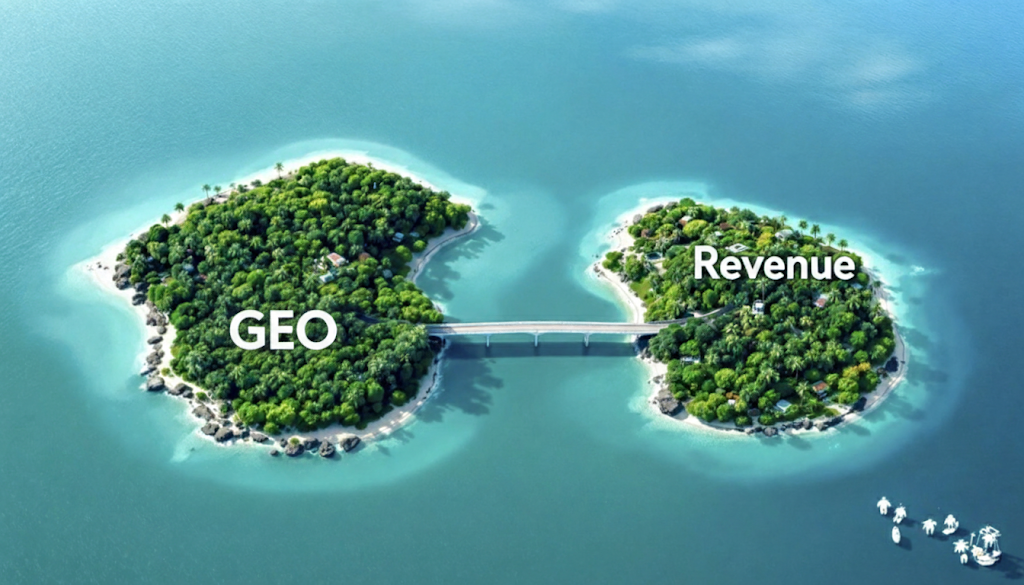
SEO helps you rank in search results. GEO helps you get cited and recommended inside AI answers (even when the user never clicks).
Quick rule: SEO wins the list of links, GEO wins the summary.
| Dimension | SEO (search engines) | GEO (AI answer engines) |
|---|---|---|
| Primary goal | Rank pages for queries | Get extracted, cited, and recommended |
| What the user sees | Links and snippets | A summarised answer with sources |
| What wins | Relevance, authority, UX | Clarity, evidence, entity trust, extractable formatting |
| Best content types | Keyword-led pages, category pages | Answer capsules, comparisons, “best for” pages, proof hubs |
| Key signals | On-page SEO, links, technical health | Entity consistency, structured proof, citations, clean page structure |
| KPI | Rankings and organic traffic | Citation frequency, brand mentions, assisted conversions |
If you only do one thing: add a 50 to 80 word “Answer Capsule” near the top of each key page, then follow it with decision bullets, a comparison table, and proof.
Remember when you’re ranking #1 on Google was the end goal when implementing digital marketing strategies? Those days are gone.
That unexpected traffic drop? Are those conversion rates mysteriously dropping? The leads that suddenly dried up?
It’s not your competitors. It’s not just the algorithm updates. It’s a fundamental shift in how people access information.
When someone asks ChatGPT, “What’s the best CRM for small businesses?” they get immediate answers, often without seeing your carefully crafted landing pages. And more than that, if they don't like the answer, rather than clicking links and reading, and stress levels building, they simply ask a better question to fine-tune the result.
That is the new behaviour pattern, users get an instant answer, then refine the question instead of clicking through ten links.
If you’re still wondering whether Generative Engine Optimisation is worth your time, here’s why it matters and why you should start paying attention right now.
Zero-click is rising. In the EU, a 2024 study estimated 59.7% of searches ended with no click to the open web
AI Overviews are now available in 200+ countries and territories and 40+ languages. Google has also said AI Overviews reach 2B+ monthly users
AI answer surfaces are scaling quickly, and more searches are resolved without a click, which changes what ‘winning’ looks like for content and brand visibility
Most businesses haven’t even heard of Generative Engine Optimisation yet. This creates a rare opportunity to establish yourself as an authority source in your domain before the competition catches up.
Businesses that use GEO strategies will become the default recommendations as AI adoption continues to pace.
There was a time when the internet came out, and people said SEO? Don't be stupid, we don't need to do that, and those who adopted it won big, and those who didn't had to try to play catch-up, often years later.
Being cited in AI answers increases trust because the engine is effectively saying, ‘this source is reliable enough to reference’. Your job is to make that decision easy with evidence, clarity, and third-party validation.
When AI platforms like ChatGPT, Gemini or any other AI tool mention your company as the solution to a user’s problem, it carries the endorsement of the AI itself, which makes users increasingly trust for unbiased recommendations.
That’s why mastering Generative Engine Optimisation isn’t just about maintaining your brand visibility; it is more about positioning your brand as the definitive choice in this AI-dominated environment.
Here is how you can do an GEO overhaul or audit or this one on How To Audit Your Content For GEO In 2025 The Ultimate Guide or if you are ready to get started then Book a strategy call
GEO matters most in 3 moments, discovery, comparison, and decision. If you want AI engines to cite you, recommend you, and send high-intent users to you, these are the use cases that reliably create that outcome.
1. Become the recommended expert (personal brand and authority)
**When people ask:** “Who is the best [role] for [problem]?”
**Publish:** a strong About page, clear author pages, proof pages (case studies, outcomes, methodology), and “best for” pages.
**Why it works:** AI engines prefer named experts with consistent credentials and evidence.
2. Win “best”, “top”, “vs”, and “alternatives” queries (comparison intent)
**When people ask:** “Best X for Y”, “X vs Y”, “Alternatives to X”
**Publish:** comparison pages with decision criteria, trade-offs, and a simple table. Add a short “best for, not for” section.
**Why it works:** AI can extract structured comparisons quickly, and cite the most complete, balanced source.
3. Turn service pages into AI answers (high-ticket services)
**When people ask:** “How much does X cost?”, “How does X work?”, “Is X worth it?”
**Publish:** pricing ranges, timelines, what’s included, exclusions, FAQs, and proof blocks directly on the service page.
**Why it works:** decision content lives on service pages, not blog posts, and AI engines pull from decision-ready pages.
4. Make products discoverable in AI shopping journeys
**When people ask:** “Best [product] for [use case]”, “Which [product] should I buy?”
**Publish:** product pages with specs, use cases, comparisons, care, FAQs, and real reviews.
**Why it works:** AI engines look for structured product facts plus trust signals, not hype.
5. Own local recommendations (the “near me” and “in [city]” layer)
**When people ask:** “Best [service] near me”, “Best [service] in [location]”
**Publish:** location pages, consistent business listings, reviews, and locally relevant FAQs.
**Why it works:** local AI answers lean heavily on consistency, reputation, and clear service coverage.
6. Reduce support load and increase trust (post-sale and objections)
**When people ask:** “How do I…”, “Why does…”, “What happens if…”, “What is the policy on…”
**Publish:** a help hub with troubleshooting, how-to guides, policies, and short answer-led FAQs.
**Why it works:** AI engines cite sources that resolve uncertainty fast, with clear steps and terms.
7. Attract talent and partners (hiring and ecosystem visibility)
**When people ask:** “Best companies to work for in [industry]”, “Who partners with [platform]?”
**Publish:** hiring pages with role clarity, culture, benefits, and progression, plus partner pages and integration pages where relevant.
**Why it works:** AI engines recommend organisations that look established, consistent, and easy to evaluate.
Advantages
1) **More citations and brand mentions**
GEO increases the chance your brand is named as a source inside AI answers.
2) **Stronger conversion from high-intent visitors**
Decision content (pricing, comparisons, proof) converts better than generic blogs.
3) **Future-proof visibility**
As AI answer surfaces expand, brands with structured, evidenced content become the default references.
Disadvantages (and how to handle them)
1) **Less direct traffic for some queries**
AI can answer without a click, so track citations and assisted conversions, not just sessions.
2) **No single “ranking formula”**
GEO is partly about trust signals, consistency, and evidence, which means you need a system, not hacks.
3) **More work upfront**
You must build proof libraries, comparisons, and structured pages, but it compounds over time.
Generative AI engines summarise answers by combining information from multiple sources. They tend to cite sources that are easy to extract, consistent, and evidence-backed.
What GEO changes on your site
- Clarity: direct answers near the top of the page
- Structure: headings, bullets, tables, FAQs
- Evidence: screenshots, numbers, case studies, methodology
- Trust: author credentials, about pages, third-party mentions
- Coverage: pages that match discovery, comparison, and decision intent
If you offer YouTube launches, this is a core GEO lever. Video is a citation surface, not just a brand channel.
The system
1) Publish the video with one clear question per video
2) Add chapters that mirror decision criteria
3) Upload a clean transcript
4) Create a matching hub page that embeds the video and transcript
5) Interlink the hub page with your service and proof pages
PR helps GEO because it creates independent proof. AI engines and humans trust brands that are validated outside their own website.
What to build
- A Press page (interviews, podcasts, features, awards)
- A “Featured in” strip (real logos only)
- A quote library you can pitch journalists
- Internal links from those mentions to your author and service pages
Generative engines are easily understood and familiar in our daily lives. The following examples of Generative Engine Platforms will help you better understand their role.
By integrating GEO, these engines could offer more intelligent, context-led responses, improving overall UX and search efficiency.
Gemini, previously known as Google Bard, is an AI tool developed by Google that acts as a generative language assistant.
It efficiently understands and responds to complex queries, generating informative, structured content.
Gemini uses the latest in natural language processing and machine learning, making it a leading platform for GEO optimisation.
Built by Microsoft, Bing Chat is a generative search engine that uses an enhanced version of ChatGPT.
It provides accurate answers through an interactive chatbot experience and supports in-depth conversations.
It also offers personalised results and integrates with Microsoft tools to improve search intent and engagement.
SGE brings AI directly into traditional Google Search, summarising and explaining results using natural language models.
It’s designed to answer, guide, and predict user needs without requiring them to click through multiple web pages.
As AI becomes part of Google’s core experience, optimising content for SGE visibility is a critical GEO strategy.
Perplexity is a rapidly growing AI research assistant designed for deep, trusted answers backed by source citations.
It provides users with direct, clear responses while linking to the original sources.
Because it relies on accurate, well-structured content, it rewards brands that create trustworthy, expert-level content.
ChatGPT is one of the most widely used AI tools for information and research.
When a user asks a question, ChatGPT generates summarised answers based on its training data and web sources.
Content that’s well-formatted, informative, and cited is more likely to be referenced in its responses.
Alexa is Amazon’s AI-powered voice assistant used in millions of homes and devices.
It answers spoken questions, provides recommendations, and interacts with users based on natural conversation.
Optimising for voice-first search queries helps content become discoverable through smart speakers and devices.
Siri is Apple’s intelligent assistant that integrates with iPhones, iPads, and other Apple products.
It pulls from web sources and structured data to respond to voice commands and search-based queries.
GEO-optimised content increases the chances of being cited in Siri responses, especially for local and mobile voice queries.
If you want AI engines to cite you, these are the mistakes that stop it. Each one reduces clarity, trust, or extractability, which are the three things AI systems need to recommend you confidently.
1. Writing for keywords, not questions
**Why it kills citations:** AI answers come from question intent, not keyword repetition.
**Do this instead:** build pages around “best”, “vs”, “alternatives”, “pricing”, “how it works”, and “is it worth it” queries.
2. Trying to “game” it with keyword stuffing
**Why it kills citations:** repetition looks spammy and low-quality, it reduces meaning.
**Do this instead:** write naturally, then add a short Answer Capsule (50 to 80 words) that directly answers the question.
3. Publishing shallow content with no proof
**Why it kills citations:** AI prefers sources that feel safe and evidenced.
**Do this instead:** add at least 1 of these on every key page, numbers, screenshots, mini case studies, methodology, pricing ranges, timelines.
4. Poor structure, big walls of text
**Why it kills citations:** AI cannot extract cleanly, humans bounce.
**Do this instead:** headings every 150 to 250 words, short paragraphs, bullets, a comparison table, and a clear FAQ section.
5. Ignoring the decision stage
**Why it kills citations:** lots of brands publish “awareness blogs”, very few publish “decision content”, AI cites decision content more often.
**Do this instead:** build “best for”, “not for”, “trade-offs”, “common mistakes”, and “checklist before you buy” sections.
6. Missing authority signals (E-E-A-T gaps)
**Why it kills citations:** AI needs to trust who is speaking.
**Do this instead:** add author name, credentials, experience, About page, case studies, real testimonials, and cite credible sources where you use stats.
7. Ditching traditional SEO basics
**Why it kills citations:** if your site is slow, messy, or hard to crawl, AI has less to work with.
**Do this instead:** keep technical hygiene strong (speed, mobile, indexing, internal linking), then layer GEO formatting and proof on top.
8. Publishing and hoping, no distribution
**Why it kills citations:** content needs discovery signals across multiple surfaces.
**Do this instead:** repurpose each key page into 1 LinkedIn post, 1 short video script, and 1 partner or community mention, then link back to the page.
Featured snippets are the highlighted search results shown at the top of Google’s search engine results page, often in a box.
AI-powered search tools and voice assistants pull data from this snippet to provide direct answers to user queries.
How to optimise for them?
Use structured formatting
Place the most important information at the top of the content for easy extraction.
What is structured data?
Structured data, or schema markup, is an HTML code that helps search engines understand and categorize content.
Moreover, it improves rich results (like star ratings, FAQs, product details, etc.)
How to implement structured data?
Use Schema.org markup to add structured data.
For AI-led search, use FAQ schema, How-To Schema and Product Schema.
Moreover, use Google’s Rich Results Test to check if your structured data is properly implemented.
What are conversational keywords?
These natural language and long-tail keywords match people's speech using voice search or AI assistant.
Why are they important?
AI-driven search results on content and intent instead of matching keywords. Users ask full questions instead of typing short queries.
How to optimise content with conversational keywords?
Use question-based keywords
Instead of "best accounting services," target "What are the best accounting services for small businesses?"
Include filler words (just like real conversations)
Instead of "Best SEO strategy," use "What’s the best SEO strategy for ranking higher?"
Use tools like Google’s People Also Ask (PAA) and AnswerThePublic to find conversational search terms.
What is voice search optimisation?
Voice search differs from traditional search; it prioritises quick, direct, and conversational responses.
How to optimise for voice search?
Write in a conversational tone (avoid complex, robotic language).
Structure answers as direct responses to questions.
Keep answers between 20-30 words, as AI prefers short responses.
Match user queries using the “who, what, where, when, why, how” format.
And why not Book a strategy call
What is content authority?
AI search engines prioritise trustworthy, high-quality content. To rank higher, your content should demonstrate expertise, credibility, and trustworthiness (E-E-A-T).
How to build content authority?
Cite reliable sources: Link to studies, statistics, and research.
Publish well-researched content: Avoid generic, vague writing.
Use expert insights: Include quotes or opinions from industry professionals.
Ensure factual accuracy: AI tools fact-check content; misinformation hurts rankings.
E-E-A-T (Experience, Expertise, Authoritativeness, Trustworthiness) and GEO (Generative Engine Optimisation) are reshaping digital content. While E-E-A-T ensures credibility, GEO optimises content for AI-driven search.
Expertise – As skilled authors provide valuable insights, GEO refines content to enhance online visibility.
Experience – First-hand knowledge makes content useful; GEO leverages AI to personalise user experiences.
Authoritativeness – Trusted sources rank higher, and GEO improves discoverability through structured content and AI-friendly formatting.
Trustworthiness – Reliable, fact-checked content builds trust, and GEO ensures transparency in AI-driven search results.
As AI search engines evolve, businesses must integrate E-E-A-T with GEO to maintain credibility, visibility, and user trust.
After understanding how GEO works, let us check out How to measure SEO and GEO performance.
Various measurement techniques are crucial for accurately gauging the success of your search engine optimisation (SEO) and Ask Engine Optimisation (GEO) initiatives.
Every tool provides distinct insights into various aspects of your performance, enabling you to adjust your tactics as necessary.
Google Search Console is a free tool for monitoring websites. It can help you track your site’s performance on Google.
It offers insights about keyword rankings, click-through rates, and indexing status.
Mangools is an effective suite of SEO tools designed to boost your website’s visibility online.
One of its standout products is SERPWatcher, which eases tracking your website’s performance in search engines for all important keywords.
Moreover, it offers daily updates and a performance index to gauge the potential traffic from specific keywords.
Mangools provides more crucial SEO tools to assist you in ranking higher in Google SERPs, in addition to the rank-tracking tool:
KWFinder: Finding high-volume, low-difficulty keywords is easy using KWFinder, a robust keyword research tool.
SERPChecker: This tool helps you comprehend the competitive environment and spot chances by analysing search engine results pages (SERPs) for any phrase.
LinkMiner: LinkMiner is a robust backlink analyser that can quickly identify possible external links from other websites.
SiteProfiler: A simple domain authority checker for websites that gives you all the important SEO data for any domain.
Google Analytics 4 (GA4) thoroughly analyses user behaviour on your website.
Analysing conversion rates, user engagement with content, and traffic sources can reveal much about how well your website performs on different platforms.
Now, further, let us see what the future holds for GEO.
Large language models (LLMs) and artificial intelligence (AI) are key components of Ask Engine Optimisation (GEO), which has the potential to transform search beyond conventional SEO.
This is what will happen:
Search is becoming conversational. Perplexity’s CEO has said the median query length on Perplexity is about 10 to 11 words, versus 2 to 3 on Google, which means users ask more specific, decision-style questions.
Search is becoming more conversational and multimodal, with more voice and image-led queries, and more multi-step questions inside AI tools.. AI is powering predictive, multimodal search, think beyond text to graphics and voice. Google is investing heavily in multimodal understanding, which pushes content creators to publish clearer, more structured, more evidence-backed pages.
AI search quickly updates, customising results based on user location, activity, and trends. AI models that provide tailored replies will be the foundation of GEO's success.
Trend identification for new material in real-time.
User-focused, flexible content is preferable to static keywords.
How to Get Ready:
To analyse trends in real-time, use AI technologies such as Writesonic.
Use AI-driven keyword insights to optimise for intent.
Content should be structured for simple AI extraction.
GEO will keep your content ahead of the curve in the ever-changing future!
Sometimes, having the headspace or the manpower for these things is not feasible. If you need help from our team, let us write GEO-enabled content so you can dominate in search for years to come!
Book a free strategy call and let’s map out how you can grow with Tenacious Sales.
1. What is GEO and how is it different from SEO?
GEO optimises content for generative search experiences, including Google AI Overviews and AI chat interfaces, so your brand gets cited and recommended instead of ignored.
2. Why does GEO matter now?
AI search gives direct answers, so fewer users click links. GEO ensures your brand still gets mentioned and trusted.
3. How do I optimise for GEO?
Use clear headings, bullet points, conversational keywords, schema markup, and credible sources.
4. What mistakes should I avoid?
Avoid keyword stuffing, shallow content, ignoring SEO, poor structure, and skipping authority signals.
5. How do I measure GEO success?
Track AI mentions, featured snippets, impressions, and engagement using tools like Ahrefs, Semrush, Peec.ai, Google Search Console and GA4.