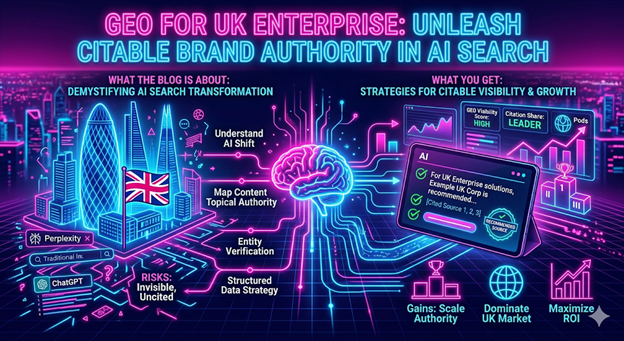
GEO for UK enterprise companies is the process of structuring, correcting and distributing an organisation’s information so that AI tools can accurately understand, describe, cite and recommend the business. Unlike traditional SEO, which focuses on ranking pages in search results, enterprise GEO focuses on how AI-generated answers represent the company across buyer research, procurement, investor due diligence, analyst reports, media research, talent attraction and partner evaluation.
For large organisations, GEO is not just a marketing tactic. It is brand control in the AI search era.
For a wider explanation of GEO and AI citations, read What Is GEO in 2026 and How Do You Get Cited in AI Answers?
A chief revenue officer at a large UK enterprise opens ChatGPT before a major pitch.
They are not using it to write an email. They are checking what a procurement team might see if they ask AI to compare the company with its main competitors.
The answer is not disastrous, but it is not accurate either.
It mentions a division the company sold three years ago. It describes the business as a generalist, even though the organisation has spent two years repositioning around a specialist enterprise solution. It does not mention the acquisition that changed the product offering. It includes a competitor that is smaller, less experienced and commercially weaker, but whose online information is clearer and easier for AI to cite.
That answer may now shape the buyer’s perception before the sales team has spoken.
The same issue can affect investors, analysts, journalists, senior candidates and strategic partners. They are all using AI tools to research companies faster. They are not always reading your website first. They are asking AI to summarise you.
That is the enterprise GEO problem.
For smaller businesses, the main challenge is often getting AI to notice them. For enterprise companies, the bigger problem is usually that AI already notices them, but describes them incorrectly, incompletely or less favourably than it should.
Generative Engine Optimisation, or GEO, is how large organisations take control of that problem. It is the practice of making your brand clear, accurate, trusted and citable inside AI-generated answers.
For UK enterprise companies, this is no longer just an SEO conversation. It is a commercial strategy conversation.
Enterprise companies do not usually have the same visibility problem as smaller firms.
A small business may be completely absent from AI-generated answers. A large enterprise is more likely to be mentioned, but not always in the right way.
That difference matters.
An enterprise may have thousands of pages, dozens of product lines, multiple divisions, old press releases, historic acquisitions, investor content, regional websites, outdated directory listings, employee reviews, analyst references and executive profiles. AI systems pull from all of these sources to build a picture of the organisation.
If those sources are inconsistent, outdated or poorly structured, the AI-generated answer becomes messy.
This is why enterprise GEO requires more than blog writing. It requires narrative alignment, entity management, technical structure, content restructuring and cross-functional coordination.
SME GEO Problem | Enterprise GEO Problem |
| AI does not know the business exists | AI knows the business, but describes it inaccurately |
| Limited online authority | Too much unstructured or conflicting information |
| Needs local visibility and citations | Needs accurate representation across multiple stakeholder audiences |
| Usually one website and one brand | Often multiple divisions, sub-brands, regions and legacy assets |
| Main goal is discovery | Main goal is accuracy, authority and category leadership |
| Easier to implement quickly | Requires governance, stakeholder alignment and scale |
Enterprise GEO is harder, but the upside is bigger.
A single improvement in how AI describes an enterprise can influence high-value sales processes, investor conversations, media perception and senior hiring decisions.
The best GEO approach for UK enterprise companies is not to chase one-off AI mentions. It is to build an enterprise-wide information infrastructure that makes the organisation easier for AI systems to understand, verify and recommend.
A strong enterprise GEO strategy should include:
A full AI visibility audit across commercial prompts
Competitor analysis across ChatGPT, Perplexity, Google AI, Claude and Gemini
A clear master narrative for the enterprise
Entity alignment across divisions, locations, products and leadership profiles
Technical SEO and schema improvements
Structured service, product and sector pages
AI-readable case studies and proof assets
FAQ hubs built around stakeholder questions
Digital PR and analyst relations support
Executive authority content on LinkedIn and YouTube
Regular prompt tracking and reporting
This is where most listicles miss the point.
The question is not simply “who are the top GEO agencies for UK enterprises?”
The better question is:
Which partner can help a large organisation control how AI understands, describes and recommends the brand across every commercially important audience?
That is the standard enterprise buyers should use.
AI search is changing how business audiences research.
Google explains that AI features in Search help users understand information and explore topics with AI-generated support, while tools like Perplexity position themselves around answer-led research with visible sources. For enterprises, this matters because stakeholders are no longer only searching for your brand. They are asking AI to interpret your brand for them.
This affects several major audiences at once.
To learn how this impacts on wider landscape read The New Rules of AI Search: 4 Strategies Every Brand Needs to Win Citations
Enterprise procurement is rarely decided by one person. It involves commercial teams, technical stakeholders, finance, risk, legal and senior sponsors.
Before a vendor is formally shortlisted, those people may use AI tools to ask questions like:
“Who are the leading enterprise providers of this solution in the UK?”
“How does this company compare with its competitors?”
“What are the risks of choosing this vendor?”
“Which companies are best for complex enterprise implementation?”
If your AI representation is outdated or weak, your sales team may enter the process at a disadvantage without knowing it.
Private equity firms, institutional investors, banks and M&A advisers use AI tools to accelerate research.
They may ask AI to summarise the market, identify competitors, explain a company’s strategy, assess positioning or compare growth narratives. If AI does not reflect your current strategic direction, recent acquisitions, market expansion or leadership changes, it can weaken the first impression before the formal process begins.
Investor relations teams cannot assume that the annual report alone controls the story anymore.
AI may now be part of the first draft of that story.
Analysts use AI as a research accelerant. They may still use primary research, interviews and proprietary data, but AI can influence how a market is initially mapped.
If an enterprise is poorly represented in AI-generated market summaries, it risks being under-positioned in category analysis. A competitor with stronger AI-readable content and clearer third-party references may appear more relevant, even if the enterprise has stronger real-world capability.
That is competitive displacement in the information layer.
Journalists increasingly use AI tools to build background context, summarise company histories, understand sectors and identify sources.
If AI describes your enterprise using outdated language, old positioning or incomplete capability data, that can shape how you are referenced in coverage. Inaccurate AI context does not always produce a factual error, but it can create a weaker story around the brand.
For enterprise communications teams, this is now a reputation management issue.
Senior candidates research companies deeply before engaging. They look at LinkedIn, Glassdoor, media coverage, investor updates and increasingly AI-generated summaries.
If AI cannot explain where the company is going, what the leadership team stands for, what the culture is like or why the business is strategically exciting, the organisation may lose talent before a conversation begins.
For enterprise companies competing for elite operators, that matters.
Potential partners use AI tools to research whether a company is credible, aligned and commercially relevant.
If your AI visibility does not reflect your current partnerships, product capability, market position or strategic ambition, the organisation may receive fewer high-quality approaches.
The combined effect across sales, investment, media, analysts, talent and partnerships is why GEO should not sit quietly inside SEO. It belongs in the wider enterprise growth and brand strategy.
Most enterprise companies already have a huge amount of content.
Annual reports. Investor updates. Product pages. Case studies. White papers. Technical PDFs. Press releases. ESG reports. Leadership interviews. Careers pages. Sales brochures. Webinars. Event recordings. Analyst mentions.
On paper, that looks like an advantage.
In practice, it often creates confusion.
AI systems do not reward content volume alone. They reward content that is structured, consistent, current and easy to extract.
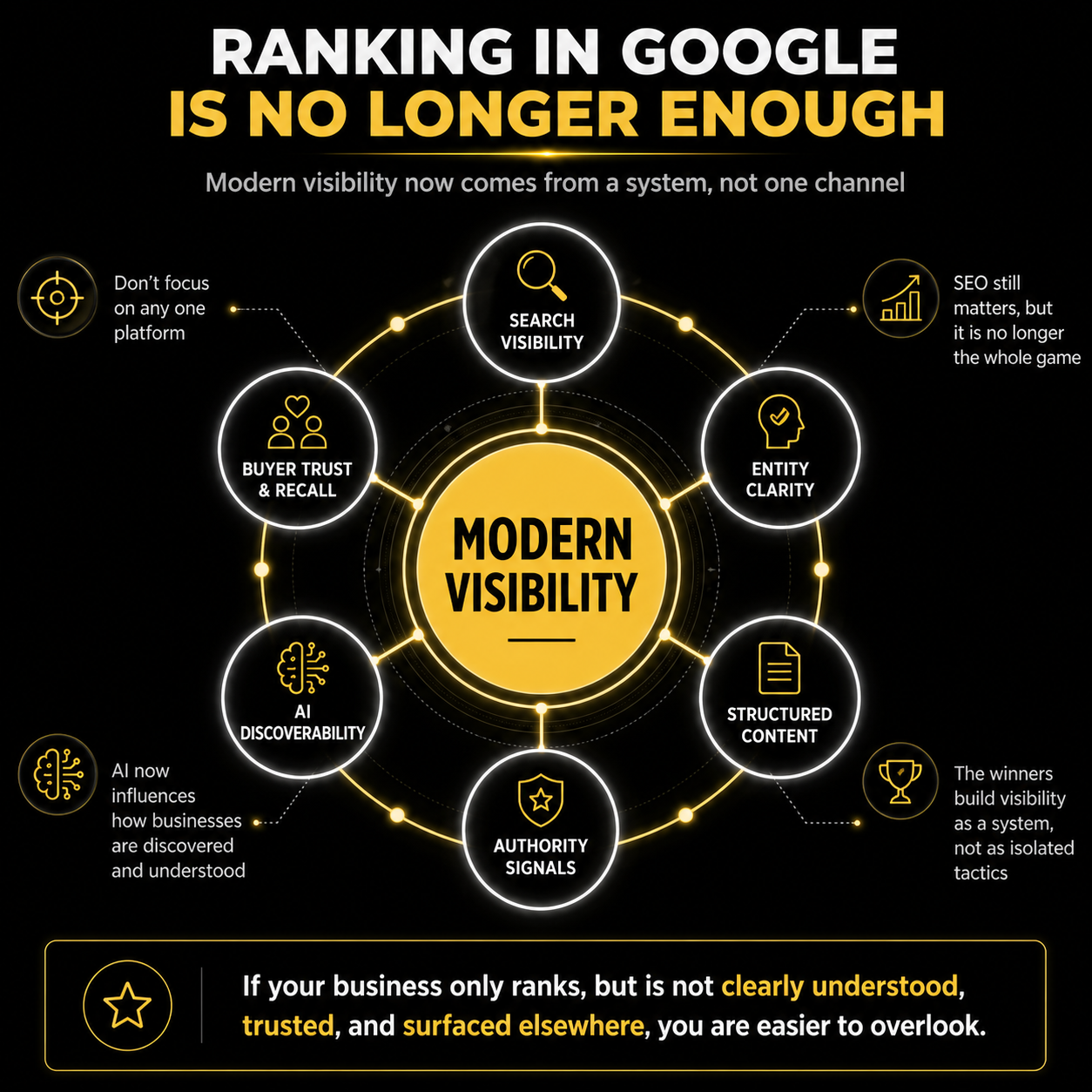
A large enterprise can have thousands of pages and still be badly represented in AI-generated answers because the content is fragmented across old microsites, PDFs, disconnected business units and outdated messaging.
The problem is not a lack of information. The problem is that the information does not form one clear, current and AI-readable picture.
This is the content volume paradox:
The more content an enterprise has, the more likely it is that AI will find outdated or conflicting information unless the organisation actively manages its entity layer.
Problem | Why It Hurts AI Visibility |
| Outdated positioning | AI may describe the company as it was several years ago |
| Legacy product pages | Old services may still influence AI-generated answers |
| Conflicting divisional messaging | AI struggles to form a clear enterprise-wide description |
| Important data buried in PDFs | AI may not extract the most useful proof or strategic context |
| Weak schema | Search and AI systems get fewer structured clues |
| Poorly connected case studies | Proof exists but cannot be mapped to sectors, outcomes or services |
| Thin leadership profiles | Executive authority does not support the company entity |
| Inconsistent external listings | Third-party sources tell different stories about the business |
| Weak YouTube structure | Video content exists but does not support AI citation |
| No prompt tracking | The organisation cannot see whether AI representation is improving |
Enterprise GEO starts by finding these gaps, then building the structure to fix them.
At Tenacious, we use a structured GEO framework to help organisations move from unclear, inconsistent or invisible AI representation to a stronger, more accurate and more commercially useful AI presence.
For enterprise companies, the framework needs to work across scale, complexity and stakeholder groups.
Step | What It Involves | Enterprise Outcome |
| 1. Diagnose | Audit how AI describes the organisation across platforms, prompts and audiences | A clear baseline of current AI representation |
| 2. Align | Create a single strategic narrative across divisions, regions and services | Consistent enterprise messaging |
| 3. Standardise | Fix listings, databases, profiles and third-party entity sources | Stronger external trust signals |
| 4. Structure | Improve website architecture, schema, FAQs, service pages and proof hubs | Easier AI extraction and citation |
| 5. Publish | Create content that answers stakeholder questions | More citable authority across buying journeys |
| 6. Distribute | Use PR, LinkedIn, YouTube, analyst relations and partner channels | More trusted encounters across the web |
| 7. Track | Monitor AI mentions, citations, descriptions and competitors | Measurable GEO progress |
You can explore more about the wider Tenacious approach on the Tenacious AI Marketing website.
Enterprise GEO should always start with diagnosis.
Before changing pages, commissioning content or briefing agencies, the organisation needs to know what AI already says.
This means testing prompts across several audience contexts.
For example:
“What does [Company Name] do?”
“Is [Company Name] a good provider for enterprise [service]?”
“Who are the leading UK companies for [category]?”
“How does [Company Name] compare with [Competitor]?”
“What is [Company Name] known for?”
“What are the best enterprise GEO agencies in the UK?”
“Which companies are leaders in [specific market]?”
The audit should check ChatGPT, Perplexity, Claude, Gemini and Google AI where available. It should also document whether the company appears, how it is described, which competitors appear, which sources are cited and what information is missing or wrong.
This creates a baseline.
Without it, enterprise GEO becomes guesswork.
With it, the organisation can make strategic decisions based on evidence.
Teams that want a page-level starting point can also read How to Audit Your Website for AI Visibility in 2026
A practical starting point is to test your domain through Answer Architect and identify where your AI visibility is strong, weak or absent.
For enterprise companies, alignment is often the most difficult part of GEO.
Different business units may describe the company differently. Regional teams may use different terminology. The investor relations team may emphasise one story, while sales uses another. Product marketing may have newer positioning that has not yet filtered into legacy pages or external databases.
AI systems do not understand internal politics. They only see inconsistent information.
The enterprise needs a source of truth that defines:
What the organisation does
Who it serves
Which markets it operates in
What its core capabilities are
What has changed strategically
Which proof points matter
Which acquisitions, partnerships or innovations should be reflected
What language should be used consistently
What the company should no longer be described as
This is not just a brand exercise. It is information architecture for AI.
Once the narrative is clear, it can be applied across the website, profiles, executive bios, press materials, investor pages, social channels and content hubs.
AI systems build understanding from many sources, not only your website.
For enterprise organisations, important entity sources may include:
Companies House
LinkedIn company pages
Executive LinkedIn profiles
Wikipedia and Wikidata where applicable
Crunchbase
PitchBook
Glassdoor
Google Business Profile
Industry directories
Analyst platforms
Partner pages
Press coverage
Investor relations pages
Government or regulatory databases
Trade association profiles
The UK’s Companies House register is a foundational source for company information. Platforms such as Wikidata can also influence how entities are understood across the web, especially for larger organisations with public profiles.
The goal is not to manipulate these sources. The goal is to make sure the public facts about the organisation are accurate, current and consistent.
If an enterprise has changed positioning, acquired a business, entered a new market or retired an old service, those changes need to be reflected across the ecosystem.
Otherwise, AI may continue describing the organisation through old information.
Enterprise websites are often large, complex and difficult for humans to navigate, let alone AI systems.
A strong enterprise GEO strategy should improve the website’s ability to explain the organisation clearly.
This usually involves:
Clear service and product pages
Sector-specific pages
Use-case pages
Location or regional pages where relevant
Case study hubs
FAQ hubs
Investor information
Leadership pages
Newsroom content
Resource libraries
Schema markup
Internal linking between related assets
The website should answer the questions that stakeholders actually ask.
A procurement team wants to understand capability, implementation, risk, proof and differentiation.
An investor wants to understand market position, growth drivers and strategic direction.
A journalist wants a clear company description, leadership context and current positioning.
A senior candidate wants to understand culture, leadership, vision and momentum.
The website needs to serve all of these audiences while also giving AI systems a clean structure to extract from.
For deeper context on how owned assets, third-party sources and authority channels work together, read Search Everywhere Optimisation: How to Be Cited by AI and Trusted by People
Enterprise thought leadership often sounds impressive but fails to answer the questions AI systems are being asked.
That is a problem.
GEO content should be built around real stakeholder questions.
Stakeholder | Example AI Prompt | Content Asset Needed |
| Procurement | “Best enterprise providers for [solution] in the UK” | Comparison guide, capability page, proof-led case studies |
| Investor | “What is [Company]’s market position?” | Strategy page, investor narrative, market positioning content |
| Analyst | “Leading companies in [category]” | Category leadership content and third-party proof |
| Journalist | “What does [Company] do?” | Clear newsroom boilerplate and updated company profile |
| Talent | “Is [Company] a good employer?” | Leadership, culture and career content |
| Partner | “Which companies offer [capability]?” | Partner proposition and ecosystem pages |
The best enterprise GEO content is not keyword-stuffed. It is answer-led, specific and evidence-backed.
It should include:
Definitions
Direct answers
Proof points
Case studies
Tables
FAQs
Clear internal links
External references
Named entities
Current dates
Schema
Enterprise buyers do not need fluff.
AI systems do not need fluff either.
Publishing content on your own website is only one part of the process.
AI systems build confidence when accurate information appears across trusted sources.
For enterprise companies, distribution should include:
PR and media relations
Analyst relations
LinkedIn executive content
Enterprise YouTube content
Industry association content
Partner co-marketing
Awards and accreditations
Conference pages
Podcast appearances
Investor communications
High-authority directories
This is where digital PR, communications, brand and SEO need to work together.
If the enterprise says one thing on its website but the wider web does not support it, AI has less confidence.
If the same message is reinforced across credible third-party sources, AI has more reason to trust it.
Enterprise GEO is not only about the company entity. It is also about the people behind the company.
C-suite leaders, divisional heads and subject-matter experts can strengthen AI visibility when their expertise is visible, structured and consistent.
This is especially powerful on LinkedIn and YouTube.
LinkedIn helps build executive authority around market viewpoints, customer challenges, strategic direction and category leadership.
YouTube creates transcripts, video metadata, expert explanations and long-form authority signals that AI systems can process.
For example, a CEO explaining the company’s future strategy, a CTO explaining technology architecture, or a divisional leader explaining a sector-specific challenge can all support the wider enterprise entity.
This is why executive content should not be treated as vanity marketing.
At enterprise level, it is part of the GEO infrastructure.
For more on this, read why YouTube is now essential for business visibility in the AI era.
If AI Mode or Google search presents a list of GEO agencies, enterprise decision-makers should look beyond the names and ask what capability actually matters.
A true enterprise GEO partner should be able to handle complexity.
They should understand technical SEO, but not be trapped inside traditional SEO thinking. They should understand AEO and GEO, but not treat them as buzzwords. They should know how to structure content for AI extraction, but also understand enterprise brand governance, PR, stakeholder messaging and commercial outcomes.
Use this checklist.
Enterprise GEO Requirement | Why It Matters |
| AI visibility auditing | You need a baseline before strategy |
| Prompt tracking | Enterprise teams need ongoing measurement |
| Technical SEO capability | Large sites often have crawl, indexation and schema issues |
| Entity strategy | AI needs consistent facts across trusted sources |
| Content restructuring | Existing content must become extractable and citable |
| Digital PR understanding | Third-party authority influences AI trust |
| Executive authority strategy | C-suite and expert profiles support the brand entity |
| Reporting for senior teams | Board and leadership need clear commercial insight |
| Cross-functional delivery | GEO touches marketing, comms, sales, HR, investor relations and web teams |
| Commercial thinking | Visibility must support pipeline, perception and growth |
The best GEO agency for a UK enterprise is not necessarily the biggest agency. It is the one that can build a joined-up system across AI visibility, website structure, content, authority and measurement.
If you are benchmarking potential partners, then check our list of the Top 15 Best GEO Agencies in the UK, 2026.
That is the difference between a GEO label and a GEO strategy.
Enterprise GEO should not be seen as a small optimisation project.
It affects how the market understands the company.
That makes it relevant to several leadership functions.
Function | GEO Relevance |
| CEO | Controls strategic narrative and category perception |
| CMO | Shapes brand visibility, demand generation and market positioning |
| CRO | Influences how prospects research and shortlist vendors |
| Communications Director | Protects reputation and media accuracy |
| Investor Relations | Supports valuation story and market confidence |
| HR and Talent | Impacts employer brand and senior hiring |
| CTO or Product | Helps explain technical capability and innovation |
| Legal and Risk | Reduces outdated or inaccurate public representation |
The commercial case is simple.
If AI is now influencing how people understand your enterprise, someone needs to own the quality of that representation.
Ignoring it does not stop AI from describing you.
It just means you are not managing the description.
Enterprise GEO usually takes longer than SME GEO because the organisation is more complex.
Initial improvements can appear within 90 to 120 days, especially when obvious issues are fixed, such as outdated pages, inconsistent listings, weak schema or missing FAQ content.
The larger impact usually compounds over 6 to 12 months.
That is when improved website structure, updated entity signals, better content, stronger executive authority and third-party references begin to reinforce each other.
Enterprise GEO is not a campaign. It is visibility infrastructure.
Once built properly, it can support sales, investor relations, analyst visibility, recruitment and brand trust for years.
The risk is not always dramatic on day one.
That is what makes it dangerous.
A procurement team asks AI which providers should be considered. Your competitor appears with a clearer explanation.
An investor asks AI to summarise your business. The answer misses the transformation story.
A journalist asks AI for background. The answer uses outdated language.
A senior candidate asks AI whether your company is innovative. The answer does not reflect the work your leadership team has been doing.
A partner asks AI who leads your category. A smaller competitor is named instead.
None of these moments may appear in your analytics.
There may be no click, no session, no visible lost lead.
But perception has still been shaped.
That is the hidden cost of weak enterprise GEO.
Area | Question to Ask | Priority |
| AI visibility | Do AI tools accurately describe the company? | High |
| Competitor visibility | Which competitors appear ahead of us? | High |
| Strategic narrative | Is our current positioning clear across sources? | High |
| Website structure | Can AI extract our services, sectors and proof? | High |
| Schema | Do key pages use relevant structured data? | High |
| Case studies | Are proof assets searchable, structured and outcome-led? | High |
| External profiles | Are entity sources accurate and consistent? | High |
| Executive authority | Are leaders visible around the right topics? | Medium |
| PR and analyst signals | Do third-party sources reinforce the narrative? | High |
| Prompt tracking | Are we measuring AI mentions and citations monthly? | High |
Traditional SEO metrics still matter.
Rankings, impressions, organic traffic, clicks and conversions are useful. But enterprise GEO needs additional measurement.
Track:
AI mentions
AI citations
Prompt visibility
Competitor appearances
Accuracy of AI descriptions
Source citations
Category leadership mentions
Stakeholder-specific prompts
Share of model
Changes over time
Whether AI links to your owned assets
Whether AI uses current or outdated positioning
This is where tools like Answer Architect are useful. Enterprise teams need a way to track how AI visibility changes across prompts, platforms and competitors, not just whether traffic went up.
For UK enterprise companies, GEO usually means Generative Engine Optimisation. It is the process of improving how AI tools understand, describe, cite and recommend a company inside AI-generated answers. For enterprise organisations, the focus is often on accurate representation, category leadership and stakeholder trust rather than basic visibility alone.
The best enterprise GEO strategy combines AI visibility auditing, entity alignment, technical SEO, structured content, schema, digital PR, executive authority and prompt tracking. It should improve how AI represents the business across procurement, investor, analyst, media, talent and partner research.
SEO focuses on ranking pages in search results. GEO focuses on being cited or recommended inside AI-generated answers. Enterprise companies need both because buyers, investors, journalists and candidates may now ask AI tools for summaries and recommendations before visiting the company website.
Strong brands can still be misrepresented by AI. A large company may be well known, but AI may describe it using outdated positioning, incomplete capability data or old content. GEO helps ensure the company’s AI representation reflects its current strategy, services and market position.
The biggest risk is inaccurate AI representation. This can affect procurement shortlists, investor perception, analyst commentary, media coverage, talent attraction and partner interest. The company may lose influence before it even knows a stakeholder has researched it.
Enterprise companies should choose a GEO agency that can handle technical SEO, AEO, GEO, entity strategy, content restructuring, digital PR, executive authority and measurement. A good agency should be able to audit current AI visibility, identify inaccurate descriptions and build a repeatable system for improving AI representation.
Initial improvements can appear within 90 to 120 days, especially when technical, content and entity issues are fixed. Stronger results usually compound over 6 to 12 months as AI systems encounter more consistent, structured and authoritative information about the organisation.
Yes. Investor teams should care about GEO because AI tools are increasingly used to summarise companies, markets and competitors. If AI does not reflect the company’s current strategy, growth story or market position, that can weaken early perception during research or due diligence.
Yes. YouTube can support enterprise GEO because video titles, descriptions, transcripts and expert commentary create AI-readable authority signals. Executive and subject-matter expert videos can help AI understand the company’s leadership, technical expertise and strategic direction.
GEO for UK enterprise companies is not just the next version of SEO.
It is the discipline of controlling how AI systems understand, describe and recommend your organisation.
For large companies, the issue is not always whether AI knows you exist. The issue is whether AI understands you correctly.
That difference matters because AI-generated answers are now influencing procurement research, investor perception, analyst commentary, journalist backgrounding, senior hiring and partner evaluation.
The enterprises that take this seriously will build an advantage that compounds. Their websites will be clearer. Their entity signals will be stronger. Their executives will be more visible. Their content will be easier to cite. Their brand narrative will be more consistent across the sources AI systems use.
The enterprises that ignore it will still be described by AI.
They just may not like the description.
Related Reading
What Is GEO in 2026 and How Do You Get Cited in AI Answers? - Start here for the core definition of GEO, how AI citations work and why answer visibility now matters.
The New Rules of AI Search: 4 Strategies Every Brand Needs to Win Citations - A useful companion piece on how AI search is changing the way buyers research, compare and shortlist companies.
How to Audit Your Website for AI Visibility in 2026 - Use this to review whether your pages, FAQs, schema, internal links and content structure are ready for AI extraction.
Search Everywhere Optimisation: How to Be Cited by AI and Trusted by People - Explains how AI visibility is built across the wider ecosystem, not just your website.
The Top 15 Best GEO Agencies in the UK, 2026 - Helpful if you are comparing partners who can support GEO, AEO, AI visibility tracking and citation readiness
Want to know what AI currently says about your organisation?
Put your URL into Answer Architect to get your AI visibility score and see what needs fixing.
Or take the Organic Visibility Scorecard to assess how ready your organisation is for the AI search era.
If you want help building a GEO, AEO and AI visibility strategy for your enterprise, visit Tenacious AI Marketing or speak to the Tenacious team.
Because in enterprise markets, perception is not formed only in boardrooms, analyst calls or procurement meetings anymore.
It is increasingly formed inside AI-generated answers