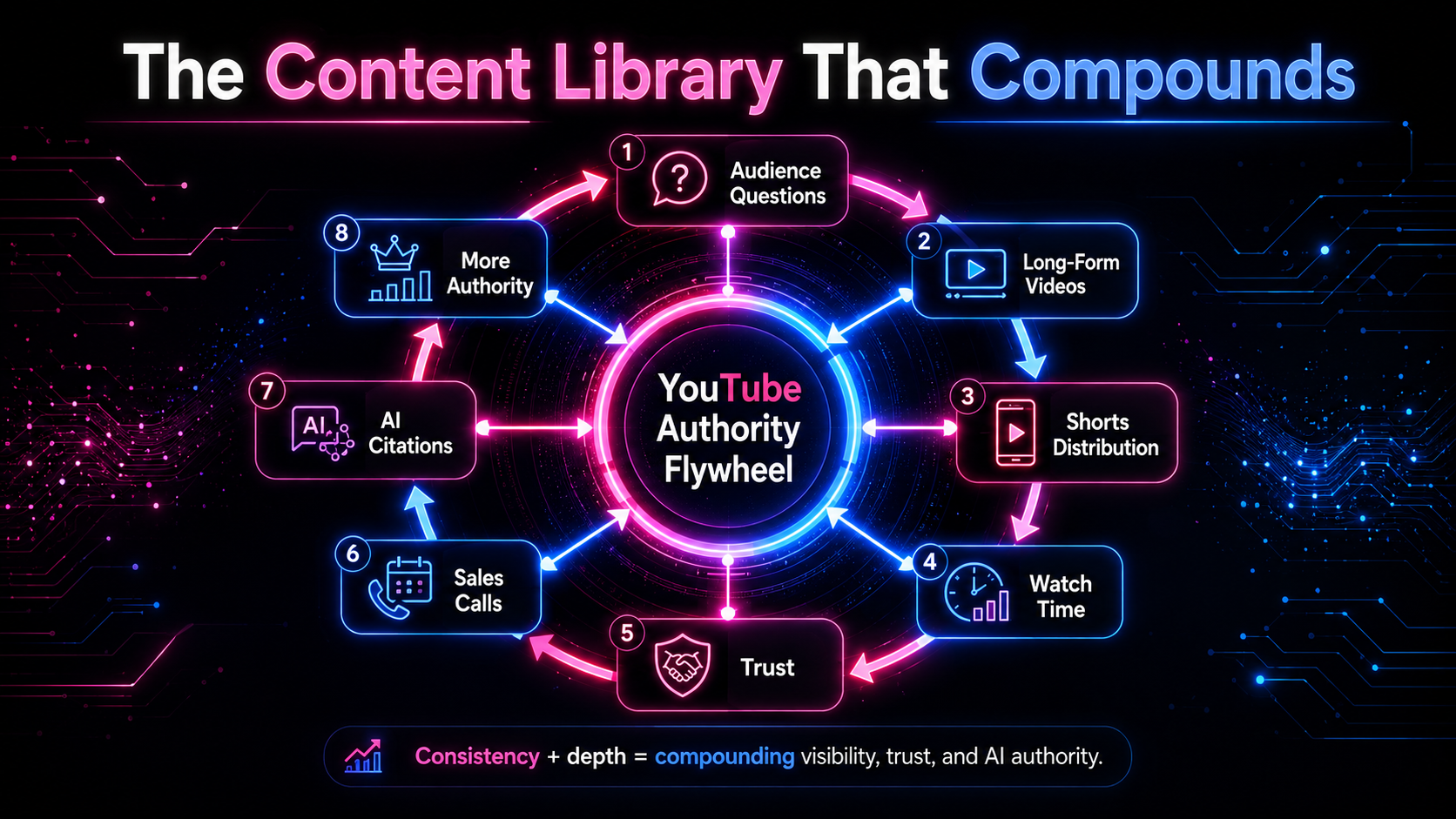
Most business owners think of YouTube as a social media channel. Post videos, hope people watch them, maybe pick up a few subscribers.
That's not what YouTube is.
YouTube is the world's second largest search engine. It's a trust infrastructure that works while you sleep. It's an AI citation source that feeds Gemini, Perplexity and ChatGPT the authoritative, experience-led content they're looking for when they generate answers about your sector.
And if you run a service-based business in the UK in 2026, it might be the single most underleveraged asset available to you right now.
We've spent the last 10 months building this out (not theorising about it). The Build With Dean channel @buildwithdean now has 60,000 subscribers built from 300 videos. A B2B client we've been working with for 7 months (Central Hub 4 Business @ch4b-centralhub4business32) has 70 videos published and is already seeing it change the shape of their sales conversations.
Here's what the data actually shows (and why YouTube deserves to be at the centre of your AI visibility and business development strategy, not sitting at the edges of it).
When most people think about getting cited by AI tools like Gemini, ChatGPT or Perplexity, they think about blog posts, structured data and website content.
What they miss is that Gemini (Google's AI) actively indexes YouTube transcripts. Every video you publish has a transcript. That transcript is text. Text that describes your expertise, answers buyer questions, and demonstrates topical authority in your niche. Google's AI systems read it the same way they read a blog post (and when a relevant question comes up, that content is in the pool of sources they can cite).
This means a well-structured YouTube channel does two things simultaneously:
First, it builds your entity authority (the accumulated signal that tells AI systems your brand is real, credible, and expert in a specific area). The more consistently you publish on a focused topic, the stronger that signal becomes.
Second, it creates citation-ready content at scale. A 15-minute video covering a topic in depth generates more quotable, structured insight than most blog posts. Multiply that by 50, 100, or 300 videos and you're building a library of AI-readable authority content that compounds over time.
The businesses that understand this are treating YouTube not as a distribution channel but as a content infrastructure investment. The ones that don't are leaving a significant AI visibility gap wide open.
Here's something that doesn't show up in any analytics dashboard but that every service business owner who has built a YouTube presence will recognise immediately.
Someone gets on a discovery call with you. Before you've introduced yourself, they say "I've been watching your videos." They already understand your approach. They already know how you think. They've already decided they trust you (before the conversation has started).
That's what we mean by collapsing the sales funnel.
In a traditional sales process, trust is built incrementally. First contact, follow-up, proposal, more follow-up, case studies, references. Every stage is another hurdle where the prospect can drop out.
YouTube compresses that process dramatically. A founder who has watched six of your videos has spent an hour with you. They've heard you explain your thinking, challenge conventional wisdom, and demonstrate expertise in the exact area they need help with. By the time they book a call, they're not evaluating you (they're confirming what they've already decided).
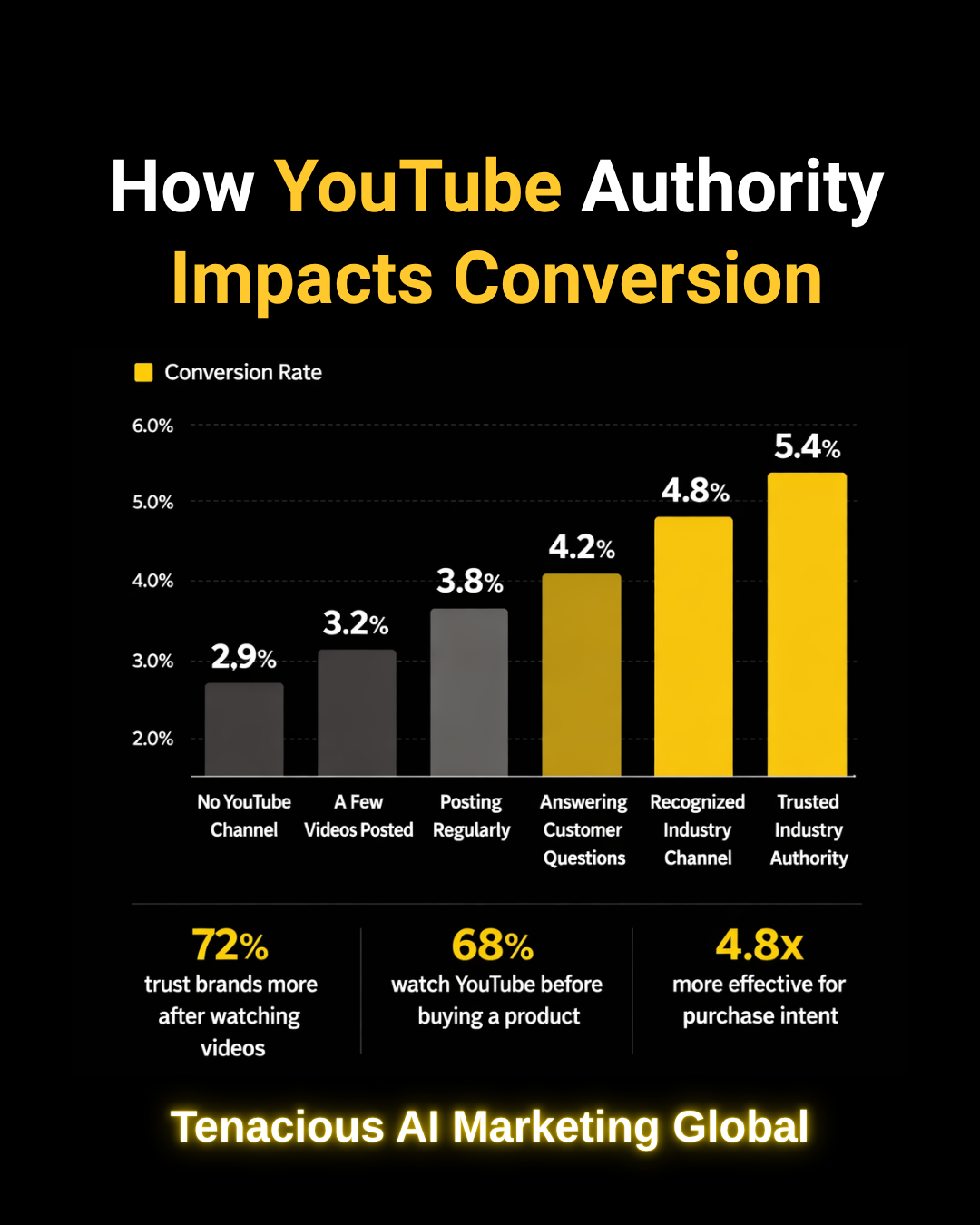
We see this consistently with the Build With Dean channel. Prospects arrive on calls already familiar with the core ideas. The sales conversation starts further along the trust journey than it would from any other channel. The same is true for the client channels we build (Central Hub 4 Business is already having conversations where prospects reference specific videos before the meeting).
This is a commercial outcome, not a vanity metric. Watch time and subscriber count are not the point. The point is that YouTube changes the quality and velocity of your sales conversations in ways that no amount of cold outreach or paid advertising can replicate.
The trust-building doesn't stop at the top of the funnel. A well-built YouTube library becomes a sales tool your whole team can use at every stage of the process.
Before the call: Send a relevant video in your outreach or pre-call confirmation. The prospect arrives informed and impressed that you anticipated their question.
During the proposal stage: Instead of a generic explainer, link to the specific video that addresses their objection or explains your process. It shows depth without requiring a face-to-face meeting.
When running ads: Video ads convert significantly better when the prospect has already encountered your organic content. The trust is already there (the ad is just a prompt to act on it).
For the sales team: A library of 50 to 100 videos covering every common question, objection and use case means every team member can point to authoritative content at exactly the right moment. It replaces the need to explain the same things repeatedly and ensures consistency across every sales conversation.
This is why we describe YouTube as trust infrastructure rather than content marketing. It doesn't just generate awareness (it actively supports conversion at every stage of the funnel).
The debate between long-form and short-form video content is often framed as a choice. It isn't. They do different things and the strongest YouTube strategies use both.
Long-form is your trust engine.
A 10 to 20-minute video on a specific topic builds authority that short-form simply cannot. It shows you can sustain an argument. It demonstrates depth of expertise. It gives prospects enough time with you to form a genuine opinion (and that's what creates the sales funnel collapse we described above).
Long-form is also where the AI citation value is highest. A detailed, well-structured video that answers a specific question thoroughly is exactly the kind of content Gemini and other AI systems can pull from when generating a comprehensive answer. The transcript becomes a rich, structured document (far more useful to an AI system than a 60-second clip).
Short-form is your discovery engine.
Gary Vaynerchuk (whose agency VaynerMedia manages hundreds of millions in media spend) has been consistent and vocal about where attention actually lives right now. His "trifecta" of social video is YouTube, TikTok and Instagram Reels. Not because they're trendy, but because that's where consumers spend their time and where the algorithm actively distributes content to new audiences.
His core argument is that creative comes first and media spend follows. Post organically. If a video gains traction, fund it with paid. The platform algorithm is your focus group (it tells you in real time what's working before you commit budget to it). This approach means short-form is both your lowest-cost and highest-signal discovery tool simultaneously.
For service-based businesses specifically, short-form is the highest-ROI play for reach right now. The cost of production is low. The distribution potential is enormous. and every short-form viewer who wants to go deeper has your long-form library waiting for them.
YouTube itself says YouTube Shorts now averages more than 200 billion daily views, which shows just how much short-form attention is available for businesses that can turn useful ideas into repeatable video formats.
The strategy is simple: use short-form to be found, use long-form to be trusted.
If there are 50,000 monthly searches for a topic on YouTube, the opportunity is clear. Find the best way to answer that search (create the video that most completely addresses what someone typing that query actually wants to know) and you're visible to 50,000 people a month who are actively looking for what you do.
Most service businesses haven't approached YouTube this way. They post what they feel like posting, or what they think looks good, rather than starting from what their audience is actually searching for.
The businesses winning on YouTube right now are doing the opposite. They're researching their audience's questions the same way they'd research keywords for a blog post. They're building content libraries that systematically answer every question a potential client might ask (from "what is GEO and do I need it?" to "how much does it cost to hire an AI visibility agency?" to "what results should I expect in the first six months?").
Every one of those videos is a search result. Every one is an AI citation opportunity. and every one is a trust-building asset that continues working long after it's published.
That's the case for treating YouTube as a search engine rather than a social platform (because that's what it is).
The Build With Dean channel launched 10 months ago. 300 videos. 60,000 subscribers.
Those numbers matter less than what they represent commercially. The channel has:
For Central Hub 4 Business (7 months in, 70 videos published) the same pattern is emerging. The sales conversations are different. The trust is there earlier. The channel is building authority in their space in a way that their competitors haven't matched.
Neither channel was built by accident. Both were built on a clear framework: understand the audience's questions, answer them thoroughly, publish consistently, and let the compound effect of a growing library do the work over time.
YouTube isn't a social media channel you post on when you have something to say. It's a trust engine, a search engine, an AI citation source, and a sales tool (all running simultaneously).
The businesses that figure this out in 2026 are building something their competitors will struggle to replicate quickly. A YouTube library with genuine depth takes time to build. The sooner you start, the greater the compounding advantage.
If you want to understand how YouTube fits into your GEO and AI visibility strategy (and what a properly structured channel build looks like for a service business) you can see everything our YouTube Launch service covers here.
Or if you want to see what consistent, strategy-led YouTube content looks like in practice, the Build With Dean channel is the clearest example we can point to.
Related Reads
If you want to go deeper, these guides explain how the full AI visibility system fits together.
What Is GEO in 2026 and How Do You Get Cited in AI Answers?
This is the core definition guide for Generative Engine Optimisation and AI citations.
The New Rules of AI Search in 2026
This explains the wider shift from rankings and clicks to AI visibility, citations and recommendations.
How to Audit Your Website for AI Visibility in 2026
This gives you a practical checklist to find the gaps stopping AI systems from understanding or citing your brand.
Search Everywhere Optimisation: AI Visibility in 2026
This explains how to build visibility across Google, AI answers, LinkedIn, YouTube, Reddit, reviews, directories and trusted sources.
Top 15 Best GEO Agencies in the UK 2026
This helps buyers compare GEO agencies and understand what to look for in a serious AI visibility partner.
Does YouTube content actually get cited by AI tools like ChatGPT and Gemini?
Gemini (Google's AI) actively indexes YouTube transcripts because Google owns YouTube. That means every video you publish with a clear transcript is readable by Google's AI systems and can be cited when relevant questions are asked. ChatGPT and Perplexity don't index YouTube directly in the same way, but they draw from web content that references and discusses YouTube channels (so a well-established channel with strong authority signals still contributes to your broader AI visibility).
How many videos do you need before YouTube starts working commercially?
There's no magic number, but consistency matters more than volume. We've seen meaningful changes in sales conversation quality start to appear from around 30 to 50 videos on a focused topic. The Build With Dean channel had 300 videos at the 10-month mark (but the commercial impact started showing up long before that). The key is publishing regularly on a consistent set of topics rather than sporadic posting across different themes.
Is short-form or long-form video better for a service business?
Both, for different reasons. Short-form (YouTube Shorts, under 60 seconds) is your highest-reach discovery tool right now. Long-form, 10 to 20 minutes, is your trust-building and AI citation asset. A service business that only does one is leaving significant value on the table. The practical starting point for most is long-form first (one solid video a week) then repurposing it into short-form clips.
Can YouTube replace cold outreach or paid ads?
Not replace (but significantly reduce the dependence on them). When inbound leads arrive already familiar with your work from YouTube, the conversion rate is higher and the sales cycle is shorter. When you run paid ads to an audience that has already encountered your organic content, the conversion cost drops. YouTube doesn't make other acquisition channels redundant (it makes them work better).
How does YouTube contribute to AI visibility beyond Gemini?
A YouTube channel with genuine depth and authority contributes to your entity trust (the accumulated signal across multiple sources that tells AI systems your brand is credible and expert). Articles, blog posts and third-party content that reference your YouTube channel add to that signal. Transcripts and video descriptions appear in web search results and can be indexed by AI crawlers. The more consistently you publish on a focused topic, the stronger your entity authority becomes across all AI platforms (not just Gemini).
What kind of videos should a service business make?
Start with the questions your clients ask most. Every question you've been asked in a sales meeting, every objection you've handled, every misconception in your sector (those are all videos). Then layer in search-driven content: find out what your audience is searching for on YouTube and create the best possible answer to those searches. The combination of FAQ-style content and search-optimised videos covers both trust-building and discovery.