For the past two years, businesses have been obsessing over AI tools.
Which chatbot should we use? Which platform is best? How do we automate tasks? How do we create content faster?
But underneath all of this noise, something far bigger is happening.
AI itself is rapidly becoming commoditised.
McKinsey’s 2025 Global Survey found that 88% of organisations now use AI regularly in at least one business function, yet only 39% report any enterprise-level EBIT impact from AI. In other words, using AI is no longer rare. The advantage comes from how deeply the business is redesigned around it
The real competitive advantage is no longer access to AI. It is whether your business is structured in a way that AI systems can understand, trust, recommend and eventually transact with.
That changes everything.
Right now, most companies are simply layering AI on top of old infrastructure.
They are adding ChatGPT to their workflows. Installing copilots. Automating admin tasks. Creating AI-generated content. Experimenting with agents.
But they are not redesigning the business itself for an AI-first internet.
That is the mistake.
Because the businesses that dominate over the next decade will not simply "use AI." They will become AI-readable businesses. Their knowledge, systems, authority, workflows and infrastructure will be structured in ways that AI can access, evaluate and trust.
That is the real shift. And most businesses are nowhere near making it.
Historically, customers searched manually. They compared websites, read reviews, worked through search results, visited multiple pages and made decisions themselves.
Now AI increasingly sits in the middle of that journey.
Users ask ChatGPT. They use Google AI Mode. They use Perplexity. They ask AI for recommendations, comparisons, and guidance.
This is not theoretical. Adobe Analytics found that traffic to U.S. retail websites from generative AI sources increased by 1,200% in February 2025 compared with July 2024. Adobe’s consumer survey also found that 39% of U.S. consumers had already used generative AI for online shopping, with 53% planning to do so that year.
And soon, AI agents will not just recommend businesses. They will shortlist suppliers, compare options, and complete transactions on behalf of users.
That means the question is no longer: "How do we rank on Google?"
The question becomes: "Is our business structured in a way that AI systems choose us?"
That is a completely different game. And most businesses are still playing the old one.
Traditional SEO was largely about webpages and rankings. The next era is about entity understanding, trust signals, authority, and interoperability.
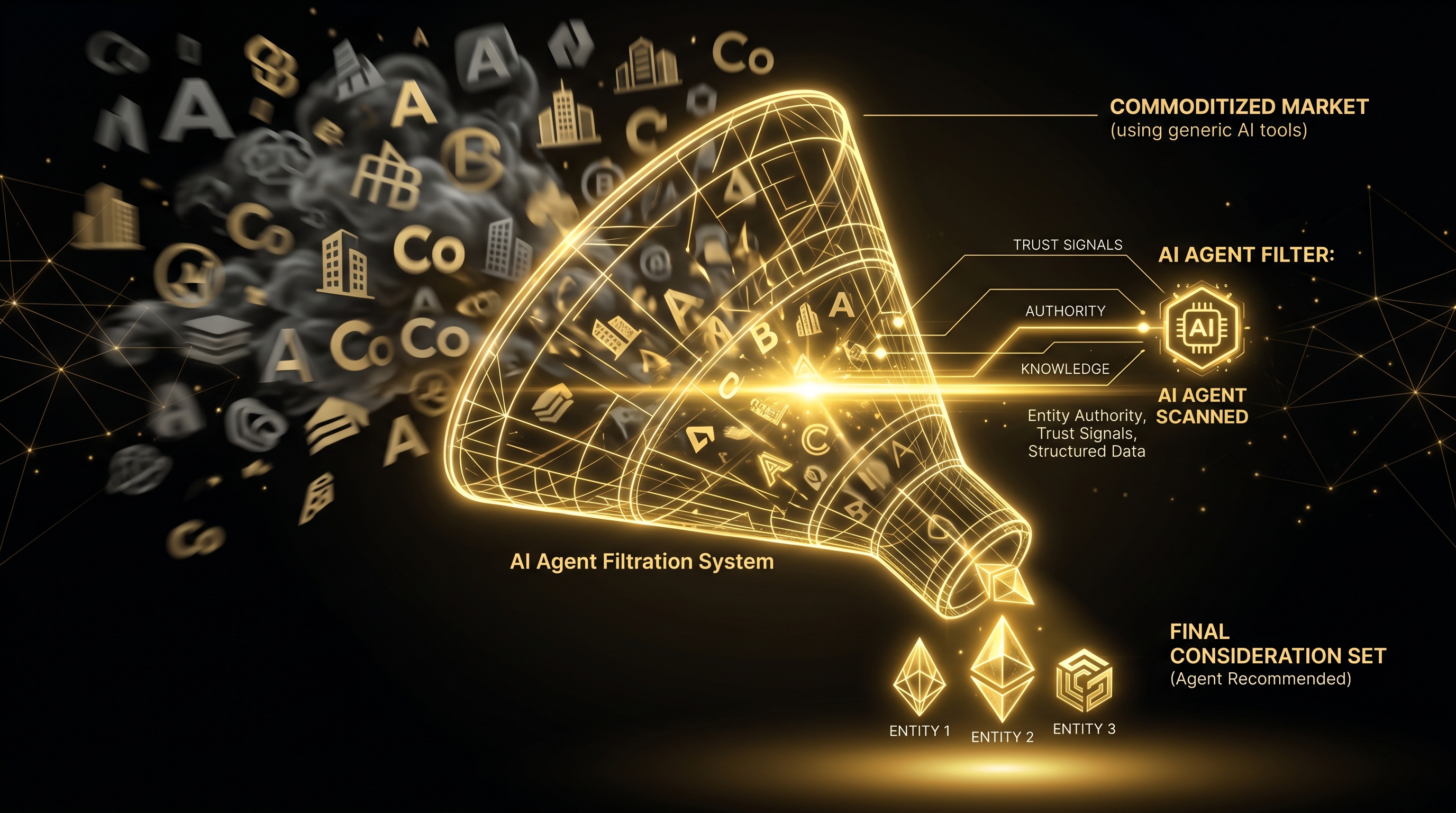
AI systems do not simply rank pages. They evaluate confidence. They look for consistent authority signals, structured information, trusted mentions, reviews, clear expertise, interconnected knowledge, multi-platform consistency, strong founder presence, and genuine brand understanding.
This is why many businesses ranking on page one today are almost invisible inside AI systems. Their websites were built for search engine crawlers, not for AI interpretation.
The future belongs to businesses that understand both. And the businesses investing in that understanding now will be significantly harder to displace in two or three years.
One of the most important ideas emerging right now is this: AI tools are not the moat. Your proprietary knowledge is.
Every company has unique operational intelligence. Customer conversations. Internal processes. Sales patterns. Market understanding. Delivery workflows. Case studies. Institutional expertise. Years of hard-won experience that exists nowhere else.
The businesses that structure, protect and operationalise that knowledge will create massive competitive advantages. The ones that leave knowledge trapped across disconnected systems and siloed teams will struggle to compete as AI systems become the primary discovery layer.
When AI agents are evaluating which supplier to recommend, they will not be able to distinguish between two businesses that both use the same generic AI tools. They will be able to distinguish between a business with rich, structured, accessible knowledge and one without it.
This is why enterprise architecture suddenly matters to marketing, visibility and growth. Everything is becoming connected.
The next major shift is agentic infrastructure.
AI agents will increasingly research suppliers, compare pricing, read documentation, evaluate credibility, check reviews, access APIs, interact with MCPs, trigger workflows and complete purchases. They will do all of this without a human directing every step.
That means businesses must evolve beyond static websites. They need infrastructure AI systems can interact with directly.
This is where structured data, APIs, MCPs and AI-readable systems become critical.
But here is an important point that often gets missed. Agent-readiness and visibility are not separate concerns. They are sequential.
Before an AI agent interacts with your systems, your business still needs to be selected. The recommendation layer comes first. Visibility determines whether you are in the consideration set at all. Only then does agent-readiness determine whether the interaction can actually happen.
You cannot skip to infrastructure without winning the recommendation game first.
Many people assume that if AI agents become the dominant discovery mechanism, traditional visibility work becomes less important.
The opposite is true.
Visibility becomes more important because fewer businesses will be selected.
AI systems compress choice. A human buyer might research 20 companies. An AI agent may shortlist 3. That creates an enormous concentration effect. The winners receive disproportionate consideration. The businesses that are not selected may become almost invisible.
This is why Generative Engine Optimisation matters so much right now. Not because rankings disappear. But because recommendation systems have become the new gateway to demand.
The future is not: "Who ranks first?" It is: "Who gets recommended first?"
And the answer to that question will be determined by which businesses are structured in a way that AI systems understand, trust, and cite with confidence.
No. And the opportunity here is significant.
Most businesses are still thinking in traditional SEO terms. Still treating AI as a productivity tool rather than a structural transformation. Still creating generic AI content, ignoring entity authority, ignoring AI visibility, and ignoring what it would take to be agent-compatible.
Very few are redesigning their business around how AI systems discover, interpret, and transact.
That creates a first-mover window. In the same way that businesses that understood SEO early built enormous, durable advantages, businesses that understand AI visibility and AI infrastructure early will dominate the next era.
The window will not stay open indefinitely. As more businesses wake up to this shift, the effort required to stand out will increase. The time to move is before that happens.
The businesses that win over the next decade will not simply have better websites, better ads, or better content.
They will have businesses designed for AI discovery, AI understanding, AI trust, AI recommendations, AI interoperability, and eventually AI transactions.
The future internet will increasingly operate through recommendation engines, agents, and intelligent systems. The brands that win will be the ones AI understands best.
Because in the age of AI, visibility is no longer just marketing.
Visibility becomes inclusion inside the systems that are making decisions.
If you want to understand where your business currently stands in terms of AI visibility and what it would take to build real AI authority, Tenacious Marketing's GEO and AEO services are built exactly for this. We help B2B businesses move from invisible to recommended.
Related Reading
Beyond the Search Bar: Why AEO Testing Is Now a Business Visibility Metric
Why YouTube Is Now Essential for Business Visibility in the AI Era
What Is GEO in 2026, and How Do You Get Cited in AI Answers?
The New Rules of AI Search in 2026
Search Everywhere Optimisation: AI Visibility in 2026
How to Audit Your Website for AI Visibility in 2026
An AI-readable business has its knowledge, authority, and infrastructure structured in ways that AI systems can access, interpret, and trust. This includes consistent entity information across platforms, well-structured content, strong authority signals, clear expertise positioning, and (at the more advanced end) APIs and data systems that AI agents can interact with directly.
Traditional SEO focuses on ranking webpages in search engine results. AI visibility is broader: it is about whether AI systems understand who you are, what you do, why you are credible, and whether you should be recommended or cited in response to a buyer query. AI systems look at entity consistency, authority signals, structured information, and cross-platform trust, not just page rankings.
MCPs (Model Context Protocols) are standardised ways for AI systems to interact with external data sources and tools. As AI agents become more capable, they will use MCPs to access business information, check availability, compare pricing and trigger workflows directly. Businesses that build MCP-compatible infrastructure will be accessible to agents in a way that businesses with static websites are not.
This is already beginning in limited contexts and is expected to expand significantly over the next two to four years. The pace varies by industry and transaction type, but the trajectory is clear. Businesses that wait to see how it develops before preparing will find they are behind by the time it matters.
The starting point is usually a GEO and AI visibility audit: understanding how your business currently appears (or does not appear) across AI platforms, identifying gaps in your entity authority, and building a structured content strategy that addresses real buyer questions in a format AI systems can cite with confidence. From there, the work expands into authority building, structured data, and eventually infrastructure readiness.
Entity authority refers to how clearly and consistently an AI system can understand who your business is, what it does, and why it should be trusted. It is built through consistent information across your website, social profiles, PR mentions, directory listings, and structured data. Businesses with strong entity authority are significantly more likely to be cited and recommended by AI systems than those with inconsistent or thin entity signals.