
When we asked ChatGPT, Claude and Perplexity which UK construction suppliers and manufacturers they recommend, only one company appeared across all three AI models:
Travis Perkins.
That makes Travis Perkins the only construction supplier in this dataset with full cross-platform AI visibility.
The wider results were far more fragmented.
Across all questions and models, 115 unique companies were mentioned, making construction suppliers and manufacturers one of the broadest and most fragmented sectors in the Tenacious AI Visibility Index.
For suppliers, manufacturers and distributors, that creates a clear opportunity.
The market is not yet dominated by a long list of AI-visible brands.
In most categories, the leaderboard is still being formed.
Construction procurement has traditionally relied on relationships, frameworks, trade suppliers, specification networks and contractor experience.
That still matters.
But buyers, architects, contractors and specifiers are increasingly able to ask AI systems questions such as:
The answers AI systems return can shape which brands are discovered early.
That does not mean AI replaces procurement.
It does mean AI can influence the first layer of supplier research.
And in this dataset, that first layer is highly fragmented.
Only Travis Perkins achieved full three-model visibility.
Every other supplier, distributor or manufacturer appeared across two models or fewer.
For construction brands, this is a signal worth paying attention to.
For this edition of the Tenacious AI Visibility Index, we asked ChatGPT, Claude and Perplexity ten UK-focused questions designed to reflect how architects, contractors, developers and procurement teams research construction suppliers.
The questions covered:
The objective was not to identify the best construction suppliers.
The objective was to identify which companies AI systems recommend when answering buyer and specifier questions.
As with previous sectors, each AI model behaved differently.
ChatGPT returned a single sector-level ranking rather than answering every question individually.
Claude answered all 10 questions with named company recommendations.
Perplexity answered all 10 questions but only returned named company citations on 2 of the 10 questions.
The remaining 8 responses contained no named company recommendations.
For readers who want to understand how this type of visibility is measured, our AI visibility metrics guide explains the core metrics increasingly shaping discoverability across AI-generated recommendations.
| Rank | Company | ChatGPT Rank | Claude Mentions | Perplexity Citations | Models Agree |
| 1 | Travis Perkins | #4 | 1 | 1 | 3/3 |
| 2 | Kingspan | #1 | 1 | — | 2/3 |
| 3 | Wolseley UK | #5 | 1 | — | 2/3 |
| 4 | Forbo Flooring Systems | — | 1 | 1 | 2/3 |
| 5 | Jewson | — | 1 | 1 | 2/3 |
| 6 | MKM Building Supplies | — | 1 | 1 | 2/3 |
| 7 | Tarkett | — | 1 | 1 | 2/3 |
| 8 | SIG plc | #2 | — | — | 1/3 |
| 9 | Tarmac Group | #3 | — | — | 1/3 |
| 10 | Hanson UK | #6 | — | — | 1/3 |
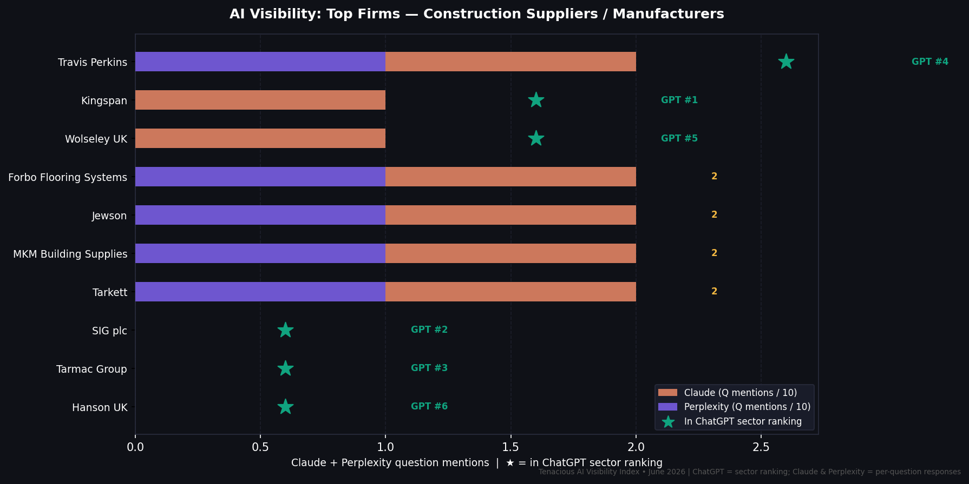
The headline is simple.
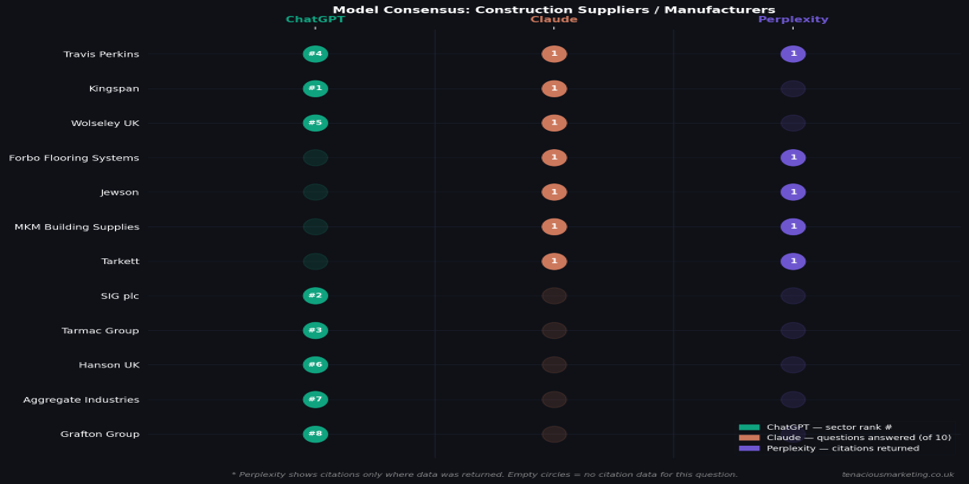
Only Travis Perkins appeared across all three AI models.
The company ranked fourth in ChatGPT’s sector shortlist, appeared once in Claude and was also cited once by Perplexity.
That makes Travis Perkins the clearest cross-platform construction supplier in this dataset.
Beyond that, the picture becomes much less consistent.
Kingspan ranked first in ChatGPT’s list and appeared once in Claude, but did not appear in Perplexity’s cited results.
Wolseley UK showed a similar pattern.
Forbo Flooring Systems, Jewson, MKM Building Supplies and Tarkett did not appear in ChatGPT’s sector ranking, but they did appear across Claude and Perplexity.
This suggests different AI platforms are interpreting the market through different category lenses.
ChatGPT appears to favour major building material groups and distributor brands.
Claude and Perplexity surface more product-category-specific brands, particularly around flooring and building materials.
That creates a very different experience for buyers depending on which AI tool they use.
Construction produced one of the longest tails in the index.
A total of 115 unique companies appeared across the dataset.
That reflects the structure of the industry.
Construction supply is not one market.
It includes:
Because the category is so broad, AI systems appear to surface different companies depending on how the question is framed.
For example, a flooring-related question surfaced companies such as Tarkett, Forbo Flooring Systems, Interface, Burmatex and Polyflor.
A building materials question surfaced Travis Perkins, Jewson, MKM Building Supplies, Forterra and Marshalls.
A façade question surfaced Kingspan Facades, Permasteelisa UK, Schüco UK and Reynaers Aluminium UK.
This fragmentation is important.
It means construction suppliers may not need to dominate the entire sector to become visible.
They need to dominate the specific product category, specification query or buyer problem that matters most to their business.
This is where B2B content strategy becomes critical.
For suppliers and manufacturers, visibility often depends on whether AI systems can connect a brand to specific use cases, technical requirements and buyer questions.
Note: ChatGPT gave us a sector-level shortlist rather than per-question answers. Claude answered all 10 questions with named recommendations. Perplexity answered all 10 questions and returned company citations on 2 of 10 — where it did not name firms, we've noted that below.
| Rank | Company | Why ChatGPT Ranked Them |
|---|---|---|
| #1 | Kingspan Group | Leading provider of high-performance insulation and building envelope solutions. |
| #2 | SIG plc | Supplier of specialist building materials with extensive distribution network. |
| #3 | Tarmac Group | Major UK supplier of building materials including aggregates, asphalt and ready-mix concrete. |
| #4 | Travis Perkins | Largest distributor of building materials in the UK with nationwide branches. |
| #5 | Wolseley UK | Distributor of plumbing, heating and cooling products. |
| #6 | Hanson UK | Producer of aggregates, ready-mixed concrete and asphalt with sustainability initiatives. |
| #7 | Aggregate Industries | UK subsidiary of LafargeHolcim offering aggregates and building materials. |
| #8 | Grafton Group | International building materials distributor owning multiple brands. |
| #9 | CRH (UK) / Tarmac | Global building materials group active in aggregates and cement markets. |
| #10 | Saint-Gobain UK | Supplier of glazing, insulation and construction products under multiple brands. |
Q1 Which UK flooring manufacturers or suppliers do architects and contractors consider for commercial projects?
Claude | Perplexity |
|---|---|
| 1. Tarkett | 1. James Halstead PLC |
| 2. Forbo Flooring Systems | 2. Forbo Flooring Systems |
| 3. Interface | 3. Tarkett UK |
| 4. Burmatex | 4. Victoria PLC |
| 5. Shaw Contract | 5. Gerflor UK |
| 6. Altro | 6. Karndean Designflooring |
| 7. Polyflor | 7. PROJECT FLOORS |
| 8. Milliken | 8. Floor |
Q2 Which UK lighting manufacturers are recommended for architects, designers and commercial contractors? [Perplexity: no citation data returned]
Claude | Perplexity (no data) |
|---|---|
| 1. Whitecroft Lighting | No citation data returned for this question |
| 2. Zumtobel Group | — |
| 3. Thorn Lighting | — |
| 4. Designed Architectural Lighting (DAL) | — |
| 5. 299 Lighting | — |
| 6. Detail Lighting | — |
| 7. Mount Lighting | — |
| 8. Apollo Lighting | — |
Q3 Which UK concrete suppliers or manufacturers are recommended for large construction projects? [Perplexity: no citation data returned]
Claude | Perplexity (no data) |
|---|---|
| 1. Heidelberg Materials UK (formerly Hanson) | No citation data returned for this question |
| 2. Tarmac (CRH Group) | — |
| 3. CEMEX UK | — |
| 4. Holcim UK (formerly Aggregate Industries) | — |
| 5. Breedon Group | — |
| 6. FP McCann | — |
| 7. Creagh Concrete | — |
| 8. Pro-Mix Concrete Ltd | — |
Q4 Which UK façade manufacturers or suppliers are specified for commercial buildings? [Perplexity: no citation data returned]
Claude | Perplexity (no data) |
|---|---|
| 1. Kingspan Facades | No citation data returned for this question |
| 2. Permasteelisa UK | — |
| 3. Schüco UK | — |
| 4. Reynaers Aluminium UK | — |
| 5. Kawneer UK (now Novastruct UK) | — |
| 6. AluK (GB) Ltd | — |
| 7. Structura UK | — |
| 8. Eden Facades | — |
Q5 Which UK signage suppliers are recommended for hotels, hospitals, universities and corporate buildings? [Perplexity: no citation data returned]
Claude | Perplexity (no data) |
|---|---|
| 1. xsign | No citation data returned for this question |
| 2. Signs Express | — |
| 3. Hardy Signs | — |
| 4. PromoSigns | — |
| 5. Hollywood Monster | — |
| 6. Fitzpatrick Woolmer | — |
| 7. Norsign Group | — |
| 8. Specialized Signs | — |
Q6 Which UK building material suppliers are trusted by main contractors and developers?
Claude | Perplexity |
|---|---|
| 1. Travis Perkins | 1. Travis Perkins |
| 2. Tarmac (CRH) | 2. Jewson |
| 3. Jewson | 3. MKM Building Supplies |
| 4. Forterra | 4. Building Materials Nationwide |
| 5. Marshalls | 5. Trusted Building Supplies |
| 6. MKM Building Supplies | — |
| 7. STARK Building Materials UK | — |
| 8. Wolseley UK | — |
Q7 Which UK acoustic product manufacturers are recommended for offices, education and hospitality projects? [Perplexity: no citation data returned]
Claude | Perplexity (no data) |
|---|---|
| 1. Rockfon | No citation data returned for this question |
| 2. Ecophon | — |
| 3. Autex Acoustics | — |
| 4. Troldtekt | — |
| 5. AMF (Knauf AMF) | — |
| 6. British Gypsum | — |
| 7. EQ Acoustics | — |
| 8. Acoustic Panels UK | — |
Q8 Which UK roofing and cladding suppliers are recommended for commercial construction? [Perplexity: no citation data returned]
Claude | Perplexity (no data) |
|---|---|
| 1. SIG Roofing | No citation data returned for this question |
| 2. Kingspan | — |
| 3. Lane Roofing Contractors Ltd | — |
| 4. Total Cladding and Roofing | — |
| 5. Nationwide Industrial Roofing | — |
| 6. IKO PLC | — |
| 7. Starfish Construction | — |
| 8. CA Group | — |
Q9 Which UK suppliers provide CPD, technical support and specification guidance for architects? [Perplexity: no citation data returned]
Claude | Perplexity (no data) |
|---|---|
| 1. RIBA CPD Providers Network | No citation data returned for this question |
| 2. NBS Source | — |
| 3. illbruck UK | — |
| 4. Reynaers Aluminium | — |
| 5. ROCKWOOL | — |
| 6. Lignacite | — |
| 7. GEZE UK | — |
| 8. Eurocell | — |
Q10 Which UK construction product manufacturers are most visible in AI recommendations for architects, specifiers and main contractors? [Perplexity: no citation data returned]
Claude | Perplexity (no data) |
|---|---|
| 1. SFS UK Construction | No citation data returned for this question |
| 2. Procore | — |
| 3. BuildersAI | — |
| 4. NavLive | — |
| 5. ProcurePro (BidLevel) | — |
| 6. Fieldwire | — |
| 7. ALICE Technologies | — |
| 8. Buildots | — |
The construction sector presents one of the biggest AI visibility opportunities we have measured so far.
Unlike sectors where a handful of brands dominate recommendations, construction remains highly fragmented.
Only Travis Perkins achieved full three-model visibility.
Everything else is still up for grabs.
That matters because construction buyers increasingly research products, suppliers and manufacturers online before engaging directly with sales teams.
As AI search becomes embedded into procurement workflows, suppliers that appear in recommendations gain an early advantage.
The challenge is that much of the construction industry remains behind the curve on content marketing.
Many suppliers still rely heavily on:
Those channels remain valuable, but they do little to improve AI visibility.
The suppliers most likely to appear in future AI recommendations are likely to invest in:
This aligns closely with what we discuss in our generative engine optimisation guide and our research into AI visibility services, both of which explore how brands become discoverable inside AI-generated recommendations rather than traditional search results alone.
Construction firms that build digital authority today will likely gain disproportionate visibility as AI-assisted supplier research becomes more common.
One of the most interesting findings from this dataset is how category-specific recommendations behave.
Large distributors such as Travis Perkins, Jewson and MKM Building Supplies appear because they are widely recognised.
But specialist manufacturers often appear only when the question is narrowly focused.
For example:
This suggests specialist manufacturers do not necessarily need broad market visibility.
They need authority within their specific product category.
For many suppliers, that is a far more achievable objective.
The firms that create the best educational resources, technical guidance, specification content and industry commentary have a strong chance of becoming the default recommendation for niche construction queries.
Several patterns emerge from the results:
The largest distributors and building materials groups continue to appear across multiple AI systems. Established market presence creates visibility advantages.
Manufacturers that dominate specification conversations tend to appear when questions become product-specific.
Where detailed information exists online, AI systems have more confidence recommending suppliers.
Compared with sectors such as marketing, recruitment and professional services, construction has relatively low competition for AI visibility.
That creates a significant first-mover advantage.
Trade press mentions, awards, specification databases, CPD programmes and technical resources all appear to influence which suppliers AI systems surface. This supports our broader findings around AI citations and authority signals, where trusted third-party references increasingly influence AI recommendations.
Construction suppliers remain one of the least consolidated sectors in AI search.
While Travis Perkins stands alone as the only supplier recommended by all three AI models, the broader dataset reveals a market that is still wide open.
With 115 unique companies appearing across the research, no single supplier dominates the conversation.
That creates both a challenge and an opportunity.
The challenge is that AI recommendations are inconsistent.
The opportunity is that construction suppliers willing to invest in educational content, technical authority and digital visibility can still establish themselves before the market becomes crowded.
For many manufacturers and distributors, AI visibility may become the next competitive battleground alongside specification, distribution and contractor relationships.
The brands that build authority now are likely to become tomorrow's default AI recommendations.
Want To Measure Your AI Visibility?
If your construction business is not appearing when buyers ask AI for supplier recommendations, there is a good chance your competitors are gaining visibility you are missing.
Run a free AI visibility scan today.
You'll receive:
Or book a free AI Visibility Audit: https://meetings-eu1.hubspot.com/dwhitby
We'll analyse your visibility across modern AI search environments and show you exactly where opportunities exist to improve discoverability.
Which UK construction supplier appeared in all three AI models?
Travis Perkins was the only construction supplier recommended by ChatGPT, Claude and Perplexity.
How many companies appeared in the construction dataset?
A total of 115 unique companies were mentioned across all questions and models.
Which construction suppliers ranked highest overall?
The leading companies were:
Why did ChatGPT and Claude recommend different companies?
Each model appears to rely on different source patterns and weighting systems. ChatGPT favoured major building material groups and distributors, while Claude surfaced a broader range of specialist manufacturers and suppliers.
Did Perplexity provide full citation coverage?
No. Perplexity returned named company citations on only 2 of the 10 questions in this sector. The remaining 8 responses contained no named supplier recommendations.
What is the biggest AI visibility opportunity in construction?
Specialist product categories. Because the sector is highly fragmented, manufacturers can become visible by owning a narrow area of expertise rather than competing for broad industry visibility.