You've heard about GEO. You've heard about AEO. You might even have started doing something about it.
But here's the question most UK business owners can't answer: is it working?
With traditional SEO, you can check your rankings. You can see your traffic. You can measure clicks, conversions, and bounce rates. The feedback loop is clear.
With AI visibility, most businesses are flying blind. Recent UK government research found that only around 1 in 6 UK businesses, 16%, are currently using at least one AI technology, which means most firms are still early in understanding, adopting and measuring AI-driven visibility.
They have no idea whether ChatGPT mentions them when someone asks a relevant question. They don't know what Perplexity says when a prospect researches their sector. They can't tell whether Gemini describes their business accurately or at all.
That's not because AI visibility can't be measured. It's because most businesses haven't set up the right measurement framework yet.
This post fixes that. Here's exactly what to track, why it matters, and how to do it.
Before getting into what to measure, it's worth understanding why your existing tools won't catch this.
Google Analytics tracks sessions, pageviews and conversions all of which require someone to visit your website. If a prospect asks ChatGPT "which AI marketing agencies are worth speaking to in the UK?" and ChatGPT names your business, that prospect now knows you exist. They might look you up directly, call you, or follow you on LinkedIn. None of that shows up as a referral from ChatGPT in your analytics. It looks like direct traffic, if it appears at all.
Google Search Console shows you queries and rankings in Google's search results. It tells you nothing about how you appear or don't appear in AI-generated answers across ChatGPT, Perplexity, Gemini or Claude.
Standard rank trackers monitor your position for specific keywords. They don't test whether an AI tool cites you when someone asks a conversational question in your space.
The result is a growing blind spot. That blind spot matters because McKinsey reports that 50% of consumers already use AI-powered search, meaning AI-generated answers are no longer a fringe discovery channel; they are becoming part of mainstream buyer research.
AI influence on buying behaviour is increasing. Your measurement systems aren't capturing it. You're making content and brand decisions without knowing whether the most important new discovery channel is working for you or against you.
This is why AI visibility needs its own measurement framework separate from, but connected to, your existing SEO reporting.
AI visibility is how often, how accurately, and how positively your brand appears in the responses generated by AI tools when users ask questions relevant to your business.
It breaks down into three dimensions:
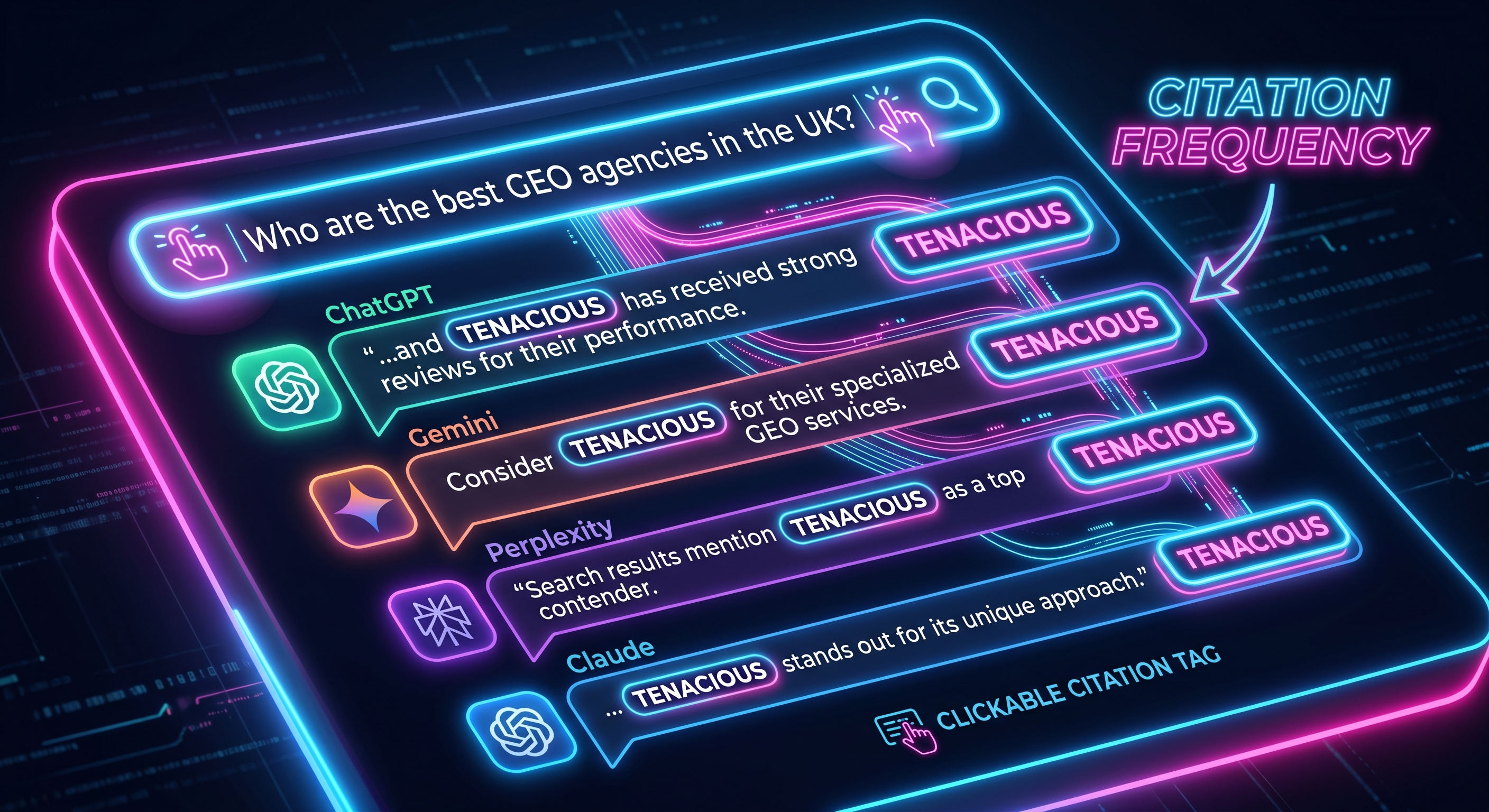
Presence - Does your brand appear at all? When someone asks ChatGPT "who are the best GEO agencies in the UK?" or asks Perplexity "what should I look for when hiring an AI visibility consultant?", is your business named?
Accuracy - When AI tools do mention your business, are they describing it correctly? Are they citing the right services, the right location, the right expertise? Inaccurate AI mentions can be actively damaging a prospect who hears something wrong about your business from an AI tool may never reach out.
Sentiment - When your business is mentioned, is it in a positive, neutral or negative context? An AI tool recommending you confidently is very different from one that mentions you in passing alongside three competitors it describes more favourably.
All three matter. A business that appears frequently but inaccurately, or positively but rarely, is not winning AI visibility it's just partially visible.
These are the five metrics that give you a real picture of your AI visibility over time.

How often does your brand appear in AI-generated responses across a defined set of test queries?
This is the most fundamental metric. Pick 20 to 30 queries that reflect how your target clients would ask about your services "best GEO agency UK", "how do I improve AI search visibility", "who should I speak to about generative engine optimisation" and test them regularly across ChatGPT, Gemini, Perplexity and Claude.
Track: how many queries trigger a mention of your brand. Track the number over time. If it's going up, your GEO work is landing.
When your brand appears in AI responses, how often does it appear relative to your competitors?
If your brand is mentioned in 8 out of 30 test queries, and your closest competitor is mentioned in 22 out of 30, that's your share of model gap. This is the AI equivalent of share of voice and it's one of the clearest competitive signals available.
Share of model is particularly useful for showing clients and stakeholders what's actually at stake. A business with low share of model is losing the AI discovery race even if it can't see it yet in traffic numbers.
Not all mentions are equal. When AI tools reference your business, what are they saying?
Track whether mentions are:
Positive, direct recommendations carry significantly more weight than neutral inclusions. If your brand is consistently appearing but never leading, that's a signal your authority signals need strengthening not just your presence.
Which pages, content pieces or external mentions are driving AI citations of your brand?
When AI tools cite your business, they're often drawing from specific sources your blog posts, your LinkedIn profile, press mentions, directory listings, or third-party content. Knowing which sources are being cited most gives you a direct line of sight into what's working and what to invest in next.
This is one of the most actionable metrics in AI visibility reporting. It tells you whether your blog content is being used, whether your structured data is being read, and whether your off-site presence is strong enough.
When your brand doesn't appear in a relevant AI response, who does?
This is often the most clarifying data point for a business that's sceptical about AI visibility investment. Showing a founder that three of their competitors are consistently recommended by ChatGPT while their brand isn't mentioned once is more compelling than any abstract argument about the future of search.
Track competitor mentions across the same query set you use to test your own presence. The gap between your visibility and theirs is your opportunity and your risk if you ignore it.
Measurement only becomes useful when it's tracked over time. A single snapshot tells you where you are. Monthly tracking tells you whether what you're doing is working.
The practical approach:
Set a baseline first - Before doing any GEO or AEO work, run your full query set across the main AI platforms and record the results. Note citation frequency, share of model, sentiment and sources. This is your starting point.
Test the same query set monthly - AI models update regularly their training data changes, their sources shift, and their outputs evolve. Monthly testing across a consistent query set gives you a meaningful trend line.
Track by platform separately - ChatGPT, Gemini, Perplexity and Claude don't behave identically. A brand might appear consistently in Perplexity but be absent from ChatGPT. Knowing the platform-by-platform picture tells you where to focus your content and authority-building work.
Connect activity to outcomes - When you publish a new piece of content, add structured data, or earn a significant mention in a trusted publication, note the date. If your citation frequency improves in the following four to eight weeks, you have evidence of what's working.
This is the measurement loop that most businesses haven't built yet but that separates businesses doing GEO seriously from those doing it ad hoc.
Competitor AI tracking follows the same logic as your own visibility measurement but with a specific focus on displacement.
The questions to answer:
The last point is often overlooked. Not every query in your space is dominated by a well-known competitor. Some are genuinely uncontested meaning the first business to build clear, well-structured content around that topic has a real chance of becoming the default AI recommendation.
Identifying those gaps is one of the most valuable things a proper AI visibility audit will surface. Rather than fighting for share in a crowded query, you build authority in areas that are currently wide open.
Until recently, measuring AI visibility meant manual testing typing queries into ChatGPT, recording what came back, and building your own tracking spreadsheet. That works at small scale but breaks quickly once you're testing across multiple platforms, dozens of queries, and multiple competitors every month.
Dedicated AI visibility tracking tools now exist to automate this. Answer Architect is built specifically for this tracking your brand's presence across ChatGPT, Gemini, Perplexity and Claude, monitoring citation frequency and share of model over time, and surfacing the competitor gaps and source attribution data that manual testing can't reliably capture.
For businesses serious about understanding and improving their AI visibility, a structured tool removes the grunt work and makes the data consistent enough to actually make decisions from.
At the simpler end, you can get a useful starting point by manually testing 10 to 15 of your most important queries across the main platforms and logging the results in a spreadsheet. It won't scale, and it won't catch everything but it will show you quickly whether you have an AI visibility problem worth addressing.
There are no universal benchmarks for AI visibility yet. The discipline is too new and too varied by sector, geography and query type for anyone to say "you should be appearing in 60% of queries in your space."
What good looks like in practice:
Short term (0 to 3 months): You have a baseline. You know your citation frequency, share of model, and which competitors are currently dominating your core query set. You're testing monthly and tracking the trend.
Medium term (3 to 6 months): Your citation frequency is measurably higher than your baseline. At least one of your blog posts or content pieces is being cited as a source by one or more AI platforms. Your share of model is moving relative to your nearest competitor.
Longer term (6 to 12 months): Your brand is consistently mentioned across multiple platforms for your core service queries. AI tools describe your business accurately. The sentiment of mentions is predominantly positive and direct. You're visible in AI answers at the same stage of the buyer journey where you previously relied entirely on Google.
The most important number isn't a specific percentage it's direction. Is your AI visibility improving month on month? If yes, the strategy is working. If it's flat or declining despite content investment, something in the signal mix needs reviewing.
AI visibility is not a vague concept. It's measurable you just need the right framework to measure it.
Citation frequency, share of model, sentiment, source attribution, and competitor presence give you a clear, trackable picture of how your brand is performing in AI search. Traditional analytics won't capture any of it. But with the right approach, you can build a reporting structure that shows exactly what's working, what isn't, and where the biggest opportunities are.
Most UK businesses haven't started measuring this yet. The ones that do now have a real advantage because they're making decisions based on evidence while their competitors are still guessing.
If you want to understand your current AI visibility before investing in improving it, Answer Architect gives you the tracking infrastructure to do that properly. Or if you'd prefer to start with a guided audit, we can run one for you at Tenacious.
Related Reading
If you want to go deeper, these guides explain how the full AI visibility system fits together.
What Is GEO in 2026 and How Do You Get Cited in AI Answers?
This is the core definition guide for Generative Engine Optimisation and AI citations.
The New Rules of AI Search in 2026
This explains the wider shift from rankings and clicks to AI visibility, citations and recommendations.
How to Audit Your Website for AI Visibility in 2026
This gives you a practical checklist to find the gaps stopping AI systems from understanding or citing your brand.
Search Everywhere Optimisation: AI Visibility in 2026
This explains how to build visibility across Google, AI answers, LinkedIn, YouTube, Reddit, reviews, directories and trusted sources.
Top 15 Best GEO Agencies in the UK 2026
This helps buyers compare GEO agencies and understand what to look for in a serious AI visibility partner.
Can I measure AI visibility for free?
To a point. You can manually test queries across ChatGPT, Gemini, Perplexity and Claude without paying for anything and for a small business with a limited query set, that gives you a useful snapshot. The limitation is consistency and scale. Manual testing is hard to repeat reliably every month, easy to do inconsistently, and doesn't track competitor mentions efficiently. Dedicated tools like Answer Architect are built to solve that.
How often should I test my AI visibility?
Monthly is the minimum for businesses actively working on GEO or AEO. More frequently if you're publishing significant content, running a campaign, or have just made structural changes to your website. The goal is to catch changes in AI responses quickly enough to act on them.
Does Google Search Console show AI visibility data?
No. Google Search Console shows performance in Google's traditional search results and, to a limited degree, AI Overviews. It doesn't show how your brand appears in ChatGPT, Perplexity, Gemini (outside Google's own surfaces) or Claude. Those platforms have no equivalent of Search Console yet which is why third-party tracking tools matter.
What is share of model and why does it matter?
Share of model is how often your brand appears in AI responses relative to your competitors, across a defined set of test queries. It's the AI equivalent of share of voice in traditional marketing. A low share of model means your competitors are getting recommended in situations where you should be and that translates directly into pipeline you're not seeing.
How long before AI visibility improvements show up in measurements?
Typically four to eight weeks after meaningful content or authority changes, though it varies significantly by platform. Perplexity tends to index and reflect new content faster than ChatGPT, which updates less frequently. Google's AI Overviews can reflect changes in traditional search rankings relatively quickly. Building a monthly tracking cadence gives you enough data to see genuine trends rather than noise.
What if AI tools are mentioning my business inaccurately?
This is more common than most businesses realise and worth taking seriously. Inaccurate AI descriptions typically stem from inconsistent information across your website, third-party listings, and social profiles AI systems synthesise from multiple sources, and if those sources conflict, the output is often muddled. Fixing it means auditing and aligning your brand information consistently across all platforms, strengthening your structured data, and creating clear, authoritative content that defines exactly what your business does.