.jpg)
5 Key Takeaways
In 2026, one of the most important questions a business can ask is, “What does GEO include, and how is it different to SEO?”
AI assistants like ChatGPT and Perplexity are no longer just summarising pages. They are where customers compare options, shortlist providers, and make decisions.
Customers now:
This is why GEO matters. SEO is about rankings and clicks. GEO is about being cited, trusted, and recommended inside the answer.
Dean Whitby captured this shift better than anyone:
“Build a business AI can’t replace. Master the skills AI can’t commoditise.”
So let’s break down exactly what GEO includes in 2026, why it’s different to SEO, and what brands need if they want AI to understand them, cite them, and recommend them.
SEO helps you rank pages in traditional search results.
GEO helps you become a cited, trusted source inside AI answers and recommendations.
A simple way to think about it:
SEO = “Help people find your page.”
GEO = “Help AI confidently cite and recommend your brand.”
GEO focuses on:
Entity clarity (who you are, what you do, who you help)
Consistent brand positioning across your site and key profiles
Cross-platform data uniformity (so AI sees one consistent truth)
Proof layers (case studies, reviews, PR, community validation)
Structured service pages that AI can quote and users can act on
AEO (Answer Engine Optimisation) supports GEO by making answers easy to extract, but GEO is the bigger system that makes the recommendation feel safe.
Understanding GEO starts with understanding the modern buyer.
Recent behaviour shifts show AI is now mainstream, not a niche. In the UK, 70% of respondents have used AI in their daily lives in the past six months, and in the US 61% of adults have used AI in the past six months, with nearly one in five using it daily.
They aren’t just searching anymore.
They are asking, evaluating, and acting inside AI systems.
If your business isn’t optimised for AI, you’re invisible during the most important moment, the moment of decision.
Before we go deeper, here’s a short video from Dean Whitby on how AI is reshaping sales and marketing, it perfectly sets the context for everything in this guide.
As more customer journeys move into AI assistants and away from traditional search results, businesses are now operating in a zero-click environment.
Most SEO programmes focus on:
Technical performance (crawlability, speed, indexation)
Keyword-led content and internal linking
Backlinks and authority building
On-page optimisation for rankings
GEO adds the layers SEO usually misses:
Entity clarity (a consistent “who we are” across sources AI uses)
Proof-layering (reviews, case studies, PR, community validation)
Structured service pages written to be cited (definitions, steps, FAQs, comparisons)
Multi-platform consistency (so AI sees one unified truth)
Conversion readiness (clear offers and frictionless next steps)
To understand this shift deeper, here’s how brands win in a zero-click future.
Most people still think in terms of the old Google Knowledge Graph, but generative engines work completely differently.
Generative engines don’t just store facts; they build probabilistic, multi-source entity profiles.
If your entity is inconsistent, confused, or duplicated. AI becomes uncertain and avoids citing or recommending you.
If a business uses:
Then AI experiences Entity Confusion.
When this happens:
AI may exclude you entirely from answers
Fixing entity confusion is core to GEO.
This is where Entity Training comes in.
Generative engines must be trained consistently to recognise your business.
Entity Training includes:
1. Choosing ONE primary entity
The official brand identity AI should learn.
2. Reinforcing it everywhere
With:
3. Repetition across multiple trusted sources
Generative engines rely on cross-source consensus.
If everything aligns, AI becomes extremely confident in your identity.
High confidence = high citations.
GEO depends on consistent, uniform business data.
AI checks:
If your information differs between these sources, AI treats your business as unreliable.
Uniformity → Trust
Trust → Citations
Citations → Recommendations
Recommendations → Bookings
This consistency layer is mandatory for GEO success.
Most SEO retainers focus on rankings and traffic. That still matters, but it does not guarantee you will be cited or recommended inside AI answers. GEO adds the trust, proof, and entity clarity layers that AI relies on to make decisions.
Here’s what most SEO programmes include (and why it’s not enough on its own in 2026):
This usually includes:
The goal is usually to rank and earn clicks. It can help with AI visibility, but it does not guarantee citations or recommendations.
This involves adding:
These make your content machine-readable.
GEO providers often optimise:
This helps AI understand what your brand is about.
This includes:
These help your content appear in direct answers.
This means:
These make it easier for AI to lift your content.
This involves:
This ensures search engines and AI systems can access your content. These services are important, but they often only cover the minimum layer: visibility, not trust, citations, or recommendations.
To win in AI answers, brands need more than visibility. They need entity clarity, proof layers, multi-source reinforcement, and structured pages that AI can confidently cite.
As Dean Whitby puts it: “If AI can’t cite you, you don’t exist.”, and if customers can’t book you, you don’t convert.
SEO helps you get discovered. GEO helps you get selected. That requires a structured system, not just blog posts and schema. Our GEO playbook for dominating AI search is a great read for this too.
This is where most AEO and GEO services fall short.
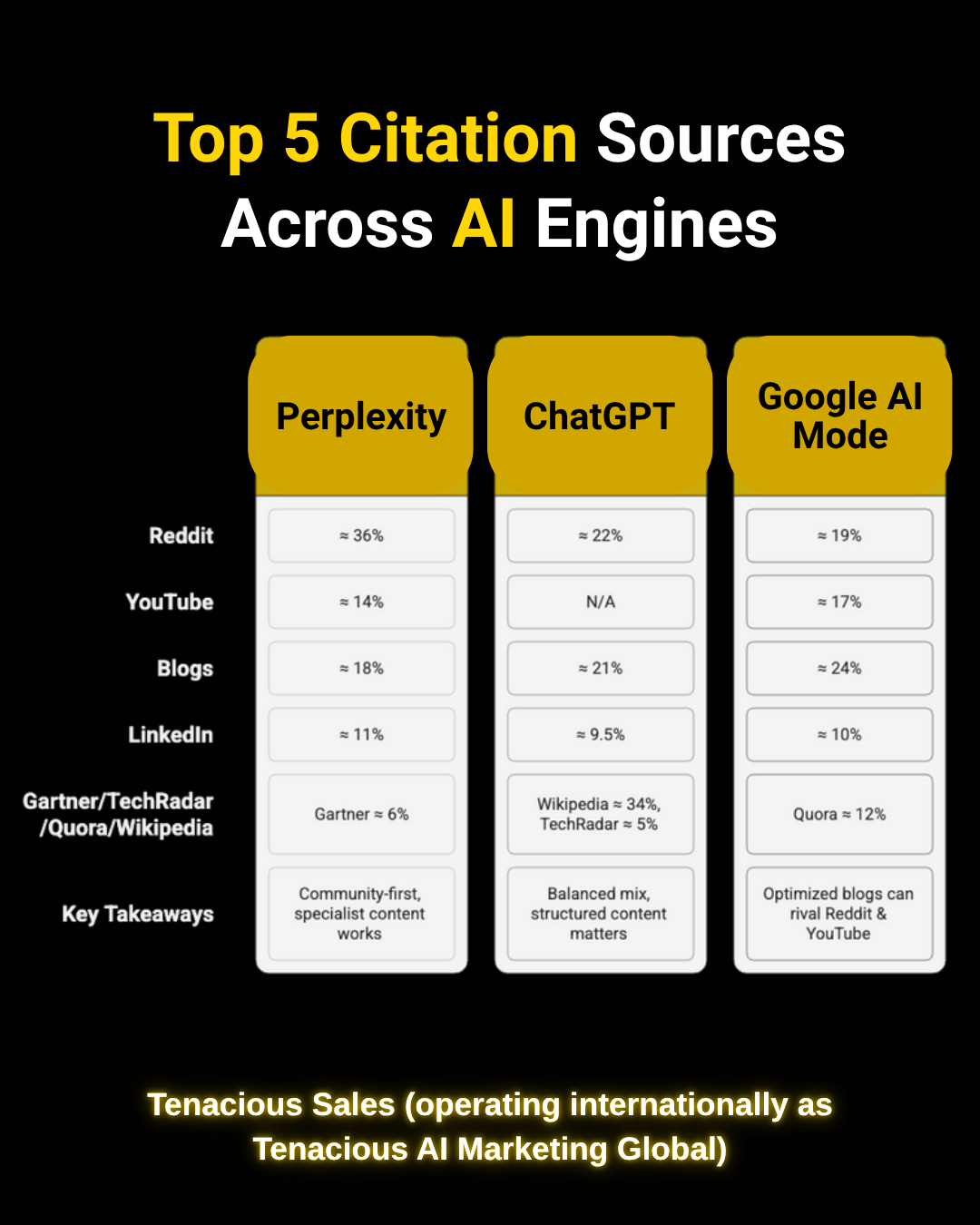
GEO is no longer just content and schema.
To win inside AI ecosystems, brands need authority, evidence, community presence, and bookability.
This is where Tenacious delivers a higher tier of GEO, built for how AI assistants actually evaluate businesses.
YouTube is the most powerful form of machine-readable authority.
We launch and run full YouTube ecosystems:
Every video includes:
Why YouTube supports GEO:
Dean’s message reinforces this: “Your voice must be present and meaningful for AI to quote you.”
YouTube is that voice.
YouTube isn’t just a video platform, it’s one of the strongest authority signals for AI engines, especially when paired with strategic video production for visibility and trust.
We secure 5–6 quality PR features every month via journalist request platforms.
These become:
AI pays attention to reputable external sources, because they validate expertise. PR should be part of every serious GEO strategy.
AI models ingest Reddit heavily.
So companies should focus on:
This builds durable social proof, the type AI assistants prioritise in their reasoning.
This is where GEO meets conversion.
Rebuild pages with:
Plus:
These pages:
This is the glue that connects discovery → trust → purchase.
This is one of the most overlooked, yet most valuable, parts of GEO in 2026.
Once AI recommends your business, customers must be able to book instantly.
Tenacious builds AI-powered agents that:
This is the future of conversion.
Not landing pages.
Not forms.
Not chat widgets.
AI assistants book directly, and we make your brand bookable.
This shift is already happening across industries, and we break it down fully in our guide on why websites are dead and agents are taking over.
GEO is essential for industries where customers compare options quickly, want reassurance, and act on recommendations, including:
Restaurants
Luxury hospitality
Cosmetic clinics
Dental practices
Aesthetics and wellness providers
Tourism and travel experiences
Global service businesses
Other service-based sectors that benefit heavily in 2026 include:
Accountants and fractional CFOs
Marketing agencies and consultants
Law firms and solicitors
Mortgage brokers and insurance advisors
Recruitment agencies and staffing firms
Architects and specialist contractors (planning, structural, build)
Home services (plumbers, electricians, HVAC, roofing)
Property services (estate agents, lettings, property management)
Private healthcare (physio, chiro, dermatology, mental health)
Education and training providers (tutors, coaching, academies)
B2B SaaS and implementation partners
Managed service providers (IT support, cybersecurity)
Logistics, removals, and relocation services
Events, venues, and experience providers
Because Tenacious doesn’t just create content, we build full systems that make your business:
We understand the entire business ecosystem:
We don’t deliver blog bundles. We build the infrastructure AI needs to choose your brand.
GEO includes every element required for AI to:
This requires:
This is the complete, modern GEO with supporting AEO ecosystem, and Tenacious AI Marketing is one of the few companies in the world able to build it end-to-end.
If you want your brand to:
Then Tenacious AI Marketing is your partner. Book a strategy call.
See your opportunities, become the brand AI recommends, every time.
If AI can’t cite you or book you, it can’t sell you. We make sure it can do both.
1. What does GEO include??
GEO includes entity clarity, consistent brand data across key sources, proof layers (reviews, PR, case studies, community validation), structured service pages written to be cited (definitions, comparisons, FAQs), and schema that reduces ambiguity. SEO helps you rank, GEO helps you get cited and recommended inside AI answers.
2. Why is GEO important for businesses in 2026?
GEO is important because AI assistants increasingly shape the shortlist before a buyer ever visits websites. If your brand is not clearly understood and confidently cited by AI systems, you can be invisible at the moment of decision, even if your SEO is strong.
3. Is GEO just content and schema?
No. Content and schema help, but GEO also requires entity clarity, proof layers, cross-platform consistency, and structured service pages that AI can cite and users can act on.
4. How does YouTube help with GEO?
YouTube provides transcripts, long-form expertise, and machine-verifiable proof. AI systems use this as a trust signal, which increases the chances of your brand being cited and recommended.
5. What industries benefit most from GEO?
Restaurants, hospitality, clinics, dentists, wellness brands, tourism companies, and any business where customers plan or book before arriving benefit most from GEO as people now can buy within thew AI engines without leaving. It serves up products and checkout.
6. Can AI assistants complete bookings directly?
Yes. AI can schedule appointments, take payments, and manage follow-up actions, if a brand integrates AI booking agents.
7. What is the difference between SEO and GEO?
SEO optimises for rankings and clicks in traditional search. GEO optimises for being cited and recommended inside AI answers by strengthening entity clarity, proof layers, structured content, and consistent signals across multiple sources AI trusts.