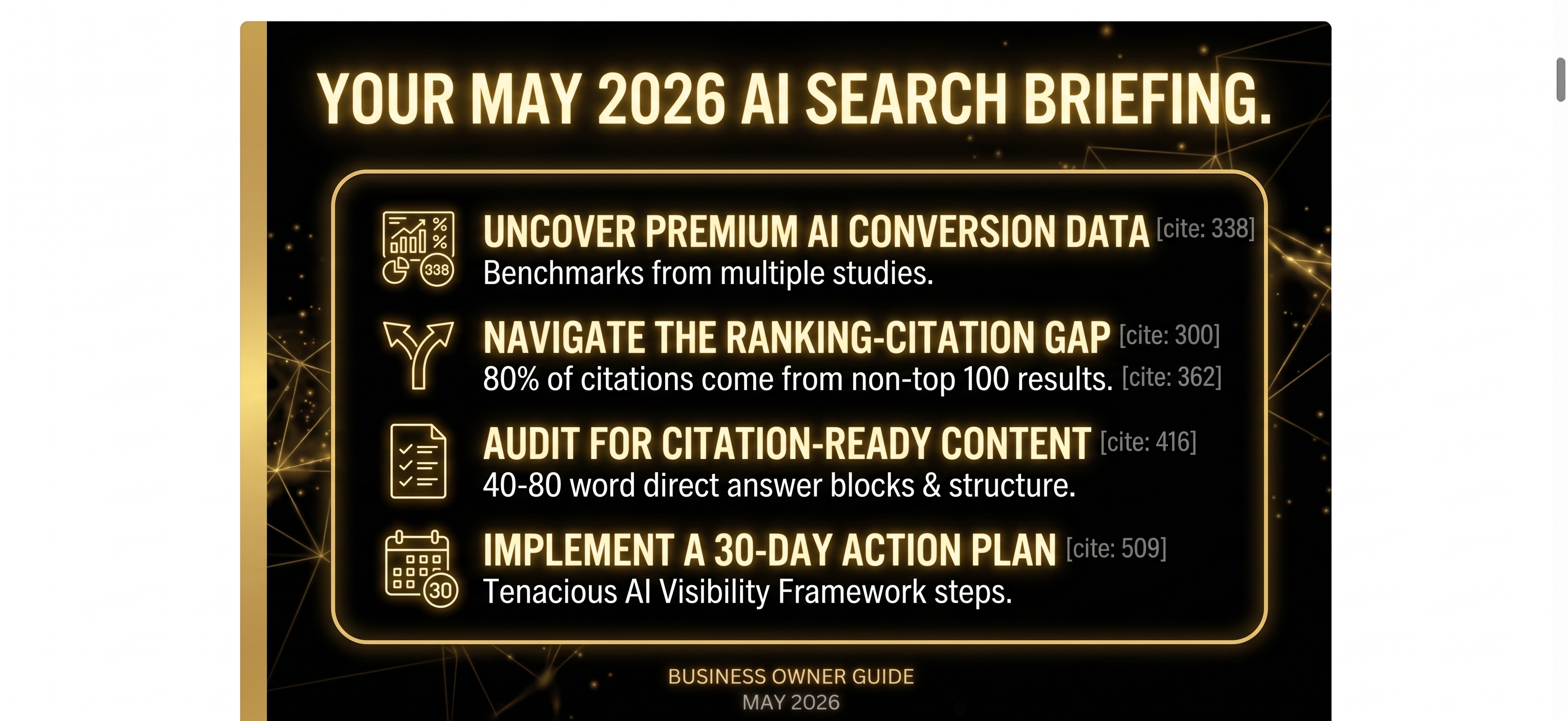
AI search accounts for a small share of total web traffic currently, but converts at significantly higher rates than traditional organic. Traffic arriving from AI citations is decision-ready, not exploratory.
Your Google ranking and your AI visibility are now separate problems. Up to 80% of AI citations come from pages that do not appear in the traditional top 100 results.
Google AI Overviews are changing organic traffic patterns in both the US and UK. They reduce clicks for some organic results, but being cited inside AI-generated answers can increase trust and bring higher-intent visitors.
The content quality bar has shifted. Google’s 2026 core updates reward original insight, real data and genuine expertise, and penalise scaled content that rehashes what already exists online.
Being cited in AI Overviews while ranking in position one simultaneously produces the highest volume of high-quality traffic. Being absent from both is now a serious business risk.
The brands winning in AI search are not those publishing the most content. They are those publishing the most credible, specific and well-structured content.
Search is splitting into three layers: rankings, citations and recommendations. Each layer now needs its own strategy.
AI search in May 2026 is moving from novelty to normal behaviour. Customers are using ChatGPT, Perplexity, Gemini, Claude and Google AI Overviews to research businesses, compare options, understand complex topics and build shortlists before they visit a website. Traditional SEO still matters, but it is no longer enough on its own. Businesses now need to optimise for AI visibility, citations and recommendations, not just rankings and clicks.
For the core definition of this discipline, read What Is GEO in 2026 and How Do You Get Cited in AI Answers?.
Search is not what it was twelve months ago.
If you have noticed that your organic traffic figures look different this year, more volatile, harder to attribute and occasionally puzzling, you are not imagining it. The search landscape has shifted in ways that are structural, not cyclical.
While the headlines tend to focus on AI as a threat to traffic, the fuller picture is considerably more interesting.
AI search is not simply taking clicks away. It is changing when, where and how buyers form opinions.
A buyer may still use Google. They may still visit your website. They may still read reviews, ask for referrals and compare providers manually. But increasingly, they are also asking AI tools to summarise the market, explain their options, compare companies and shortlist providers.
That means the question for businesses has changed.
It is no longer enough to ask, “Do we rank on Google?”
You now also need to ask:
Do AI systems understand us?
Do they mention us?
Do they cite us?
Do they recommend us?
Do they describe us accurately?
Do they choose our competitors instead?
This briefing covers the defining developments in AI search as of May 2026: what the data actually shows, how the major platforms are behaving, what is getting cited, what is being ignored and what the practical implications are if you run a business that depends on being found.
The most important number in AI search right now is not how much traffic AI is sending. It is what happens when it does.
Conductor’s May 2026 benchmarks put the conversion rate of AI-referred traffic at 14.2%, compared to 2.8% for traditional Google organic.
Research from Emarketed reports that AI referral traffic converts at roughly 4.4 times the rate of conventional organic visits.
Perplexity traffic, specifically, has been measured converting at approximately 11 times the rate of standard search traffic.
These figures vary by source and methodology, and should be read directionally rather than as precise targets. But the pattern is consistent across multiple studies: people arriving at your website from an AI citation are not browsing. They have already used the AI system to research, compare and filter options. By the time they click through to you, the decision-making process is well advanced.
This matters for how businesses should evaluate the importance of AI visibility.
Dismissing it because the raw traffic volumes are still relatively small is a strategic miscalculation.
According to EMARKETER, 31.3% of the US population will use generative AI search in 2026, and that figure is growing steadily.
According to Which?, 47% of UK adults have used ChatGPT to search the internet, making it the most used AI search tool in the UK. Gemini follows at 22%, Copilot at 21%, and Meta AI at 18%.
For business owners thinking about where to invest their marketing attention, this is the argument for taking AI visibility seriously now rather than waiting until the volumes are impossible to ignore.
Gartner predicted that traditional search engine volume would decline by 25% by 2026 as AI chatbots and virtual agents take more of the discovery journey. Read Gartner’s search volume prediction.
The UK picture is also moving quickly. Which? reported that 51% of UK adults use AI search tools in their personal life to search for products, services and advice. Read the Which? research on consumer use of AI search tools.
This is perhaps the most consequential shift for businesses trying to maintain search visibility.
For the past twenty years, the logic of search was relatively linear. Rank well in Google, get traffic. The better your ranking, the more traffic. The more relevant the traffic, the more business.
AI has broken that linearity in a specific and important way.
AI systems do not simply reproduce the Google top ten. They make their own decisions about which sources to cite, and those decisions increasingly diverge from traditional ranking signals.
Research cited by Ahrefs shows that around 80% of AI citations now come from pages that do not appear in the traditional top 100 search results.
Our own independent research conducted by our team found that the overlap between top Google links and AI-cited sources has dropped from approximately 70% to below 20%.
What this means in practice is simple, but uncomfortable: you can rank in position one on Google for a competitive term and still be completely absent from the AI answer for that same query.
Conversely, a well-structured, specific, expert-led page that would never win a traditional ranking battle can be cited repeatedly by AI systems if it provides the clearest answer to a precise question.
The implication for businesses is not that traditional SEO no longer matters.
It does.
AI systems that use live web retrieval, including Google AI Overviews and Perplexity, still factor in your domain authority and technical health. But optimising for traditional rankings alone is no longer sufficient if you want to maintain visibility as search behaviour shifts.
This is the foundation of GEO, or Generative Engine Optimisation. GEO is not a replacement for SEO. It is the next layer of visibility.
For the wider shift, read The New Rules of AI Search in 2026.
Traditional SEO Visibility | AI Visibility |
| Focuses on ranking in Google search results | Focuses on being cited inside AI-generated answers |
| Measures rankings, impressions, clicks and organic traffic | Measures mentions, citations, recommendations and prompt visibility |
| Optimises pages around keywords | Optimises content around buyer questions and answer extraction |
| Rewards authority, relevance and technical health | Rewards clarity, structure, expertise, consistency and trust signals |
| Works mainly around search result pages | Works across AI answer engines, summaries and recommendations |
| Often starts with keyword research | Starts with prompt research and buyer question mapping |
| Still essential | No longer sufficient on its own |
The businesses that win the next phase of search will not abandon SEO. They will expand beyond it.
They will build visibility systems that work across Google, ChatGPT, Perplexity, Gemini, Claude, LinkedIn, YouTube, Reddit, reviews, directories, PR, listicles and trusted third-party sources.
That is why we call it Search Everywhere Optimisation.
Google’s AI Overviews are now appearing in approximately 25.8% of all US searches as of early 2026, with informational queries triggering them nearly 40% of the time.
This is not a feature being tested. It is now a structural part of how Google delivers search results.
According to Ofcom, around 30% of UK Google searches now show AI Overviews, while 53% of UK adults say they often see these AI summaries.
Google still dominates UK search, used by 82% of adults and handling around 3 billion searches a month, but AI Overviews are now baked into the experience rather than sitting on the sidelines. This is not a test feature anymore, it is becoming a structural part of how UK search results are delivered.
Read Ofcom’s Online Nation update on AI search in the UK.
Of course, the UK is often slower to adopt new behaviours than the US. British people tend to keep doing what they have always done until the shift becomes unavoidable. But even here, AI summaries are no longer marginal.
The traffic impact is real and measurable.
Searches that trigger AI Overviews carry an 83% zero-click rate, compared to roughly 60% for traditional queries.
Sites ranking in position one see an average 34.5% drop in click-through rate when an AI Overview appears above them, according to analysis across 68,000 real queries.
Read Ahrefs’ AI Overviews CTR study.
These numbers are uncomfortable reading for any business that depends on organic search traffic.
But the data has a second side that is less widely discussed.
Sites that are cited within AI Overviews see approximately a 35% increase in clicks compared to non-cited top-ten results, and the traffic that arrives converts at the premium rates noted above.
Being cited is not just a visibility win. It changes the quality of the audience that reaches you.
There is also evidence that the initial CTR decline is stabilising. Organic click-through rates on AI Overview-present queries dropped sharply when the feature first rolled out, fell to around 1.3% in late 2025, but had rebounded to approximately 2.4% by February 2026. The market is adjusting.
The current state, broadly, is this: AI Overviews reduce total clicks for queries where you are not cited, and meaningfully increase the value of traffic where you are.
The logical goal is to be cited.
And that requires a different approach to content than traditional SEO alone has required.
Google now gives website owners guidance on AI features in Search, including AI Overviews and AI Mode. Read Google’s guidance on AI features in Search.
The most counterintuitive finding in AI search research right now is how unpredictable citation patterns are, and how much opportunity that creates for smaller, more focused businesses.
Traditional search rewarded domain authority and volume above almost everything else.
Big brands with decades of backlink history dominated, and newcomers had to work for years to make meaningful inroads.
AI citation patterns are different.
Ahrefs data shows that only 38% of AI Overview citations come from the Google top ten. The other 62% are drawn from sources that may have little traditional SEO authority but offer something more valuable to an AI system: a clear, direct, well-structured answer.
An analysis of 680 million citations across ChatGPT, Google AI Overviews and Perplexity found that only 11% of domains are cited by both ChatGPT and Perplexity simultaneously.
Each platform has its own preferences and its own sourcing logic.
This fragmentation creates both complexity and opportunity: you do not need to be dominant across the whole web to be authoritative on your specific topic.
What the data consistently shows is that citations go to content that is answer-first, structurally clear, topically consistent and verifiably useful.
For businesses competing against larger incumbents, this is genuinely good news.
The rules of the game have changed in ways that favour depth over scale.
Citation Signal | Why It Matters |
| Direct answer near the top | Gives AI systems a clean extractable summary |
| Question-led headings | Matches how users ask AI tools questions |
| 40 to 80 word direct answer blocks | Gives AI a concise section to extract and summarise |
| Short, clear sections | Makes the content easier to parse |
| Comparison tables | Helps AI summarise options and differences |
| FAQs | Supports answer extraction and FAQ schema |
| Internal links | Builds topical authority across your own site |
| External authority links | Connects your claims to trusted sources |
| Specific examples | Shows real experience and usefulness |
| Original data or frameworks | Gives AI something distinctive to cite |
| Updated information | Reduces the risk of stale or inaccurate answers |
Industry analysis has coalesced around a clear finding: content that leads with a direct, concise answer, typically 40 to 80 words, immediately following a heading is significantly more likely to be extracted and cited by AI systems.
If the answer is buried under an extended introduction, AI crawlers tend to move on.
AI systems parse content programmatically. Heading hierarchy, short paragraphs, logical flow and labelled comparisons all make content easier to extract. Beautifully crafted long-form prose that lacks structure becomes invisible to a machine reader.
AI systems also assess whether a source demonstrates sustained, credible knowledge about a subject, not whether it has produced a high volume of content.
A smaller site that covers a narrow topic thoroughly and consistently will often earn more reliable citations than a broader publication that covers everything at surface depth.
Pages that provide something specific, such as a framework, a comparison, a data point or a practical answer to a real question, are prioritised over pages that discuss a topic in general terms without adding anything distinctive.
Google’s March 2026 core update formalised what many content strategists had already observed: the era of scaled, low-quality content is functionally over.
The update reinforced penalties for what Google describes as scaled content abuse, the production of large volumes of pages designed primarily to capture search rankings, regardless of whether those pages were written by humans or generated by AI.
The target, explicitly, is the behaviour rather than the tool.
The data from that update is instructive.
Sites that had published 50 to 100 quality articles, with AI assistance but with genuine human editing, real expertise and original insight, saw traffic increases of 30% to 80% in case studies reviewed.
Sites that had published 1,000 or more largely unedited AI articles saw traffic drops of 40% to 90%.
The line is not between AI and human. It is between content that adds something genuine and content that does not.
Google’s information gain principle, which has become increasingly explicit in its quality guidance, holds that a page needs to tell the search engine something it cannot already find aggregated elsewhere.
That might mean proprietary data. It might mean specific experience. It might mean a founder’s honest account of what worked and what did not, or a genuinely novel framework for thinking about a common problem.
What it cannot mean, and still perform, is a competent summary of what other pages already say.
This shift places a premium on things that cannot be generated at scale: original perspectives, specific expertise, real-world knowledge and a consistent and credible voice that builds trust over time.
The businesses best positioned in AI search are those where subject matter expertise lives in the people, not just in the content calendar.
AI search is not one channel. It is several, each with different behaviours, citation preferences and user intent patterns.
ChatGPT currently drives approximately 87.4% of all AI referral traffic to websites, according to Conductor’s 2026 data, making it the dominant force in raw traffic volume.
But Perplexity punches far above its traffic share in conversion quality, with multiple studies showing Perplexity-referred visitors converting at roughly 11 times the rate of traditional organic traffic.
Google AI Overviews sits in a different position: less a traffic driver and more a visibility and trust signal. Appearing in an AI Overview on a high-volume query may not send significant direct traffic, but it signals authority to the broader market and frequently precedes organic click behaviour from users who do their own verification.
The practical implication is that optimising for one platform does not guarantee visibility across others.
Only 11% of domains are cited by both ChatGPT and Perplexity simultaneously, suggesting that each platform is genuinely using different sourcing logic.
The safest approach is to optimise for citeability in general, clear structure, direct answers, consistent expertise, rather than trying to game any single platform’s specific preferences.
Perplexity’s evolution toward task orchestration, where the AI not only answers queries but executes multi-step workflows on behalf of users, is worth watching for professional services businesses specifically.
If an AI system is comparing and shortlisting lawyers, accountants or consultants on behalf of a user, structured data around your services, pricing and specialisms becomes a functional prerequisite for being considered at all.
AI search can feel mysterious, but many of the practical improvements are under your control.
Implementing appropriate schema markup, including Article, FAQPage, LocalBusiness and Organization, makes it significantly easier for AI systems to extract and categorise your content.
This is established technical SEO practice that now has direct GEO value.
Schema does not guarantee AI citations, but it gives machines cleaner clues.
Every major section of your content should open with the clearest possible answer to the question it addresses.
This is a change from traditional SEO writing, which often builds toward the answer for readability.
AI systems extract from the opening of sections, not the conclusion.
Multiple studies have identified what practitioners are calling a citation cliff, a sharp drop-off in AI citation rates for content older than approximately three months.
Regular updates to key pages, particularly those covering fast-moving topics, directly support AI visibility.
WCAG-compliant HTML is increasingly recognised as a trust signal for AI crawlers.
If a screen reader cannot parse your site cleanly, AI systems face similar difficulties.
Clean structural HTML is no longer just a legal consideration. It is a machine-readability one.
llms.txt is a proposed open standard that allows websites to provide AI systems with a verified, structured summary of key facts, such as pricing, product features and company information.
llms.txt has reached around 10% adoption among the top 500 SaaS companies.
The evidence for its direct impact on citation rates remains limited. No major AI platform has officially confirmed it uses llms.txt to source information.
It is worth monitoring and straightforward to implement, but it should not be treated as a substitute for substantive content quality.
At the moment, the core work remains the same: make your website easier to understand, your content easier to cite and your brand easier to trust.
The most important strategic shift is not that SEO is dead. It is that search is splitting into three separate layers.
Each layer still matters, but each one now needs its own strategy.
Layer | What It Means | What Businesses Need |
| Search visibility | Can people find you in Google search results? | SEO, technical health, content, backlinks and rankings |
| Answer visibility | Do AI systems cite your content when answering questions? | GEO, AEO, structured answers, FAQs, schema and source clarity |
| Recommendation visibility | Do AI systems name you as a provider or expert? | Entity authority, reviews, third-party mentions, listicles, YouTube, PR and proof |
This is the difference many businesses are missing.
Ranking is not the same as being cited.
Being cited is not the same as being recommended.
A blog post may be cited as a source. A company may be recommended as a provider. A founder may be recognised as an expert. These are related outcomes, but they are not identical.
That is why businesses need more than a content calendar. They need a visibility system.
At Tenacious, we call this Search Everywhere Optimisation: building visibility across Google, AI answers, LinkedIn, YouTube, Reddit, reviews, directories, PR, listicles and trusted sources.
Read Search Everywhere Optimisation: AI Visibility in 2026.
The clearest summary of where search stands in May 2026 is this:
The volume of traffic flowing through AI systems is growing. The conversion quality of that traffic is premium. The rules for earning a place in AI answers are different from the rules that governed traditional search, and in many ways, they favour businesses with genuine expertise and a clear perspective over those that have simply scaled content production.
What Still Works | What No Longer Works |
| Deep, specific, expert-led content | Thin AI-generated content at scale |
| Answer-first formatting and clear structure | Long introductions that bury the point |
| Consistent topical authority over time | One-off content grabs on trending topics |
| Structured schema and accessible HTML | Unstructured pages with no markup |
| Original data, frameworks and real experience | Summaries of what other sites already say |
| Geographic specificity for local services | Generic national pages for local queries |
| Internal linking and content architecture | Isolated blogs with no supporting cluster |
| Search Everywhere visibility | Website-only thinking |
| Tracking AI visibility | Only checking Google rankings |
The businesses most at risk in the current environment are those that invested heavily in content volume during the AI-tools boom of 2024 and 2025 without investing equally in editorial quality and genuine expertise.
The businesses best positioned are those that built consistent, credible, well-structured content assets around real knowledge, and that continue to refresh and deepen those assets over time.
For business owners who have not yet audited their AI visibility, specifically whether they appear in AI answers for the queries most relevant to their services, that is the most useful starting point.
The gap between where your content ranks traditionally and where it appears in AI search is often significant, and the reasons for that gap are actionable.
Read How to Audit Your Website for AI Visibility in 2026.
One of the biggest shifts in AI search is the importance of third-party validation.
When someone asks AI for the best agencies, top providers, leading consultants or recommended tools, the answer may draw on comparison articles, listicles, reviews and trusted third-party pages.
This means your presence in relevant third-party sources is now part of your AI visibility strategy.
For example, if you want to be found as a serious GEO provider in the UK, appearing in relevant agency comparison content can support both human trust and AI understanding.
That is why we created Top 15 Best GEO Agencies in the UK 2026, which helps buyers compare GEO agencies and understand what to look for in a serious AI visibility partner.
This principle applies across sectors.
If AI systems use third-party lists to understand who matters in your category, then your presence in those lists becomes part of the source layer.
This is not old-school link building with a new name. It is source engineering for the answer economy.
The worst thing to do is panic and start publishing random AI-generated blogs.
The best thing to do is diagnose the gap and fix the highest-leverage visibility issues first.
Timeline | Action | Outcome |
| Days 1 to 3 | Test your most important buyer prompts in ChatGPT, Perplexity, Gemini and Google AI | See whether you appear, whether competitors appear and which sources are cited |
| Days 4 to 7 | Review how AI describes your business, services, locations and expertise | Identify inaccurate, outdated or incomplete AI representations |
| Days 8 to 12 | Audit your key service pages for answer-first structure, FAQs and schema | Find pages that need to be made more citation-ready |
| Days 13 to 17 | Update one priority page with a direct answer, clear headings, FAQs, internal links and external citations | Create your first AI-ready content asset |
| Days 18 to 21 | Check listings, profiles, reviews and directories for consistency | Strengthen entity signals across the web |
| Days 22 to 25 | Repurpose the improved page into LinkedIn, Google Business Profile, email and video prompts | Create repeated authority signals |
| Days 26 to 30 | Set up monthly tracking for your highest-value prompts | Turn AI visibility into a measurable system |
Do not try to fix everything in a month.
Fix the layer that blocks AI understanding first.
Then improve the pages that answer commercially important questions.
Then build authority signals across the web.
That is how AI visibility starts to compound.
Step | What to Do | Why It Matters |
| 1. Test key prompts | Search your most valuable buyer questions in ChatGPT, Perplexity, Gemini and Google AI | Shows whether you appear or competitors win |
| 2. Review AI descriptions | Check how accurately AI explains your business | Finds positioning or entity problems |
| 3. Audit service pages | Check whether each page answers real buyer questions | Improves citation potential |
| 4. Add direct answers | Put concise answers near the top of key sections | Helps AI extract useful snippets |
| 5. Add FAQs | Build question-led sections around real buyer concerns | Supports AEO and FAQ schema |
| 6. Improve internal links | Connect related guides and service pages | Builds topical authority |
| 7. Add external sources | Link to trusted data and official references | Improves credibility |
| 8. Strengthen entity signals | Align profiles, directories, reviews and bios | Helps AI understand who you are |
| 9. Build authority channels | Use LinkedIn, YouTube, PR and case studies | Creates repeated trust signals |
| 10. Track movement | Monitor prompts, citations and competitor mentions monthly | Turns GEO into a measurable system |
These guides explain how the full AI visibility system fits together:
What Is GEO in 2026 and How Do You Get Cited in AI Answers?
This is the core definition guide for Generative Engine Optimisation and AI citations.
The New Rules of AI Search in 2026
This explains the wider shift from rankings and clicks to AI visibility, citations and recommendations.
How to Audit Your Website for AI Visibility in 2026
This gives you a practical checklist to find the gaps stopping AI systems from understanding or citing your brand.
Search Everywhere Optimisation: AI Visibility in 2026
This explains how to build visibility across Google, AI answers, LinkedIn, YouTube, Reddit, reviews, directories and trusted sources.
Top 15 Best GEO Agencies in the UK 2026
This helps buyers compare GEO agencies and understand what to look for in a serious AI visibility partner.
Together, these guides form the Tenacious AI Visibility Framework: understand the shift, define GEO, audit your current gaps, build Search Everywhere authority and track whether AI systems are starting to cite and recommend your brand.
If you want support implementing this properly, visit Tenacious AI Marketing or speak to the Tenacious team.
Yes. Google rankings still matter because traditional search still drives a large share of discovery and traffic. However, ranking is no longer the whole picture. AI systems can cite pages that do not rank highly in traditional search, and businesses that rank well can still be absent from AI-generated answers. The safest strategy is to improve both SEO visibility and AI visibility.
GEO, or Generative Engine Optimisation, focuses on being cited, mentioned and recommended inside AI-generated answers. AEO, or Answer Engine Optimisation, focuses on structuring content so it answers questions clearly. AI SEO is sometimes used as a broader phrase for search strategies influenced by AI. The terms overlap, but GEO is the most useful term when discussing visibility inside tools like ChatGPT, Perplexity, Gemini and Google AI Overviews.
Not automatically. The issue is quality, not whether AI was involved. Google’s updates target low-quality scaled content created primarily to manipulate rankings. AI-assisted content can perform well if it is expert-led, edited, useful and original. Content created at scale with little value, little originality and little human input is much more likely to struggle.
You can manually test your most important buyer questions in ChatGPT, Perplexity, Gemini and Google AI, then record whether your brand appears, whether competitors appear and which sources are cited. A more systematic approach is to run an AI visibility audit and track priority prompts over time.
Start with structure and answer placement. Your key pages should answer important questions clearly and early. Use direct answers, clear headings, tables, FAQs, internal links and external citations. If your best content hides the answer too far down the page, AI systems may choose a clearer source.
llms.txt may become useful as AI crawling standards evolve, but it should not be treated as the main strategy. It is worth monitoring and implementing where appropriate, but strong content, clean structure, schema, entity consistency and authority signals matter more.
Yes. AI traffic may still be smaller than traditional organic traffic, but it can be higher intent. More importantly, AI search can influence the buyer before they ever click. Even if the session does not appear clearly in analytics, the perception may already have been shaped.
B2B service businesses should take AI search seriously because their buyers usually research before enquiring. They compare options, ask questions, look for proof and try to reduce risk. AI tools are becoming part of that research journey. If your business is cited, explained and recommended during that process, you build trust earlier. If you are absent, you may never get the enquiry.
The separation between traditional SEO and AI-driven discovery is the defining shift in search for 2026.
It is not a trend to track from the sidelines. It is a structural change that is already affecting traffic, leads, trust and conversion for businesses across every sector.
The good news is that the new rules of AI visibility are not arbitrary or opaque.
Content that is clear, specific, structured and grounded in genuine expertise gets cited. Content that is generic, buried in fluff or derivative of what already exists does not.
The premium on real knowledge and a credible, consistent voice has never been higher.
For any business that depends on being found, the question is no longer whether AI search matters. It is whether your content and wider digital presence are positioned to benefit from it.
The future of search is not just rankings or clicks.
It is rankings, citations and recommendations.
Each one now needs its own strategy.
Want to know whether AI tools can find, understand and recommend your business?
Put your URL into Answer Architect to get your AI visibility score and see what needs fixing.
Or take the Organic Visibility Scorecard to assess how ready your business is for the AI search era.
If you want help building a GEO, AEO and Search Everywhere strategy that turns your expertise into visibility, visit Tenacious AI Marketing or speak to the Tenacious team.
Because in 2026, visibility is no longer just ranking.
Visibility is being trusted enough to become the answer