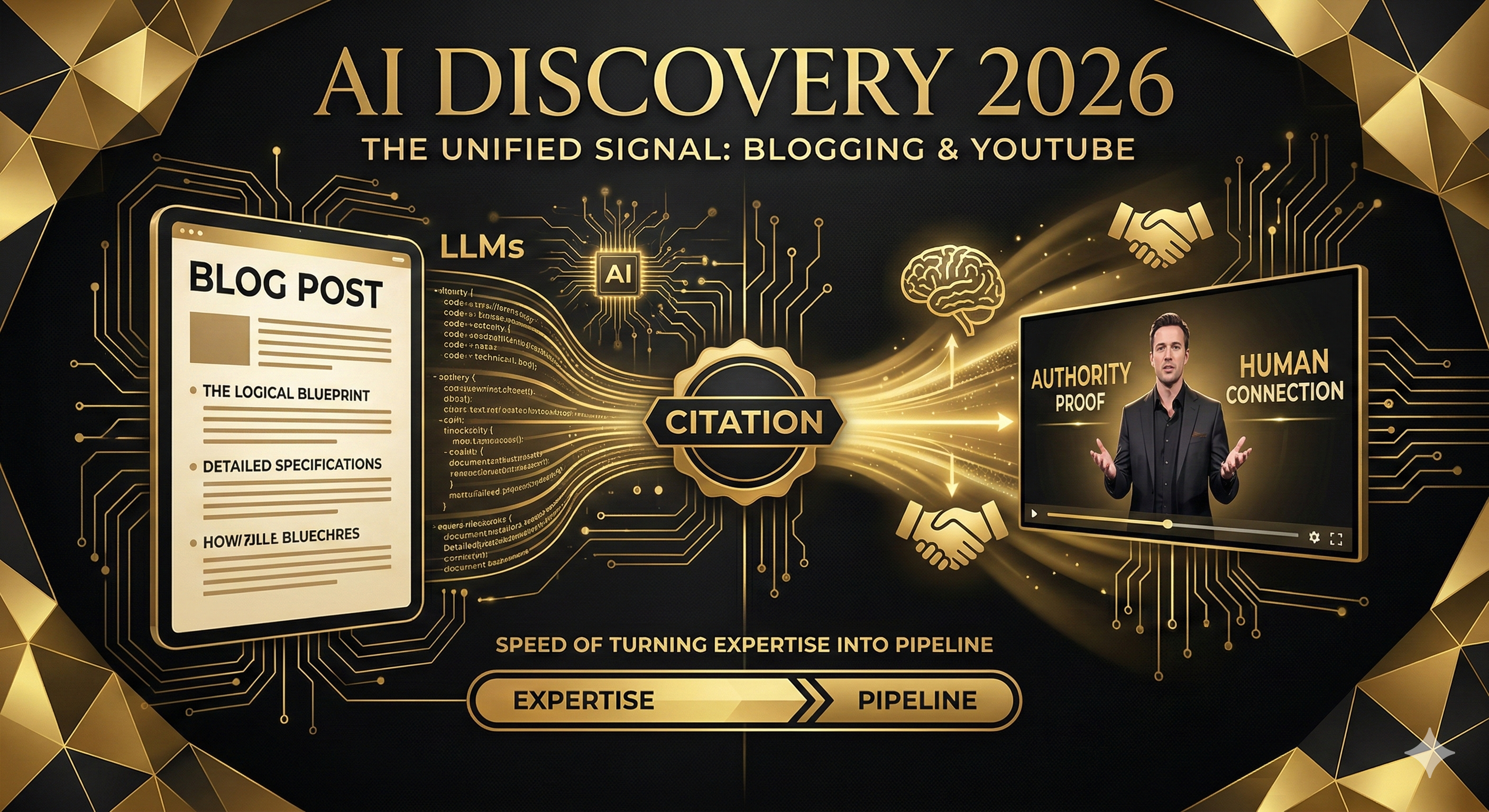
For AI discovery in 2026, the real question is not blogging or YouTube.
It is how fast you can turn expertise into pipeline.
Blogs help AI engines understand your logic. YouTube helps them trust the expert behind the claims. When unified correctly, this combination reduces sales friction because prospects arrive pre-sold.
Businesses relying on only one format often struggle not just with citations, but with conversion velocity.
Goal | Best Format |
| Technical explanations | Blogging |
| Authority proof | YouTube |
| AI citation potential | Both together |
| Lead generation | Both together |
| Trust signals | YouTube |
| Structured indexing | Blogging |
Blogging remains the most efficient way to feed an AI engine structured logic. Because Large Language Models (LLMs) were born from text, they can parse a well-structured blog post, complete with technical specs, nuanced arguments, and clear headings, faster than any other medium.
YouTube is no longer just a video platform; it is a Multimodal Proof engine. When an AI summarizes a "Best of" list for a buyer, it looks for high-confidence signals.
Video transcripts provide something text can't: a human voice, a face, and a real-time demonstration.
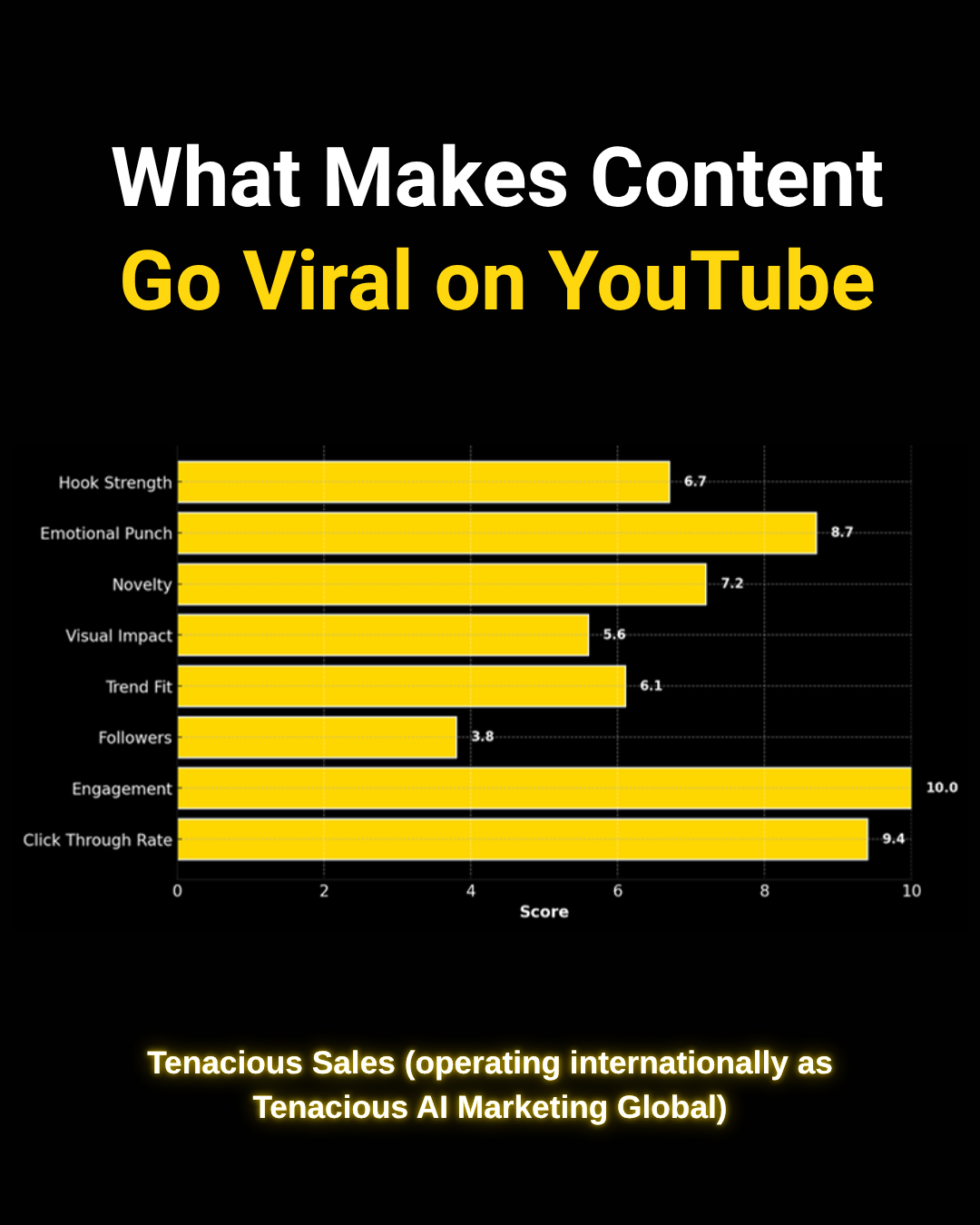
In some situations, blogging alone can still support AI discovery effectively.
Blogging-first strategies work best when:
When implemented correctly, this reduces cost per acquisition because education and trust-building happen before the sales call.
The traditional "click" is becoming a rare commodity. To navigate this shift, businesses must pivot to Generative Engine Optimisation (GEO), where the goal is no longer just ranking for clicks but becoming a cited source within the AI-generated summary.
With Google’s AI Overviews (SGE) now triggering on approximately 15% to 25% of all queries, and up to 88% for informational searches, users often get their answers without ever visiting your site.
However, when you integrate YouTube with your blog, you aren't fighting for a link; you are fighting for a citation. AI engines like Perplexity and SearchGPT treat video transcripts as high-fidelity "Source Files."
Research shows that YouTube accounts for nearly 30% of citations in informational AI queries.
By providing a video alongside your text, you give the AI the multimodal evidence it needs to trust your brand's logic, effectively turning a "Zero-Click" search into a high-intent brand recommendation.
To understand where to put your energy, you have to look at how these formats perform in the "eyes" of the AI and the end-user.
| Metric | Blogging (Text-Only) | YouTube (Video + Transcript) | The Unified Signal (Both) |
| AI Citation Probability | 15% | 29.5% | 45% + |
| Average User Dwell Time | 45 Seconds | 6 Minutes | 12 Minutes+ |
| User Engagement | Baseline | 12% more page views | 41% longer sessions |
| Search Volume Risk | 25% Projected Drop | Neutral (Platform growth) | Buffered (Omnichannel) |
| Trust Signal Strength | Low (Suspected "AI Slop") | High (Proof of Life) | Highest (Verified Entity) |
Data from Adobe (2025) reveals that AI-driven traffic to websites has jumped 12x in the last year. These AI-referred visitors generate 12% more page views and spend 41% more time on-site than non-AI traffic.
The reason for this increase in conversion is Identity Resolution. When you record a video and then use that transcript to build a structured blog, you are telling the AI: "The expert you see in this video is the same entity behind this technical blog."
This cross-verification allows you to bypass the "Hallucination Risk" filter. If you ignore one or the other, you are asking the AI to trust you with only half the evidence, a gamble that rarely pays off in a market where Gartner predicts traditional search volume will drop 25% by the end of 2026.
The secret to winning in the discovery layer is not producing more content, but producing interlocked content. In 2026, AI engines perform a "Verification Handshake." When the AI finds a technical claim in your blog, it cross-references its database for other data types that support that claim.
If you have a YouTube video discussing the exact same topic, the AI extracts the transcript, matches the semantic "fingerprint" of your voice to the text of your blog, and confirms the Entity Resolution.
This isn't just SEO; it is GEO. By using your video as the "Source of Truth" for your blog, you create a verified loop of evidence. This grounds the AI in your specific data, making it nearly impossible for it to hallucinate about your services or prioritize a competitor over your brand.
The Minimum Revenue System for AI Discovery
You do not need a full studio. You need structure.
Step 1 — Record Authority
Publish one YouTube video per month answering a high-value buyer question.
Step 2 — Convert to Indexable Assets
Turn each transcript into a structured blog post with headings, internal links, and schema.
Step 3 — Connect to Revenue
Link each asset to CRM workflows, lead routing, and automated follow-ups so discovery turns into pipeline.
This creates a discovery engine that compounds instead of a content treadmill that exhausts you.
To see how to accelerate this process, watch Dean's breakdown of the secret to getting noticed in an AI world, where he introduces the VITAL Framework to help brands go from invisible to being cited and recommended by AI engines.
Trust in the AI era is a math problem. Dean Whitby’s 7-11-4 Rule (7 hours of content, 11 touchpoints, 4 locations) is the definitive threshold for the AI era.
By using video as a "source file," you can collapse this nurturing timeline within 90 days, engineering the exact "AI Citation Readiness" required to be the recommended option in your niche.
If you only blog, you’ll never get someone to spend 7 hours with your brand. If you only do YouTube, you might not have enough technical indexing for the AI to resolve your brand's identity across the Knowledge Graph.
By unifying them, you build a system that converts while you sleep.
We are currently entering the era of "AI Slop", an infinite ocean of low-quality, text-only content designed to trick search engines. If you only provide text, you are competing on a level playing field with bots. A Visual Moat is the only structural defense against this commoditization.
While an AI can summarize your blog's key points, it cannot replicate the 7:11:4 intimacy created when a human sees your face and hears your unique perspective on YouTube. This multimodal presence creates a "Confidence Signal" that is 5x stronger than text alone.
According to 2026 consumer behavior data, B2B buyers are 74% more likely to trust a technical blog if it is accompanied by an embedded video of the author explaining the core concepts.
You aren't just blogging for a machine; you are using the video to provide the "Proof of Life" that seals the deal with the human at the end of the AI’s recommendation.
In the current landscape, AI discovery is not about content preference. It is about building a multimodal authority system that engines can verify and prospects can trust.
If your blog and YouTube channel are not structurally connected, you are invisible to the discovery layer.
If you are unsure whether AI engines currently recognise your brand as a verified authority, request an AI Discovery Audit.
We analyse:
• Whether you are cited by AI models
• Whether your transcripts are extractable
• Whether your authority is machine-readable
• Where competitors outperform you
You leave with a clear roadmap to turn visibility into revenue. Consult us to become the chosen one.
Does Google prioritize YouTube videos in AI Overviews?
Yes. Google’s AI Overviews frequently feature video carousels and transcript snippets because they provide a "richer" and more verifiable answer than static text.
Is a blog still relevant if AI answers everything directly?
Yes, but its role has changed. Your blog is no longer a "destination" for humans; it is a Source File for the AI to formulate its answer.
What if I don't have time for both?
Then you are leaving a "Competitive Chasm" open. Start with video, it is the hardest to fake, and use an AI Agent to turn those transcripts into technical, high-fidelity blogs.
Can AI understand my business through my personal brand?
Yes. AI models resolve entities by linking high-authority individuals to their respective companies. Consistent video content is the fastest way to anchor this authority.
Which one helps me get on the "AI Tender List" faster?
The combination. The "AI Tender List" is a shortlist of trusted entities. The engine chooses the brand with the most consistent, multimodal evidence of expertise.