.jpg)
In 2026, positioning as a specialist is a commercial necessity because Generative Engines (GEO) and high-value buyers filter for specific "Entity" authority, leaving generalists to be compared on price while specialists are chosen for their unique methodology.
There is a quiet, underlying fear that keeps most founders trapped in mediocrity: The Fear of Missing Out (FOMO). It usually manifests during a discovery call. A prospect asks, “We’re actually looking for someone who can also handle our [Generic Task Y]... can you do that too?”
The generalist, hungry for the revenue and terrified of a "No," smiles and says, “Yes, absolutely. We’re a full-service partner.”
In that single moment, you haven't closed a deal; you’ve signed a death warrant for your margins. By saying "Yes" to everything, you have signaled to the market that you are a commodity "pair of hands" rather than a strategic partner.
You have effectively told the prospect that your time is a fungible resource that can be applied to any task they deem necessary.
This is the Generalist’s Trap. It leads to a permanent state of "Hustle Fatigue," where you are constantly pivoting your delivery, reinventing your process for every new client, and competing against broad-market agencies that have ten times your headcount and half your price.
In 2026, being a "Swiss Army Knife" doesn't make you versatile, it makes you a tool that is easily replaced by a specialized $20/month AI subscription.
In the previous decade, marketing was about being the best. In 2026, marketing is about being the only.
When a high-value buyer has a "Bleeding Neck" problem, they don't go to Google to find a "Marketing Agency."
They go to an AI-integrated search engine like Perplexity or ChatGPT to find the Only person who has solved that specific problem using a documented, repeatable framework.
Generative Engine Optimization (GEO) has fundamentally changed how authority is assigned. AI agents do not "read" websites; they identify entities.
Watch Dean explain why businesses that fail to build this "Entity" authority will become invisible in the new AI search economy.
Specialization isn't about limiting your options; it’s about ensuring that when the market asks the "Answer Engines" for a specific solution, your name is the only one that appears.
The most common pushback I hear from founders is: "But if I niche down, I'm cutting out 90% of my potential market!" This is an optical illusion.
You aren't cutting out 90% of your market; you are cutting out 90% of your competition. Consider the "Heart Surgeon" vs. the "General Practitioner."
A General Practitioner (GP) knows a little bit about everything. They are essential, but they are a commodity. They are paid a standard rate, and their schedule is dictated by a massive healthcare system.
The Heart Surgeon, however, does one thing. They do it at a world-class level. They don't have to "market" their services; they are sought after. They don't negotiate their rates; they are paid a premium because the cost of failure in their niche is total.
Specialization creates Pricing Power. When you are a generalist, the prospect compares you to every other generalist. When you are the specialist who solves a specific problem for a specific type of founder using a specific methodology (your Signature IP), there is no comparison.
Furthermore, specialization allows you to install Leverage (The 'L' in VITAL). Because you are solving the same problem repeatedly, you can build a refined system.
You stop "reinventing the wheel" for every client and start running a high-performance machine. You move from "hours worked" to "outcomes delivered."
To survive the AI shift and escape the commodity trap, your positioning must be built on three non-negotiable pillars:
You must move from a generic job title to a proprietary role. You are no longer a "Business Consultant." You are an "Insight Architect for [Specific Niche] using the [Named Framework]."
This immediately removes you from the "comparison" pile. It forces the prospect to evaluate you based on your unique logic rather than your hourly rate.
Your positioning must be polarized. You must have a "New Way" of solving problems that explicitly rejects the "Old Way."
This acts as a Border Guard. It repels the "C-player" clients who want a cheap fix and magnetically attracts the "A-players" who have tried the old way and are desperate for your specific logic. If your website doesn't make at least 30% of visitors think, "This isn't for me," your positioning is too weak to convert.
True specialists don't just answer the client's questions; they change the questions the client is asking. By the time a prospect finds you, they think they know what their problem is. Your job is to show them the Insight Gap, the hidden architectural flaw that they haven't seen.
When you reframe the problem, you automatically become the only person qualified to provide the solution.
The numbers back this up. We are no longer in an era where "good enough" visibility wins.
According to the 2025 Edelman-LinkedIn Thought Leadership Impact Report, 73% of B2B decision-makers state that specialized thought leadership is a more trustworthy basis for assessing a partner's capabilities than their marketing materials.
Generalist content is ignored; specialized insight is the currency of trust.
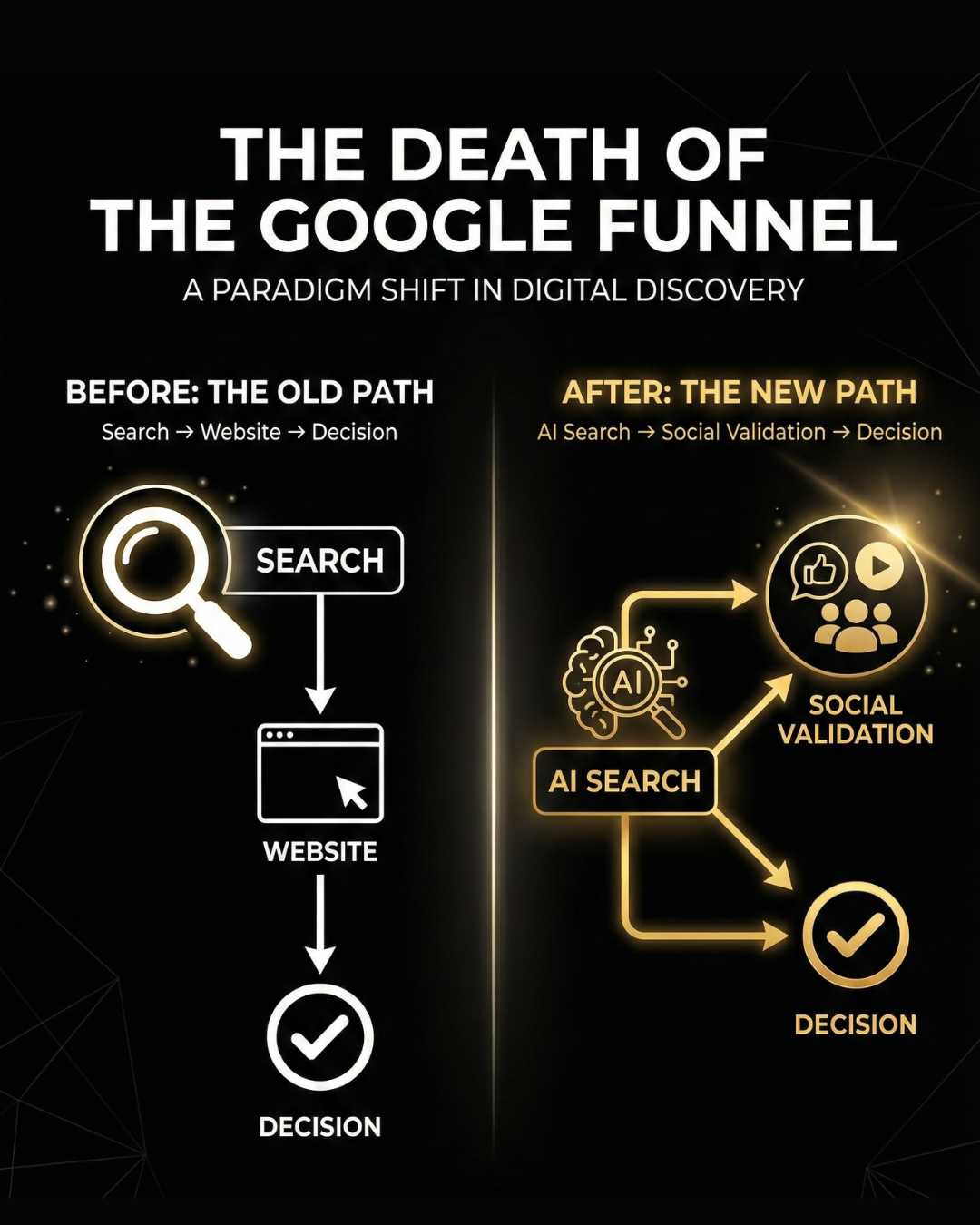
Research from Gartner confirms that by 2026, traditional search volume will drop by 25% as users migrate to AI agents. These agents prioritize "deep-niche authority" over "broad-market relevance."
If you aren't a specialist, you are invisible to the engines that now drive the buyer journey.
The table below summarizes the critical distinctions between remaining a versatile "generalist" and evolving into a "Category of One" specialist.
| Feature | The Generalist | The Specialist |
| Market Identity | Viewed as a commodity "pair of hands". | Recognized as a strategic "Entity". |
| Pricing Strategy | Compared on price and hourly rates. | Driven by pricing power and outcomes. |
| AI Search (GEO) | Classified as "Noise" and remains uncitable. | Identified as an authoritative primary source. |
| Workflow | Constant "Hustle Fatigue" from reinventing processes. | High-leverage systems using a repeatable machine. |
| Client Interaction | Says "Yes" to everything to avoid FOMO. | Acts as a "Border Guard" to repel C-players. |
| Strategic Role | Answers the client's questions. | Changes the questions the client is asking. |
| AI Replaceability | Easily replaced by $20/month AI subscriptions. | Supported by AI to scale proprietary frameworks |
The "Invisible Expert Problem" is almost always a positioning problem in disguise. You are invisible because you are trying to be seen by everyone.
In the 2026 market, the "middle ground" is a graveyard. You can either be a low-cost commodity (scaled by AI) or a high-value specialist (supported by AI). There is no third option.
If you want to stop being compared on price and start being chosen for your genius, you have to stop being a "Swiss Army Knife."
You have to extract your framework, define your identity, and build the architecture that makes you the Only Obvious Choice in your category. Execution over Theory. Architecture over Algorithms. Systems over Hustle.
Stop being a generalist "pair of hands." Become the specialist architect your market is actually looking for. Book a call with our team now.
Won’t I lose out on business if I narrow my focus?
You will lose "bad" business, the price-sensitive, high-maintenance clients, and replace it with high-margin, high-respectable "A-player" contracts.
How do I choose a niche if I’m good at multiple things?
Choose based on where the "Bleeding Neck" pain is highest and where your YouTube Revenue Infrastructure provides the most leverage.
Does specialization require me to turn away current clients?
Not immediately, but it requires you to stop marketing to them, allowing your old "generalist" revenue to be phased out by your new "specialist" assets.
How does my "Signature IP" help me stay a specialist?
Your Signature IP is the "moat" around your business; it is a proprietary logic that cannot be easily copied by AI or generalist competitors.
What is the first step to shifting my positioning today?
Audit your digital footprint and remove any "safety words" like bespoke, tailored, or full-service that signal you are a generalist commodity.
Can AI replace a specialist?
AI can replace specialized tasks, but it cannot replace the Insight Architect who designs the system and owns the proprietary framework that the AI uses as a reference.
How do I handle a prospect who wants me to do "Generalist" work?
You use the VITAL Filter: explain that your system is designed for a specific outcome and that deviating into general tasks would compromise the ROI you are hired to deliver.