
There is a new role emerging in digital marketing, and most businesses have not properly hired for it yet.
The role is called an AI Visibility Engineer.
Some people call it a GEO specialist. Others call it an AI search consultant, an AEO strategist or an AI visibility consultant. The title will probably keep changing for a while, because the category is still young. But the work itself is already becoming clear.
An AI Visibility Engineer helps businesses become visible, trusted and recommended inside AI-generated answers.
This matters because buyers are no longer only using Google in the traditional way. They are asking ChatGPT, Perplexity, Claude, Gemini and Google AI for advice, comparisons, recommendations and shortlists. Those answers can shape which businesses get researched, trusted and contacted.
A buyer might ask:
“Who are the best accountants for a growing tech startup?”
“Which solar installers are trusted in Yorkshire?”
“What marketing agency can help with AI visibility?”
“Which CRM consultant is best for small businesses?”
“Who are the best leadership coaches for scaleup founders?”
In the old search world, businesses fought to rank on Google. In the AI search world, businesses are fighting to be included inside the answer.
That is the opportunity.
This guide explains what an AI Visibility Engineer does, what skills you need, what tools to use, how to audit AI visibility, how to improve it, how to package your services and how to get your first clients.
An AI Visibility Engineer is someone who helps a business improve how it appears across AI-generated search answers.
The role is not just traditional SEO with a new name. It is not simply content writing, technical SEO, digital PR or prompt testing. It is a combination of all those disciplines, focused on one outcome: making a business easier for AI systems to understand, trust, cite and recommend.
An AI Visibility Engineer looks at how a business is described online, how clearly its website answers buyer questions, whether its entity signals are consistent, whether its content is structured well enough to be cited, and whether AI tools are already recommending competitors instead.
In practical terms, the work can include website audits, AEO and GEO content strategy, AI prompt testing, schema recommendations, Google Business Profile optimisation, listing consistency checks, review analysis, LinkedIn authority building, YouTube transcript strategy, digital PR, case study planning, service page improvement and FAQ development.
The simplest way to explain the role is this:
An AI Visibility Engineer helps a business answer the question, “When our ideal customer asks AI for help, do we show up?”
If the answer is no, your job is to find out why and build a system to improve it.
For a deeper explanation of GEO itself, read What Is GEO in 2026 and How Do You Get Cited in AI Answers?.
AI search is changing how people research products, services and providers.
A buyer does not always start by searching Google, clicking through ten blue links and reading five websites. Increasingly, they ask an AI tool for a summary, recommendation, comparison or shortlist. That shift changes what visibility means. This wider shift is explained in The New Rules of AI Search: 4 Strategies Every Brand Needs to Win Citations
A business might still have decent Google rankings, a respectable website and good reviews, but if it does not appear when someone asks an AI tool for recommendations in its sector, it is invisible in a growing part of the buyer journey.
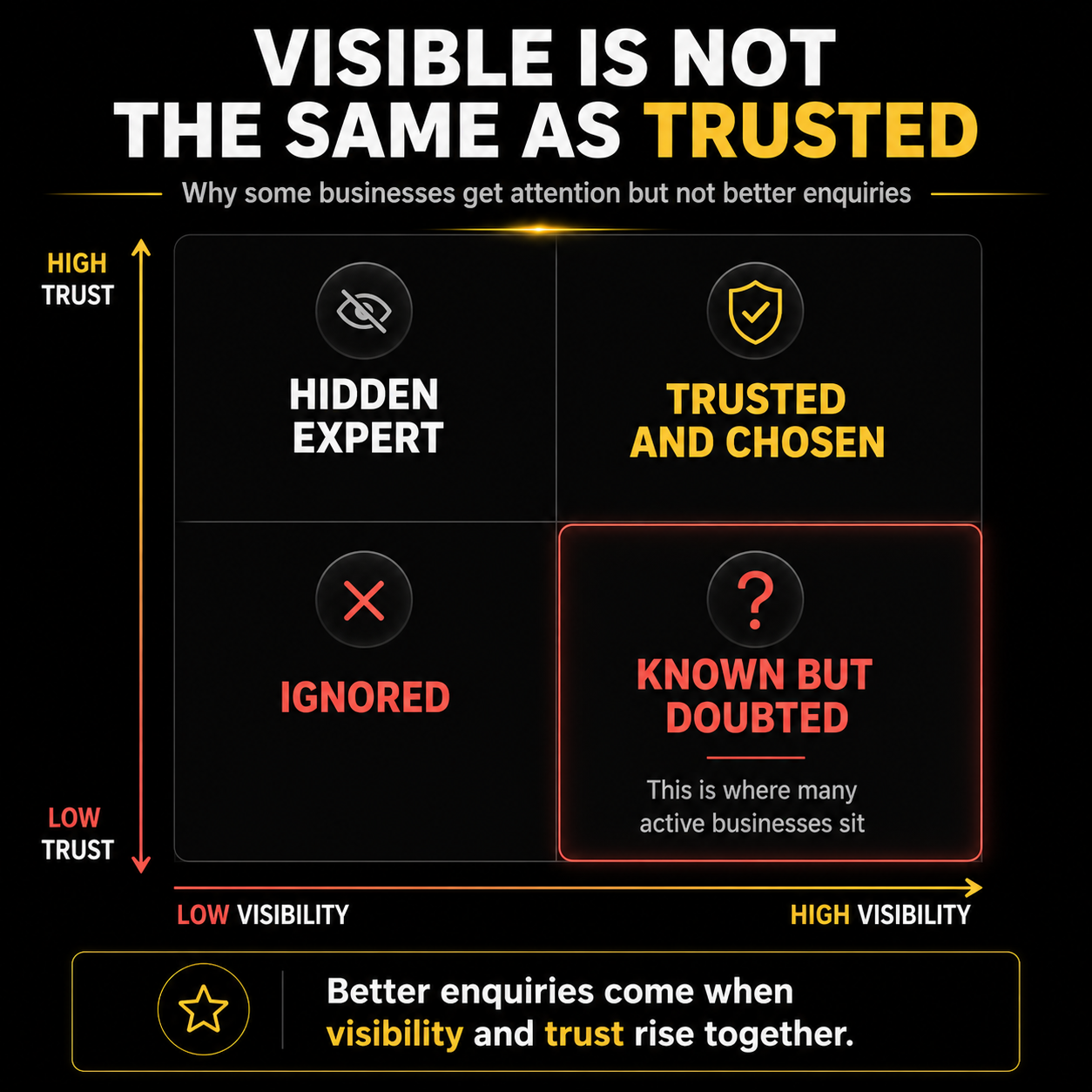
This creates a new problem for business owners and marketing teams. They know AI search matters, but many do not know how to check their current visibility, what influences AI recommendations or what to fix first.
That gap creates the need for AI Visibility Engineers.
The timing matters because the category is still forming. Traditional SEO agencies are beginning to talk about GEO, but many are still applying old SEO thinking to a new search environment. Businesses need specialists who understand that AI visibility is not only about rankings. It is about entity clarity, useful content, third-party trust signals, consistent positioning and measurable prompt visibility.
Role | Main Focus | Main Outcome |
| SEO Specialist | Improving rankings in search engines | More organic traffic |
| Content Marketer | Creating useful content for a target audience | Engagement, trust and leads |
| Digital PR Specialist | Earning third-party mentions and authority | Backlinks, coverage and credibility |
| Brand Strategist | Clarifying positioning and differentiation | Clearer market perception |
| AI Visibility Engineer | Making a business visible inside AI-generated answers | AI mentions, citations and recommendations |
An AI Visibility Engineer does not replace these roles. In reality, the best AI visibility work borrows from all of them.
You still need SEO because technical foundations, crawlability and content structure matter. You need content strategy because AI systems need clear answers to cite. You need brand strategy because vague positioning weakens entity clarity. You need digital PR because third-party mentions help build authority. You need reporting because clients need evidence that the work is creating movement.
The difference is the end goal.
Traditional SEO asks, “Can this page rank?”
AI visibility asks, “Can this business be recommended?”
That is a different question, and it requires a different kind of thinking.
An AI Visibility Engineer has five core responsibilities.
The first is diagnosis. Before you can improve visibility, you need to know what AI currently says about the business. This means testing real commercial prompts across tools such as ChatGPT, Perplexity, Claude, Gemini and Google AI. You are looking at whether the client appears, which competitors appear, which sources are cited and whether the business is described accurately.
The second is buyer question mapping. AI search is conversational, which means people ask questions in natural language. A business that only writes about itself will struggle. A business that answers the questions buyers are actually asking has a much stronger chance of being included in AI-generated answers.
The third is entity clarity. AI systems build their understanding of a business from multiple sources, including the website, LinkedIn, Google Business Profile, YouTube, directories, review sites, podcasts, articles and third-party mentions. If those sources tell an inconsistent story, the business becomes harder to understand.
The fourth is citation-ready content. This means creating content that is clear, structured, specific and useful enough for AI systems to extract and reference. Strong GEO content usually includes direct answers, definitions, examples, tables, FAQs, internal links, external authority links and original expertise.
The fifth is tracking. AI visibility is not a one-off task. It needs to be measured over time so the client can see whether they are appearing more often, whether competitors are still dominating and whether the business is being described more accurately.
You do not need to be a coder to become an AI Visibility Engineer. You do not need a computer science degree, and you do not need ten years of agency experience.
What you do need is a specific mix of practical skills.
Research is the foundation of AI visibility work. You need to investigate what buyers are asking, how competitors are appearing, which sources AI tools are citing and where the client’s digital presence is weak.
This work is not always glamorous, but it is where the value is created. A good diagnosis leads to a strong strategy. A weak diagnosis usually leads to random activity, and random activity is hard to sell, hard to measure and hard to defend.
AI visibility depends heavily on clear communication.
The content that performs best in AI search is usually specific, structured and easy to understand. It answers questions directly. It uses plain language. It avoids vague claims and unnecessary waffle.
You do not need to write like a novelist. You need to write like someone a buyer can trust. That means being useful, accurate and clear.
Clients do not pay for AI visibility because it sounds interesting. They pay because they want more trust, better leads, shorter sales cycles, stronger positioning and more inbound opportunities.
An AI Visibility Engineer needs to connect visibility to commercial outcomes. That means understanding what the client sells, who they sell to, what the buyer journey looks like and which prompts are commercially valuable.
Not every AI mention matters. A mention on a buying-intent prompt is far more valuable than a mention on a vague educational query.
GEO is not one tactic. It is a system.
Website clarity supports content. Content supports citations. Listings support entity trust. Reviews support credibility. YouTube supports authority. LinkedIn supports founder expertise. Digital PR supports third-party validation.
An AI Visibility Engineer needs to understand how these pieces connect. The real value is not in doing one of them in isolation. The value is in building a visibility system that compounds over time.
You also need to become confident with the tools of the trade. That includes AI tools, SEO tools, website crawlers, schema validators, prompt tracking tools, reporting templates and content planning systems.
You do not need to master everything on day one. But you do need to be willing to learn quickly, test often and build repeatable processes.
Tool Category | Example Tools | Why They Matter |
| AI visibility tracking | Answer Architect | Measures prompts, AI visibility and what needs fixing |
| AI testing | ChatGPT, Perplexity, Claude, Gemini, Google AI | Shows how the business appears across answer engines |
| SEO research | Ahrefs, Semrush, Google Search Console | Finds search demand, content gaps and competitor visibility |
| Question research | AlsoAsked, AnswerThePublic, People Also Ask | Finds natural-language buyer questions |
| Technical checks | Screaming Frog, Google Rich Results Test | Finds crawl, structure and schema issues |
| Schema | Schema.org tools, Rank Math, Yoast, custom schema generators | Helps AI and search engines understand page content |
| Listings | Google Business Profile, BrightLocal, industry directories | Builds consistent entity signals |
| Content production | Google Docs, Notion, ChatGPT, Claude | Helps plan, draft and manage content |
| Reporting | Looker Studio, Canva, Google Slides | Turns findings into client-ready reports |
| Sales | LinkedIn, Apollo, HubSpot, Calendly | Helps find and manage prospects |
Tools do not replace judgement, but they make your work faster, clearer and easier to prove.
For example, Answer Architect helps you turn AI visibility from a vague idea into something you can test and track. That matters because clients need to see more than opinions. They need to see where they currently appear, where they do not, which competitors are being mentioned and what needs fixing.
A good AI visibility engagement should follow a repeatable process. Without a process, GEO becomes vague, and vague services are harder to sell.
Here is a practical framework you can apply to almost any client.
Step | What You Do | Client Outcome |
| 1. Diagnose | Test current AI visibility across key prompts | Shows where they appear, where they do not, and who is winning |
| 2. Define | Clarify buyer questions, services, locations and commercial priorities | Creates a focused strategy |
| 3. Align | Standardise messaging across website, listings and profiles | Improves entity clarity |
| 4. Structure | Improve website pages, schema, FAQs and internal links | Makes the site easier to understand and cite |
| 5. Create | Publish content that answers buyer questions | Builds topical authority |
| 6. Distribute | Repurpose across LinkedIn, YouTube, email, PR and profiles | Builds repeated authority signals |
| 7. Track | Monitor prompts, citations and competitor movement | Proves progress and guides next actions |
Every engagement should start with a baseline audit.
This is where many new consultants make a mistake. They jump straight into content ideas before checking what AI already says. That is risky because the issue may not be content volume. It may be inconsistent listings, weak service pages, unclear positioning, missing schema or competitors dominating third-party sources.
Start with the prompts that matter commercially.
For a B2B marketing agency, you might test prompts such as:
“Best B2B marketing agencies for AI visibility”
“Who can help my business get cited by ChatGPT?”
“Best GEO agencies in the UK”
“How do I improve my visibility in Perplexity?”
For each prompt, record whether the client appears, which competitors appear, what sources are cited, what language the AI uses and whether the answer is accurate.
This gives you the baseline. Without a baseline, you cannot prove improvement. For a practical checklist, read How to Audit Your Website for AI Visibility in 2026
Once you understand the current visibility picture, the next step is mapping the questions the client’s buyers ask before they buy.
A useful buyer question map should include awareness questions, comparison questions, cost questions, risk questions, trust questions, location questions and service-specific questions.
For example, a renewable energy installer might need content around solar costs, battery storage, heat pumps, MCS accreditation, payback periods and local installer comparisons. An accountancy firm might need content around tax planning, fractional CFO services, payroll, VAT, startup accounting and UAE company setup.
The goal is to stop guessing what content to create. Instead, you build content around the questions that influence buying decisions.
AI needs to understand what the business is, who it serves and why it is credible.
That sounds obvious, but many businesses make this difficult. Their homepage says one thing, their LinkedIn says another, their Google Business Profile has old categories, their directory listings use outdated descriptions and their founder bio does not mention the core service.
The result is confusion.
Your job is to align the entity.
That means creating a clear source of truth for the business name, founder or leadership names, core services, primary audience, locations served, proof points, accreditations, industry categories, key differentiators and preferred business description.
Once that is clear, update the website, profiles, listings and content to match.
This is one of the least glamorous parts of the work, but it is also one of the most important. AI systems are more likely to trust a business when the same core facts are repeated clearly across trusted sources.
A website built for AI visibility needs to be easy to parse.
That means clear pages, clean headings, direct answers, logical internal links and schema where appropriate. The website should not force AI or humans to work hard to understand what the business does.
At minimum, most businesses should have a clear homepage, specific service pages, sector or use-case pages where relevant, a strong about page, case studies, reviews or testimonials, FAQ pages, blog content answering buyer questions and a contact page.
For GEO, the website should not only describe the company. It should answer the questions buyers ask before they contact the company.
This is where AI visibility and conversion overlap. A clearer website helps AI systems understand the business, but it also helps human buyers trust the business faster.
Citation-ready content is not just SEO blog content with a few AI terms added.
It is content designed to become a reliable answer source.
Strong GEO content usually includes a direct answer near the top, clear definitions, specific examples, comparison tables, FAQ sections, internal links, external authority links, commercial context and an original point of view.
For example, an article titled “What is GEO?” should not spend 800 words slowly warming up. It should define GEO early, compare it with SEO, show how it works, explain who needs it and include a practical checklist.
AI systems need clarity. Humans need clarity too.
The best citation-ready content serves both.
Publishing on the website is important, but it is not enough on its own.
AI systems build confidence from repeated signals across the web. This means your content should be repurposed and distributed through relevant authority channels such as LinkedIn, YouTube, Google Business Profile, email newsletters, podcasts, directories, partner websites, trade publications, webinars and press opportunities.
One strong blog can become a LinkedIn post, a YouTube script, a short video, a sales email, a Google Business Profile update, a carousel, a podcast talking point, a FAQ schema section and a case study reference.
This is how one idea becomes a wider authority signal. For more on building visibility across multiple platforms, read Search Everywhere Optimisation: How to Be Cited by AI and Trusted by People
The goal is not to be everywhere for the sake of it. The goal is to make sure the same expertise is visible across the places AI systems and buyers are likely to encounter.
Clients need to see what changed.
A monthly GEO report should show prompt visibility, AI mentions, AI citations, competitor mentions, sources cited, new content published, listings fixed, schema improvements, technical changes, traffic movement and next actions.
The key is to connect activity to visibility.
Do not only report that four blogs were published. Report which buyer questions those blogs target, whether AI is starting to cite them, which competitors still appear ahead and what needs to happen next.
That is the difference between content delivery and AI visibility engineering.
The easiest way to start is with a simple product ladder.
Package | Price Range | What It Includes | Best For |
| AI Visibility Snapshot | Free to £250 | Quick prompt check and short findings summary | Lead generation |
| AI Visibility Audit | £500 to £2,000 | Full prompt testing, competitor review, website review and action plan | First paid offer |
| GEO Foundations Project | £2,000 to £8,000 | Website structure, listing alignment, schema recommendations and content plan | Businesses needing setup |
| Monthly GEO Retainer | £1,000 to £5,000+ per month | Content, tracking, reporting, distribution and ongoing optimisation | Long-term growth |
| GEO plus YouTube Authority | £2,500 to £7,500+ per month | GEO retainer plus video strategy and content production | Founder-led or expert-led brands |
When you are starting, do not try to sell everything at once. Start with an audit.
A good audit makes the problem visible. Once the client sees the gap between where they are and where they could be, the next step becomes easier to sell.
Your first clients will probably come from your existing network, LinkedIn or a niche you already understand.
The mistake most people make is leading with a generic service pitch. “I offer GEO services” means very little to most business owners. They may not understand GEO yet, and even if they do, they are more interested in their own visibility than in your service label.
A stronger approach is to lead with a finding.
For example:
“I tested what ChatGPT and Perplexity say when someone asks for providers in your sector. You do not appear, but two competitors do. I recorded the prompts and sources. Worth me sending the findings?”
That works because it is specific. You are not selling theory. You are showing the prospect something real about their current market position.
Hi [Name],
I was testing how AI tools answer buyer questions in your sector and noticed something interesting.
When I asked ChatGPT and Perplexity about [specific buyer query], a few competitors appeared, but I could not see [Company Name] being mentioned.
This matters because more buyers are using AI tools to research and shortlist providers before they ever visit Google.
I pulled together a quick AI visibility snapshot. Happy to send it over if useful.
Some sectors are more ready for AI visibility services than others.
Good early niches include accountants, law firms, marketing agencies, solar and renewable energy installers, SaaS companies, recruitment firms, coaches, consultants, financial advisers, cybersecurity firms, training providers, property professionals and B2B service businesses.
The best niches usually have three things in common: high-value clients, long research journeys and trust-based buying decisions.
That is where AI visibility matters most.
If someone buys on impulse, GEO may not be urgent. But if they research, compare, ask questions and need trust before enquiring, AI visibility can influence whether your client even makes the shortlist.
You should not undercharge forever, but you also should not pretend to be an enterprise consultancy on day one.
A sensible starting point might be £500 to £1,000 for your first paid AI visibility audit, £1,500 to £3,000 for a GEO foundations project and £750 to £1,500 per month for your first retainer.
As your proof improves, your pricing should increase. Once you have case studies, testimonials, repeatable reports and a clear delivery system, your fees can move up quickly.
The category is early, which means pricing is still being shaped. Practitioners who can prove outcomes will be able to command strong fees.
You need to be careful here.
Do not promise instant AI rankings or guaranteed citations. AI answers are dynamic. They vary by platform, prompt, source availability, location, user context and model behaviour.
What you can promise is a structured process to improve the signals that make AI visibility more likely.
That includes clearer website structure, better buyer question coverage, improved entity consistency, stronger schema, more useful content, better source alignment, regular AI visibility tracking, competitor monitoring and better reporting.
You are not selling magic.
You are selling clarity, structure and measurable improvement.
That distinction matters because it protects your credibility.
Mistake | Why It Hurts |
| Selling GEO without showing a diagnostic | The client cannot see the problem |
| Treating GEO like normal SEO | AI answers use broader signals than rankings alone |
| Writing generic blogs | Generic content is unlikely to be cited |
| Ignoring listings and entity consistency | AI may struggle to understand the business |
| Not tracking prompts | You cannot prove movement |
| Overpromising results | Damages trust |
| Trying to serve every industry | Makes positioning weaker |
| Forgetting commercial intent | Visibility only matters if it supports revenue |
The most common mistake is trying to sound like an expert before doing the diagnostic work. The easiest way to become credible is to test real prompts, show real findings and explain what needs fixing in plain English.
You should use the same process on yourself.
If you want clients to trust you with their AI visibility, you need to become visible around the topic too. That does not mean you need to be famous. It means you need to publish enough useful content that buyers can understand your expertise.
Start creating content around topics such as:
What is GEO?
What is AI visibility?
How to check if your business appears in ChatGPT
Why SEO alone is no longer enough
How AI chooses which businesses to recommend
How to structure a website for AI citations
Best tools for tracking AI visibility
How to write content that gets cited by AI
GEO vs SEO
AEO vs GEO
Use LinkedIn to share quick audits, lessons, examples and practical advice. Use YouTube if you can explain ideas clearly on camera. Build a simple website page explaining who you help, what your audit includes and what outcome a client should expect.
Then track your own prompts.
You cannot sell visibility while being invisible yourself.
It sounds harsh, but it is true.
If you are serious about this path, keep learning from real tools, real tests and real examples.
Useful resources include:
Answer Architect for checking AI visibility and finding what to fix.
Google’s guide to AI features in Search for understanding how Google talks about AI search from a site owner perspective.
Perplexity for testing answer engine citations and source patterns.
ChatGPT for prompt testing, research workflows and content ideation.
Build With Dean on YouTube for practical lessons on AI visibility, GEO, marketing strategy and building authority.
You can also explore the Tenacious AI Marketing website for services, examples and the wider GEO approach.
For proof of how GEO, AEO and SEO can work together, visit the Tenacious results page.
Your first year should be treated like building a professional skill, not chasing a quick side hustle.
In months one and two, focus on learning the fundamentals. Run practice audits. Study how different AI tools answer commercial questions. Build your first templates. Publish your first content explaining what you are learning.
In months three and four, aim for your first paid audit. This might come from your network, LinkedIn or a warm introduction. Price it fairly, deliver it properly and turn the experience into a case study.
In months five and six, improve your process. Create a repeatable audit template, a reporting format, a content plan structure and an outreach system.
In months seven to twelve, aim for two to four retained clients. At that point, you are no longer just learning. You are building a specialist practice.
This is realistic if you stay focused. It is not realistic if you keep changing niche, changing offer and chasing every shiny AI tool on the internet.
Related Reading
What Is GEO in 2026 and How Do You Get Cited in AI Answers? - A clear guide to what Generative Engine Optimisation means, how AI citations work and why businesses need to become trusted answer sources.
The New Rules of AI Search: 4 Strategies Every Brand Needs to Win Citations - Explains how AI search is changing buyer behaviour and what brands need to do to become visible inside AI-generated answers.
How to Audit Your Website for AI Visibility in 2026 - A practical checklist for reviewing whether a website is structured clearly enough for AI systems to understand, trust and cite.
Search Everywhere Optimisation: How to Be Cited by AI and Trusted by People - Shows how visibility now depends on multiple platforms, including your website, AI tools, YouTube, LinkedIn, Google and trusted third-party sources.
The Top 15 Best GEO Agencies in the UK, 2026 - Useful if you want to compare how leading GEO agencies position their services and understand what businesses are now looking for in AI visibility support.
An AI Visibility Engineer helps businesses become visible inside AI-generated answers from tools like ChatGPT, Perplexity, Claude, Gemini and Google AI Overviews. The role involves auditing AI visibility, improving website structure, creating citation-ready content, aligning entity signals and tracking whether the business appears for important buyer questions.
No. SEO focuses mainly on improving rankings in search engines. AI visibility engineering focuses on whether a business is mentioned, cited or recommended inside AI-generated answers. The two disciplines overlap, but they are not the same.
SEO experience helps, but it is not essential. Strong research skills, clear writing, commercial understanding and systems thinking are more important at the start. You can learn the technical SEO and schema elements as you build your process.
At minimum, you need access to AI tools like ChatGPT, Perplexity, Claude and Gemini, plus a way to track prompts and visibility. Answer Architect is useful for this. You can also use Google Search Console, Screaming Frog, Google Rich Results Test, Ahrefs or Semrush, Google Business Profile and simple reporting tools.
Most make money through audits, GEO setup projects, monthly retainers, content strategy, reporting, website optimisation and advisory work. Some also add YouTube strategy, LinkedIn authority marketing or digital PR.
Beginners might charge £500 to £1,000 for an audit and £750 to £1,500 per month for a first retainer. More experienced specialists with proof, case studies and a clear methodology can charge several thousand pounds per month.
Yes. An AI visibility audit business can start as a side hustle because the first offer is project-based and research-led. Over time, it can become a consultancy, agency service or specialist role inside a marketing team.
The best clients are businesses where buyers research before enquiring. This includes accountants, law firms, consultants, agencies, SaaS companies, solar installers, recruiters, financial advisers, coaches, training providers and other trust-based service businesses.
Start by auditing five businesses in one niche. Test whether they appear in AI answers for commercial buyer questions. Record who appears instead, what sources are cited and what the business needs to fix. That exercise will teach you more than watching another twenty theory videos.
AI visibility engineering is early, but it is not a gimmick.
It is a response to a real shift in how people search, compare and choose businesses.
The old game was getting found in Google. The new game is getting recommended by AI.
Businesses will need help with that shift. They will need people who understand how to audit visibility, structure content, align entity signals, create citation-ready assets and track whether AI tools are actually mentioning them.
That is the opportunity.
If you want to build a career, side hustle or consultancy in a market that is still forming, AI visibility engineering is one of the most interesting places to be.
Start with the basics. Run real audits. Pick a niche. Use the tools. Build proof. Sell the diagnostic. Then turn the diagnostic into a system clients are happy to pay for every month.
Before you sell AI visibility to anyone else, check your own.
Put your URL into Answer Architect to get your AI visibility score and see what to fix for free.
Or visit Tenacious AI Marketing to learn how businesses are using GEO, AEO, content, LinkedIn and YouTube to become the brand AI recommends first.
Because the next wave of marketing careers will not just belong to people who understand search.
It will belong to the people who understand answers.