.jpg)
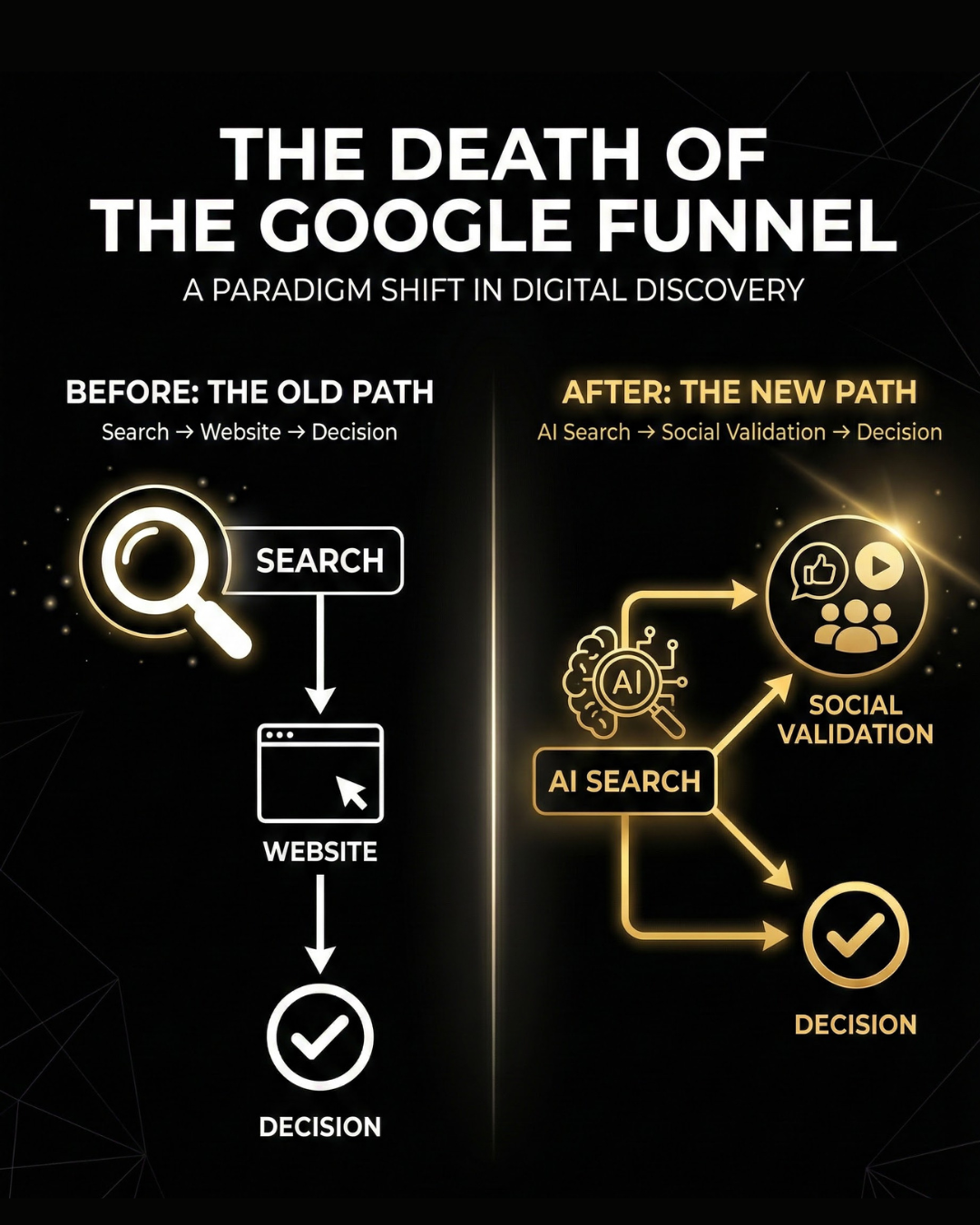
For a £1m B2B business, the marketing landscape has undergone a shift. In 2026, the first reader of your content is often not a human. It is an AI engine summarising information for the person making the decision.
If your business isn't optimised for Generative Engine Optimisation (GEO), you effectively become invisible during the discovery phase.
Improving your AI search presence is no longer about "tricks" to rank higher; it is a matter of revenue protection. You must become a verifiable entity that AI models, ChatGPT, Gemini, and Perplexity feel safe recommending to high-value prospects.
Keywords are dead; entities are the new currency of the A2A economy. The shift in buyer behaviour is already backed by hard data:
Gartner predicts that traditional search engine volume will drop by 25% by 2026 as users migrate to AI chatbots for information.
For a £1m B2B firm, this represents a critical threat. If 89% of your prospects are using AI to research their problems and you aren't being cited, you are losing millions in potential customer lifetime value. To survive, you must move from being an "Invisible Entity" to a Cited Authority.
AI engines do not just scan for text; they look for "proof of life" to verify that a human expert exists behind the brand.
Use the table below to audit how AI models weigh your business data:
| Data Type | AI Signal Strength | Impact on "AI Tender List" | Why it Matters |
| Video Transcripts | Critical (High) | Primary "Proof of Life" | AI (like Gemini) uses video to verify a human expert actually exists. |
| Schema Markup | Critical (High) | "Digital Passport" | Explicitly defines your Entity and services in machine-language. |
| Case Study Data | High | Verifiable Outcomes | AI looks for proprietary data points to justify a recommendation. |
| Third-Party Mentions | High | Primary Trust Metric | High-authority mentions prove you are a "safe" recommendation. |
| Standard Blogs | Medium | Topical Depth | Useful for context, but ignored if the AI suspects "AI Slop". |
Tenacious AI Marketing uses the VITAL framework to make your business "machine-readable" and human-trustable.
Most businesses think YouTube is about views. At Tenacious AI Marketing, we know YouTube as a business growth engine. AI engines index YouTube transcripts with high priority because video represents a higher "proof of life" than text. When you explain your methodology on camera, the AI "learns" your framework and attributes it to your brand entity.
We help businesses become visible, credible, and trusted in the AI era so they attract customers faster. This builds the authority needed to shorten sales cycles and move prospects from "Who are you?" to "How do I start?" before the first call even happens.
As Dean explains in his guide on why YouTube is the ultimate 2026 growth infrastructure, video transcripts serve as the primary 'Proof of Life' that AI engines use to verify your expertise.
For a £1m business, AI search presence isn't a "nice-to-have" marketing experiment; it is revenue protection. As traditional search volume drops by 25%, businesses that rely on old SEO are staring at a "liquidation" risk if their 3,000 monthly visitors suddenly drop to 20.
Winning in 2026 means moving from an "Invisible Entity" to a "Verified Authority" that machines trust enough to recommend. When you dominate the AI tender list, you aren't just surviving the shift; you are capturing the market share your slow-moving competitors are about to lose.
Next Step: Secure Your "Entity" in the Knowledge Graph
The "AI Black Hole" is real, but you don't have to fall into it. Answer Architect is the only visibility growth platform designed to track whether AI engines can find you and precisely what signals they need to trust you.
Ready to see your business through the eyes of an AI? Get an AI Visibility Audit Today.
Let us help you build the "VITAL" framework that protects your current revenue and builds the authority required for your next stage of growth.
How long does it take for AI engines to recommend my business?
Typically, it takes 30 to 90 days for new "entity" signals to be indexed and recognised by LLMs. However, by implementing high-signal Schema markup and the VITAL framework, we accelerate this process, moving you from an "Invisible Entity" to a Cited Authority faster than traditional SEO methods.
Does traditional SEO still matter in 2026?
Traditional SEO acts as the "technical foundation". If your site isn't technically sound or crawlable, it cannot be indexed by AI. However, ranking for keywords is no longer enough; in 2026.
Why is YouTube the primary "source of truth" for my brand?
AI engines, particularly Gemini, prioritise YouTube transcripts because they provide a higher "proof of life" than text. Video verifies that a human expert, not an AI bot, is behind the brand. Beyond search, this serves as an authority engine that builds trust and shortens your sales cycle by educating prospects before they ever get on a call.
What exactly is an "AI Tender List"?
When a prospect asks an AI for a recommendation (e.g., "Find me a B2B supply chain consultant"), the AI generates a shortlist of 3–5 companies. This is the AI Tender List. To survive this filter, your business must have high-signal "trust" markers, proprietary case study data, and consistent third-party citations.
Can a smaller B2B firm really outpace a global competitor?
Yes. Unlike traditional search that favoured big budgets and high backlink volumes, AI models prioritise specialisation and factual density. A niche £1m firm that provides unique data and deep-dive problem solving is often seen as a safer, more authoritative recommendation by an AI than a large, "generic" brand.
What happens if I don't optimise for AI discovery?
You face a significant revenue risk. As 89% of B2B buyers migrate to AI for research, businesses that rely solely on traditional Google links will see their traffic, and their leads, evaporate. If you are not cited in the answer, you are effectively invisible to the modern buyer