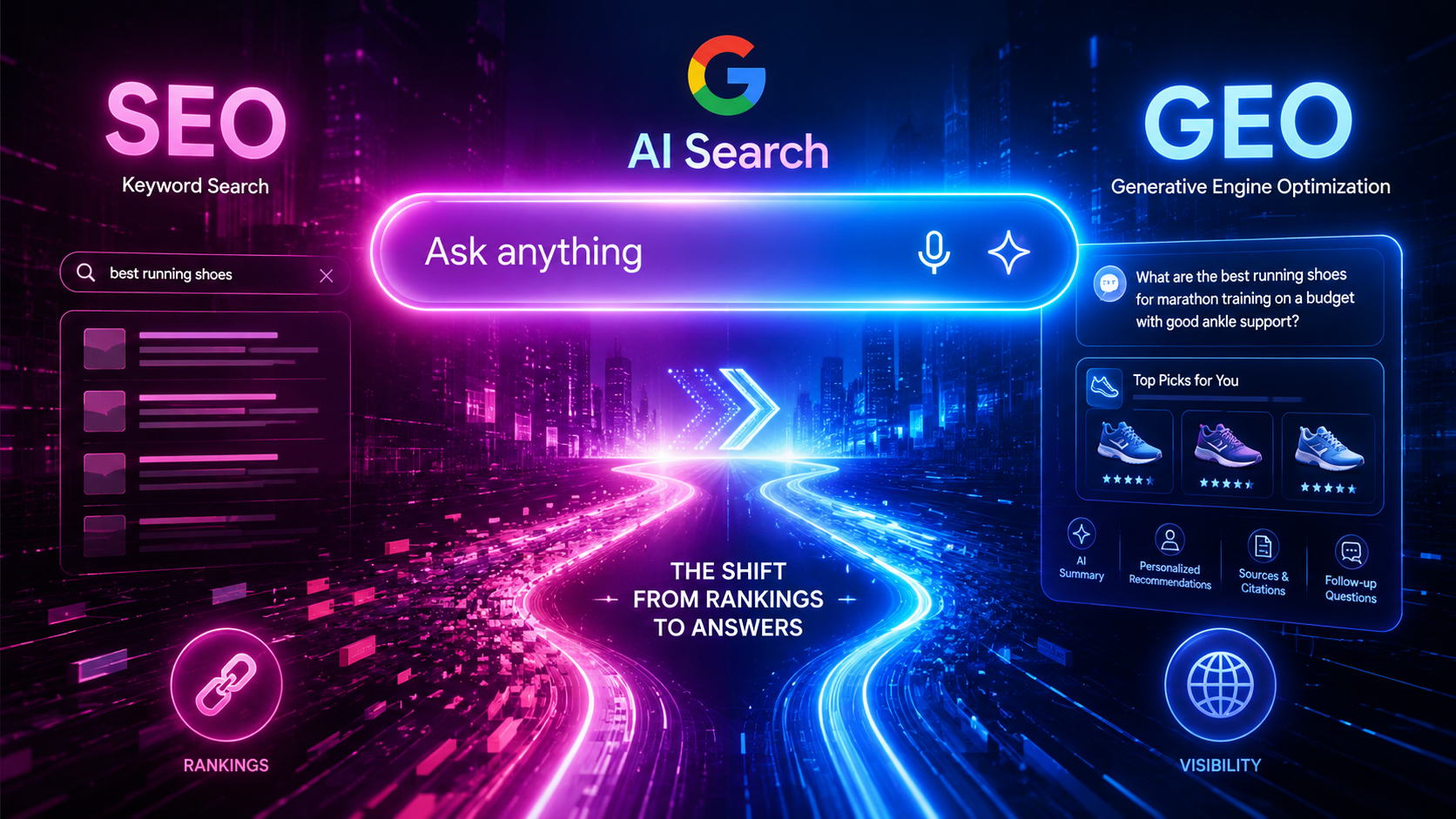
No, GEO is not replacing traditional SEO. Traditional SEO is still the foundation because AI systems need crawlable, useful and authoritative source material. Google has also said that its generative AI Search features are rooted in its core Search ranking and quality systems.
But GEO is not just traditional SEO with a new name. GEO focuses on whether AI systems can understand, cite and recommend a brand inside generated answers. A company can rank well in Google and still be weak in AI visibility if its content lacks answer-led structure, entity clarity, third-party corroboration, YouTube authority, comparison content and citation-worthy expertise.
The cleanest way to think about it is this:
SEO gets you found in the index. GEO gets you selected in the answer.
Google just changed the search box.
That sounds small until you realise the search box is the front door to the internet. For more than 25 years, people have typed keywords into Google, clicked blue links and moved through search results manually. Now Google is moving the search box towards something much more intelligent, conversational and AI-powered.
Google described the update as a new intelligent AI-powered Search box and called it the biggest upgrade to the Search box in over 25 years. The new experience is designed to give users easier access to AI-powered Search features, longer prompts, multimodal inputs and agentic support inside the search journey. Google’s own announcement says users will be able to use agents just by asking a question.
That matters because it confirms what has been obvious in the market for months: search is not just changing in the results page. Search is changing at the input level.
Google says AI Mode has now surpassed one billion monthly users globally, with AI Mode queries more than doubling every quarter since launch. Google also says Search queries reached an all-time high last quarter. In other words, AI is not replacing search behaviour. It is changing how people search.
The old search behaviour was keyword-first. Someone typed “IT support Manchester”, “accountant Leeds”, “best CRM software UK” or “SEO agency London”. The game was to rank for the phrase.
The new behaviour is longer, more specific and more conversational. A buyer might ask, “What should I look for in a managed IT provider for a 120-person professional services firm in the UK, especially if we care about Microsoft 365, cyber security and switching with minimal disruption?”
That is not a keyword.
That is a buying conversation.
And when search becomes a buying conversation, the rules of visibility change.
Traditional SEO still matters. But it is no longer enough on its own. GEO, or Generative Engine Optimisation, is now the layer that determines whether your brand is understood, cited and recommended inside AI-generated answers.
For the better part of two decades, the rules of search were well understood. Write content around the right keywords. Build authoritative backlinks. Make your site fast and technically clean. Earn rankings. Drive traffic.
Those rules have not disappeared. But they are no longer sufficient.
For a growing proportion of the searches that matter most, especially high-intent, research-led queries where a buyer is deciding who to shortlist, the destination of search is no longer a traditional results page. It is increasingly an answer. A synthesised, AI-generated response that names sources, summarises options and helps the buyer decide without forcing them to click through ten different websites.
That is why this Google update matters.
Google has not killed SEO. But it has confirmed that search is moving away from short keywords and towards complex, AI-assisted decision-making.
For the wider context, read The State of AI Search in May 2026.
Google’s official guidance says that optimisation for generative AI features in Google Search is still part of optimising for Search. It also says that AI Overviews and AI Mode are rooted in Google’s core ranking and quality systems. That means Google still wants businesses to focus on useful, people-first content, crawlability, indexability, technical accessibility and strong page quality.
That is true.
But it is not the whole story.
Google is explaining AI visibility through Google’s own ecosystem. It still has blue links. It still has Search Console. It still has Google Ads. It still has an index. It still has a commercial model built around search behaviour.
But business owners are not only asking Google anymore.
They are asking ChatGPT, Perplexity, Claude, Gemini and Grok. They are asking for comparisons, recommendations, shortlists, explanations and buying criteria. Those platforms do not behave like a traditional search results page. They do not simply return ten blue links. They synthesise, summarise and recommend.
This is why many companies can have strong SEO and still be disappointed by their AI visibility.
They rank. They get organic traffic. They may even dominate some keywords. But when a buyer asks an AI tool, “Who are the best providers for this specific situation?”, they are absent, weakly described or outranked by a competitor that has clearer positioning, better third-party corroboration, stronger answer-led content and more visible expertise.
That is not a traditional SEO failure.
It is an AI recommendation failure.
The distinction matters.
Traditional SEO optimises for position on a results page. GEO optimises for inclusion, citation and recommendation inside AI-generated answers.
Those are different goals.
Traditional SEO asks, “Can we rank for this query?”
GEO asks, “Can AI systems confidently use us as a source or recommendation when a buyer asks this question?”
That shift becomes even more important now that Google is changing the search box itself. If users are encouraged to ask longer, more detailed, conversational questions, then businesses need content that can answer those questions directly and credibly.
A page built around “accountant Manchester” might still rank.
But a page that answers “What should a 40-person e-commerce brand look for in an accountant if it sells internationally and needs VAT, stock and cash flow support?” is much more suited to AI-generated answers.
That is the difference between keyword visibility and answer visibility.

Traditional SEO is built on a well-established model. Search engines crawl and index web content, rank it according to hundreds of signals, and return a list of results ordered by relevance and authority.
The job of an SEO practitioner is to make a page score well on those signals so that it ranks as highly as possible for the queries most relevant to the business.
Traditional SEO usually optimises for:
SEO Signal | Why It Matters |
| Keyword relevance | Helps search engines match a page to search terms |
| Backlink authority | Signals trust and authority through links from other websites |
| Technical performance | Helps pages load, crawl, index and perform properly |
| Content comprehensiveness | Helps satisfy search intent and build topical depth |
| Internal linking | Helps users and crawlers understand site structure |
| Meta titles and descriptions | Helps rankings, relevance and click-through from search results |
| Core Web Vitals | Supports user experience and technical performance |
These signals still matter. They are not dead. Any agency telling you SEO no longer matters is either chasing a slogan or trying to sell you something shiny.
A technically weak website will struggle. Thin content will struggle. A poor authority profile will struggle. Pages that cannot be crawled, indexed or understood will struggle.
Google’s AI features are still built on Search infrastructure, so SEO remains the base layer.
But here is the problem.
SEO can get you into the index.
It does not automatically get you into the answer.
Generative Engine Optimisation starts from a different place.
AI tools do not only rank content. They synthesise it. They draw on multiple sources, combine information, form a response and sometimes cite the sources they used.
Getting cited in that response is not the same as ranking number one on a results page.
GEO optimises for:
GEO Signal | Why It Matters |
| Content depth and specificity | AI systems need useful, detailed source material |
| Structural clarity | Clear headings, direct answers and FAQs make content easier to extract |
| Citation-worthiness | AI systems prefer credible, trustworthy and corroborated sources |
| Answer-led writing | Direct answers help AI tools use your content quickly |
| Entity consistency | AI needs to understand who you are, what you do and where you are credible |
| Third-party corroboration | Mentions in trusted sources reinforce authority |
| YouTube and video transcripts | Video creates structured, explainable, AI-readable content |
| Named authorship | Real experts create stronger trust and expertise signals |
| Comparison content | AI often answers buyer questions by comparing options |
| Schema markup | Helps machines understand page context and question-answer structure |
That is why pure SEO tactics often underperform in AI visibility.
A page can be keyword-optimised and still not be citation-worthy. A brand can have traffic and still not be trusted as a recommendation source. A company can rank and still be missing from AI-generated shortlists.
This is the gap GEO fills.
The clearest difference is intent.
Traditional SEO often starts with a keyword. GEO starts with a question.
A traditional SEO page might target “best IT support for law firms”. It may include the keyword in the title, headings, meta description and body copy. It may build links and optimise for search volume.
That can still work for traditional search.
But when a managing partner asks ChatGPT or Google’s AI-powered Search experience, “What should I look for in IT support for a law firm that needs strong cyber security and understands SRA expectations?”, the AI is not simply looking for the page with the best keyword density.
It is looking for the content that answers the question most clearly and credibly.
The content that gets cited is more likely to:
Keyword density contributed very little to that outcome.
Clarity, depth and citation-worthiness did the work.
Signal | Traditional SEO | GEO |
| Primary goal | Rankings on search results pages | Citations and recommendations in AI answers |
| Main input | Keywords | Questions and prompts |
| Content structure | Keyword-led headings and topic clusters | Question-led headings, direct answers, FAQs and tables |
| Keyword optimisation | High importance | Lower importance than answer relevance |
| Meta description | Important for click-through | Minimal direct role in AI citation |
| Backlinks | Strong ranking signal | Indirect trust signal |
| Entity consistency | Useful but often underweighted | Critical |
| Schema markup | Helpful for rich results | Helpful for AI clarity and extraction |
| Content depth | Important | Critical |
| Third-party mentions | Often valued as backlinks | Valued as corroboration |
| YouTube and video | Useful support channel | Major authority and citation surface |
| Named authorship | Helpful | Increasingly important |
| Success metric | Rankings, clicks and organic traffic | AI mentions, citations, recommendations and referral quality |
This is the point most businesses need to understand.
Google’s intelligent AI-powered Search box is not just a visual update. It changes the behaviour Google is encouraging.
Search Engine Land described the new Search box as giving users easier access to AI search capabilities, with longer prompts and more AI options.
Campaign also reported that the update allows users to ask longer, more conversational questions and search across text, images, files, videos and Chrome tabs.
That means the buyer is being trained to stop searching like this:
“managed IT provider London”
“fractional CFO UK”
“SEO agency Leeds”
“accountant for small business”
And start searching like this:
“What should a 150-person professional services firm look for when switching managed IT provider, especially if the board is worried about cyber security, Microsoft 365 and service disruption?”
“Do I need a fractional CFO or a better accountant if my business is growing but cash flow is unpredictable?”
“Which marketing agency should a B2B service business choose if it wants to appear in ChatGPT, Gemini and Google AI Overviews?”
Those are not keyword searches.
They are context-rich buying prompts.
This is exactly why GEO matters.
Because the content that wins those prompts is not thin keyword content. It is structured, expert-led, buyer-aware content that answers the real question.
One of the most important findings in AI visibility research is that YouTube has become one of the most cited and influential sources in AI-generated answers.
This matters because YouTube gives AI systems something incredibly useful: a clear title, a topic-rich description, metadata, transcript, captions, engagement signals and a full spoken explanation of a subject.
That is not just video content.
It is structured authority content.
A business that publishes a YouTube video titled “What should a law firm look for in an IT support provider?” with a clear spoken explanation, accurate description and useful transcript has created the kind of content AI systems can understand and reuse.
No amount of keyword density in a blog post can fully replicate that.
That does not mean blogs are dead. It means written content and video content need to work together.
The strongest GEO strategy in 2026 uses YouTube, LinkedIn, long-form blogs, service pages, schema, case studies, FAQs, reviews and third-party mentions as one connected authority system.
For more on this, read Why YouTube Is Now Essential for Business Visibility in the AI Era.
Pure SEO tactics fail at GEO when they optimise for the old interface but ignore the new buyer behaviour.
Keyword density is a good example. Content that has been over-optimised to include a target keyword at a certain frequency often reads less naturally than content written to explain something clearly. AI systems are trained on natural language and are designed to answer questions. They favour clarity over repetition.
Meta optimisation is another example. A strong meta description can improve click-through from a traditional search result. But in an AI-generated answer, the user may never see that meta description. The AI has already decided whether the page is useful before a click happens.
SEO-structured content can also be too slow to answer. Traditional blog writing often opens with broad context before getting to the point. That may be fine for some human readers, but AI systems extracting answers often prefer content that answers directly and early.
The biggest difference is that SEO often focuses on one page. GEO focuses on the whole entity.
A single well-optimised page may rank. But AI systems build confidence from repeated signals across your website, YouTube, LinkedIn, directories, reviews, press mentions, industry listicles, schema and author profiles.
If all of those signals are inconsistent, weak or generic, one strong SEO page will not fix the problem.
GEO requires work that traditional SEO teams often do not own.
The first is entity management. Every mention of the business online needs to tell the same story. Same business name. Same service focus. Same audience. Same locations. Same author credentials. Same proof points. Same category. If your website says one thing, LinkedIn says another and directories say something else, AI systems receive mixed signals.
The second is answer-led restructuring. Pages need to be built around the actual questions buyers ask. That means direct answers, question-led H2s, useful tables, FAQs and clear summaries.
The third is third-party corroboration. Traditional SEO often chases backlinks. GEO needs trusted mentions and references that help AI systems verify credibility. These can come from press, podcasts, industry publications, directories, awards, review platforms, expert roundups and listicles.
The fourth is YouTube. SEO teams often treat video as a nice extra. In GEO, video is a serious authority surface because transcripts, titles and descriptions help AI systems understand expertise.
The fifth is named authorship. AI systems are increasingly better at connecting people to expertise. A post from a visible named expert with a LinkedIn profile, YouTube presence, press mentions and repeated coverage of a subject is stronger than anonymous brand content.
This is why founder-led content, expert profiles and personal brand authority now matter to search.
For more on this wider system, read Search Everywhere Optimisation: AI Visibility in 2026.
GEO and SEO are not enemies.
They share a foundation.
Both need high-quality content. Both need technically sound websites. Both benefit from authority. Both reward expertise over time. Both are harmed by thin, low-quality content created only to satisfy an algorithm.
The difference is where the effort is focused.
SEO asks, “Can this page rank?”
GEO asks, “Can this brand be trusted as an answer?”
The most effective strategy in 2026 treats SEO and GEO as complementary. Content that answers specific buyer questions clearly, provides genuine depth, is attributed to a named expert, uses useful structure, includes FAQs and is distributed across YouTube and trusted third-party sources can perform well across both traditional search and AI citation environments.
The danger is treating traditional SEO as the whole game.
It is not.
SEO is the foundation.
GEO is the recommendation layer.
B2B companies should pay close attention to this Google update because B2B search behaviour is already research-heavy.
A consumer might search quickly and buy fast. A B2B buyer often researches for weeks, compares options, checks credentials, validates referrals, watches videos, reads case studies and asks colleagues before making contact.
AI now sits inside that process.
With Google’s Search box becoming more intelligent and AI-powered, the search journey will increasingly begin with more context. That means businesses need to prepare for questions that include:
A generic service page is not enough for that.
A vague “we help businesses grow” homepage is not enough.
An old SEO blog written around one keyword is not enough.
B2B companies need content that answers the actual buying questions their audience is now asking AI systems.
Start by auditing your existing content for answer-led structure. How many of your pages provide a direct answer to a specific question in the first 100 words? How many are structured around buyer questions rather than keyword targets? How many include comparison tables, FAQs, definitions and clear next steps?
Then implement FAQ sections and appropriate schema on your highest-value pages. This is technical work your SEO team can deliver quickly.
Finally, run a GEO diagnostic. Search the specific questions your buyers ask in ChatGPT, Perplexity, Gemini and Google AI Overviews. Document where you appear, where competitors appear and where you are absent.
That gap analysis becomes your GEO brief.
Start with entity standardisation. Audit your website, LinkedIn profiles, Google Business Profile, directories, reviews, YouTube channel, author bios, press mentions and professional listings. Fix inconsistencies before investing heavily in new content.
Then build a content programme around buyer questions. Not keywords. Questions.
Use titles like:
“What should a law firm look for in an IT support provider?”
“When does a startup need a fractional CFO?”
“How should a construction supplier become visible before tender shortlists are formed?”
“What is the difference between SEO, AEO and GEO?”
Then turn the best questions into YouTube videos, blog posts, LinkedIn content, FAQs and sales enablement assets.
Do not replace your SEO investment. Maintain the foundation.
Keep improving site health, crawlability, page speed, internal links, content quality, technical SEO and authority.
But add GEO-specific activity on top:
GEO Activity | Why It Matters |
| AI visibility testing | Shows whether you appear in ChatGPT, Gemini, Perplexity and Google AI |
| Entity clean-up | Helps AI systems understand who you are |
| Answer-led content | Improves extraction and citation potential |
| YouTube content | Builds transcript-rich authority |
| Third-party mentions | Corroborates expertise beyond your own site |
| Comparison pages | Helps AI answer evaluation prompts |
| Case studies | Gives AI and buyers proof |
| Named authorship | Connects expertise to real people |
| FAQs and schema | Makes answers easier to understand |
| Internal linking | Helps machines map your topic authority |
Measure GEO separately from SEO. Traditional rankings and traffic still matter, but they do not tell you whether AI systems are mentioning, citing or recommending your brand.
For tracking AI visibility, use Answer Architect to check where you appear and what needs fixing.
Google’s new intelligent Search box is not an isolated product update. It is part of a wider movement away from keyword search and towards AI-assisted decision-making.
Google has also talked about AI agents in Search, which means users may increasingly ask Google not just to find information, but to help them complete tasks, compare options and take action.
That is a big shift.
When search becomes more agentic, brands need to be understood not just as websites, but as entities. An AI agent needs to understand what you do, who you serve, where you operate, how credible you are, what proof exists and when you should be recommended.
That is GEO.
Traditional SEO prepared businesses to be found.
GEO prepares businesses to be chosen.
The businesses building GEO capability now are not just preparing for 2026. They are preparing for 2027 and 2028, when a larger share of buyer research will happen through AI-generated answers, AI-assisted comparisons and agentic search journeys.
Here is the practical first-month plan.
Week | Action | Outcome |
| Week 1 | Audit AI visibility | See where ChatGPT, Gemini, Perplexity and Google AI mention you |
| Week 2 | Fix entity clarity | Make your website, profiles and listings consistent |
| Week 3 | Restructure key content | Add direct answers, FAQs, tables and stronger internal links |
| Week 4 | Create one answer-led video or article | Build a citable asset around a real buyer question |
Run your priority buyer questions through ChatGPT, Gemini, Perplexity and Google AI Overviews. Do not only search your brand name. Search the problem, category and buyer situation.
Look for whether your brand appears, how it is described, which competitors appear and which sources are cited.
Make your homepage, service pages, about page, Google Business Profile, LinkedIn, YouTube, directory listings and review profiles describe the business consistently.
Do not make AI guess.
Choose your five most important pages and improve them for AI extraction. Add a direct answer near the top. Use question-led headings. Add FAQs. Add comparison tables. Add internal links. Add external citations where useful. Make the page easier for both humans and machines to understand.
Pick one question your buyer is already asking and answer it better than anyone else.
Then turn it into a blog, YouTube video, LinkedIn post and sales asset.
One strong answer-led asset can become the start of a GEO content cluster.
Yes. Traditional SEO still matters because Google Search, technical crawlability, quality content, internal linking, authority and user experience still influence visibility. Google’s AI features are also rooted in its core Search ranking and quality systems. But traditional SEO alone does not guarantee visibility in AI-generated answers across ChatGPT, Claude, Perplexity, Gemini or Grok.
No. GEO shares some foundations with SEO, but it optimises for a different outcome. SEO focuses on rankings and clicks. GEO focuses on being understood, cited and recommended inside AI-generated answers. The overlap is real, but the execution is not identical.
Google is describing AI visibility from inside Google Search. From Google’s point of view, AI Overviews and AI Mode are part of Search, so optimising for them is still search optimisation. That is reasonable within Google’s ecosystem. But across ChatGPT, Claude, Perplexity and Grok, visibility depends on a broader set of signals than traditional Google SEO.
Yes, if it is structured properly. The best content answers a specific question clearly, provides genuine depth, uses clear headings, includes FAQs, is attributed to a named expert, links to related content and has enough authority behind it to be trusted. GEO-structured content can support SEO. But old-school keyword-heavy SEO content often performs poorly for GEO.
The new intelligent AI-powered Search box matters because it encourages longer, more conversational and more complex queries. Buyers are moving away from short keyword searches and towards prompts that describe their exact situation. That makes answer-led, buyer-specific content more valuable.
Ranking means your page appears in a traditional search results list. Being cited means an AI system uses or references your content inside a generated answer. A brand can rank well and still not be cited if the content is not specific, clear, structured or trusted enough.
Start with an AI visibility audit. Find out whether you appear in the answers your buyers are already asking. Then fix entity clarity, restructure important pages around direct answers, build question-led content, add YouTube where possible and strengthen third-party corroboration.
Related Reading
Beyond the Search Bar: Why AEO Testing Is Now a Business Visibility Metric
Why YouTube Is Now Essential for Business Visibility in the AI Era
What Is GEO in 2026, and How Do You Get Cited in AI Answers?
The New Rules of AI Search in 2026
Search Everywhere Optimisation: AI Visibility in 2026
Backlinks vs AI Citations: The New Authority Signals
Google’s biggest Search box upgrade in over 25 years confirms the direction of travel.
Search is becoming more conversational, more AI-assisted, and more answer-led.
That does not mean traditional SEO is dead. The scale of traditional search is still enormous. SparkToro and Datos found that Google accounted for 73.7% of desktop searches across 41 major search-heavy domains in the US in Q4 2025, while AI tools accounted for 3.2%.
So the point is not that SEO disappears. The point is that SEO is now the first layer.
The businesses that win in 2026 will not be the ones that choose SEO or GEO. They will be the ones that understand how the two work together.
SEO gets your content crawled, indexed and ranked.
GEO gets your brand understood, cited and recommended.
Google is right that generative AI optimisation still sits on top of strong search fundamentals. But the real-world visibility gap is also obvious: companies can have strong SEO and still fail to appear in the AI answers, comparisons and recommendations shaping modern buying decisions.
That is why the shift matters.
The buyer is no longer just searching for keywords.
They are asking questions.
They are comparing options.
They are validating referrals.
They are forming shortlists.
They are using AI to decide who is credible before they ever visit your website.
The brands appearing in those answers six months from now are building that position today.
If you want to understand where your business currently appears in AI search, use Answer Architect to check your AI visibility and see what needs fixing.
You can also take the Organic Visibility Scorecard or talk to the Tenacious team about building SEO, AEO and GEO into one visibility system.