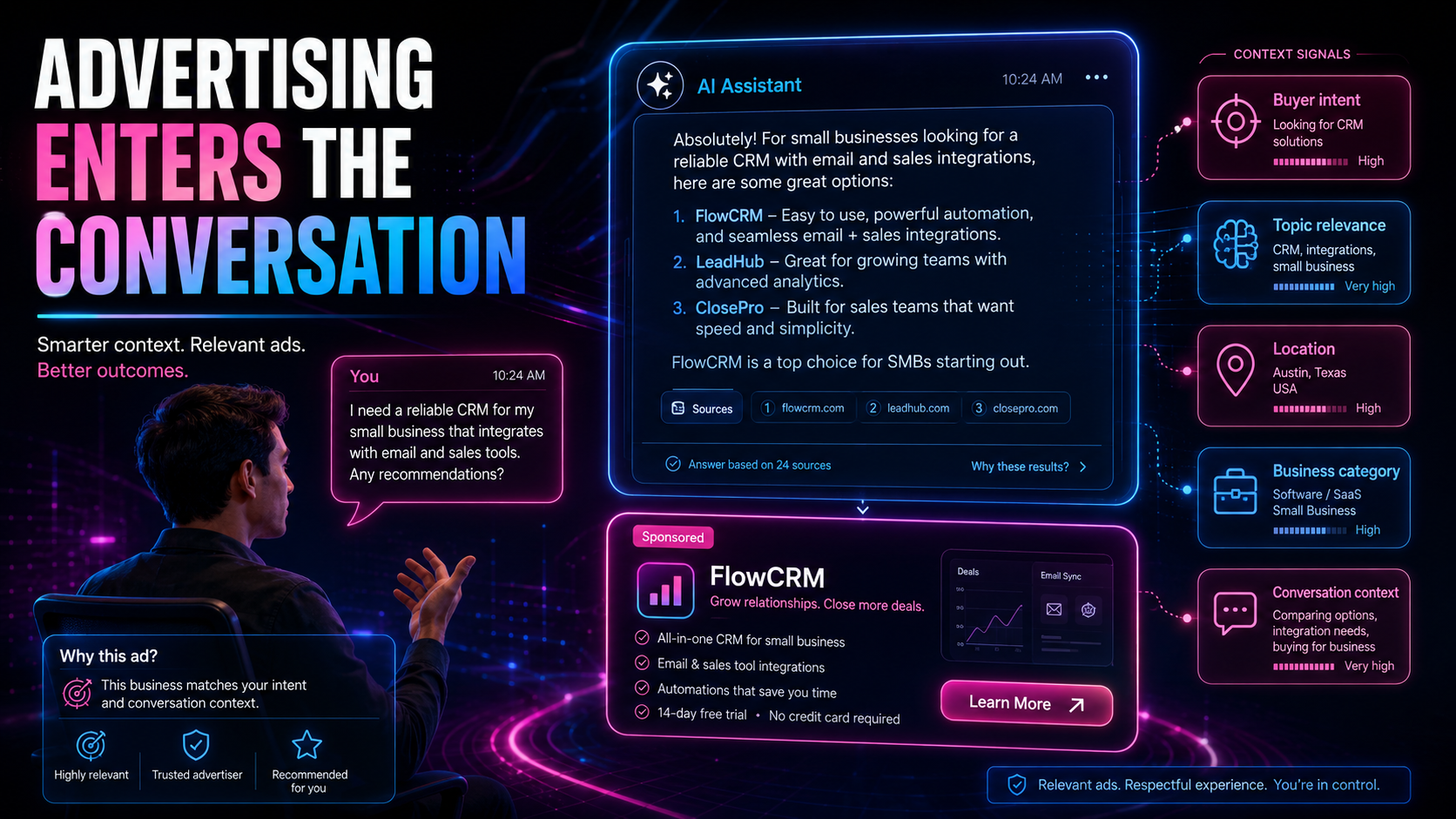
Yes. OpenAI has confirmed that it plans to expand the ChatGPT ads pilot into the United Kingdom, alongside Mexico, Brazil, Japan and South Korea. Ads are currently being tested or rolled out in selected markets including the United States, Canada, Australia and New Zealand, and OpenAI says the UK is part of the next expansion phase. For UK businesses, this means paid visibility inside AI-assisted search is no longer a distant theory. It is a channel to prepare for now.
ChatGPT Ads are no longer a future theory. They are becoming real, and the UK is now part of the next commercial conversation.
OpenAI began testing ads in ChatGPT in the United States for logged-in adult users on the Free and Go plans. It later expanded ads into Canada, Australia and New Zealand, and on 7 May 2026 OpenAI said it planned to expand the ads pilot into the United Kingdom, Mexico, Brazil, Japan and South Korea in the coming weeks. Plus, Pro, Business, Enterprise and Education plans do not currently have ads.
That matters because paid visibility inside AI-assisted decision-making is not just another advertising format. It changes where commercial influence happens.
For years, paid search was built around keywords. A user typed “best CRM software UK”, then Google showed search ads. But AI search behaves differently. A user might now ask, “We’re a 12-person consultancy. What CRM should we choose if we need automation, easy reporting and affordable pricing?”
That is not just a search query. It is a buying decision in progress.
This is why ChatGPT Ads could become one of the most important advertising channels of the next few years. Not because they will replace Google Ads overnight, but because they may sit much closer to intent, trust and recommendation.
For UK businesses, the message is simple: do not wait until AI ads are fully mainstream before you prepare. By then, the market will be louder, more expensive and more competitive.
For the wider shift from rankings to AI recommendations, read The State of AI Search in May 2026.
OpenAI has confirmed that it is testing ads in ChatGPT. The initial test began in the US for logged-in adult users on the Free and Go subscription tiers, and the official OpenAI announcement says ads are clearly labelled, visually separated from answers, and do not influence the answers ChatGPT gives. OpenAI also says conversations remain private from advertisers.
The important point is trust. If users believe AI answers are being manipulated by advertisers, the product breaks. The value of an AI answer engine is that the user believes the response is useful, independent and relevant to their situation.
That means the early model is not “pay to control the answer”. The more realistic model is likely to be: earn the answer organically, then use paid placements to increase visibility around relevant buying moments.
That is where AEO and GEO come in.
OpenAI Ads Principle | What It Means for Businesses |
| Ads are clearly labelled | Users can identify sponsored content |
| Ads are visually separate from answers | Ads are not blended into the organic answer |
| Ads do not influence ChatGPT’s answers | Paid placement does not mean control of the response |
| Conversations are private from advertisers | Advertisers do not see users’ chats, memories or personal details |
| Ads apply to Free and Go plans in the current test | Paid and business tiers do not currently have ads |
| Rollout is phased | Availability may change as OpenAI expands and learns |
Google Ads capture search intent. ChatGPT Ads may capture decision intent.
That difference is huge.
Google often catches users when they already know what they want to search for. ChatGPT catches users while they are still forming the decision. They are comparing options, asking for recommendations, explaining their situation, evaluating trade-offs and trying to understand what they should do next.
The old paid search question was, “Can we rank or bid for this keyword?”
The new AI advertising question will be, “Can we show up when the buyer is deciding who to trust?”
That is a very different game.
A Google Ads campaign is usually built around keywords, landing pages, bid strategy, ad relevance, quality score and conversion tracking. AI advertising will likely require some of those skills, but it also needs something else: the ability to understand conversational intent.
A buyer might not ask for “accountancy firm Leeds”. They might ask, “Who should I speak to if my business is growing and I need better cash flow advice, tax planning and a more strategic accountant?”
That is not keyword intent. That is situation-led intent.
This is why AI advertising will not simply be Google Ads with a new interface. It will sit inside a more complex journey where the buyer expects explanation, comparison, context and trust.
For more on how this changes the buyer journey, read The New Rules of AI Search in 2026.
OpenAI is not officially using the terms AEA or GEA, but they are useful ways to describe where the market may be heading.
AEA means Answer Engine Advertising. It describes paid visibility inside answer-led platforms where users ask questions and receive recommendations.
GEA means Generative Engine Advertising. It describes paid placement inside generative AI environments where the platform creates a response, comparison, shortlist or recommendation.
In plain English, SEO helped you rank. PPC helped you buy clicks. AEO helps you become the answer. GEO helps you become cited and recommended by AI systems. AEA and GEA may become the paid layer that sits on top of those behaviours.
Term | Role |
| SEO | Helps you rank in traditional search |
| PPC | Helps you buy clicks from search and social platforms |
| AEO | Helps you become the answer to specific questions |
| GEO | Helps you become cited and recommended by AI systems |
| AEA | Paid visibility inside answer engines |
| GEA | Paid visibility inside generative AI recommendation environments |
The paid layer is coming after the organic shift, not before it. That matters because if a business does not understand AEO or GEO, it will struggle to understand why paid AI visibility is different from conventional PPC.
Most businesses will get this wrong. They will wait for ChatGPT Ads to become widely available, then ask their PPC agency to “run some campaigns”.
That is lazy thinking.
Before a business pays to appear inside AI environments, it needs to become understandable to AI systems first. This does not mean trying to manipulate AI answers. It means building clear, useful, trustworthy information that helps AI systems understand who you are, what you do, who you serve and why you are credible.
That means fixing the foundations: clear entity positioning, strong service pages, FAQ-led content, schema markup, third-party mentions, reviews, case studies, comparison content, YouTube authority, LinkedIn authority and consistent business information.
AI systems do not only look at your website. They look for corroboration. They want to understand who you are, what you do, who you serve, why you are credible and when you should be recommended.
That is why AEO and GEO should come before AI advertising, not after.
Foundation | Why It Matters |
| Clear entity positioning | AI systems need to understand the brand clearly |
| Strong service pages | Your offer needs to be easy to identify |
| FAQ-led content | AI systems extract answers from structured explanations |
| Schema markup | Helps machines understand page context |
| Third-party mentions | Corroborates authority beyond your website |
| Reviews and proof | Builds trust signals |
| Comparison content | Helps AI answer buyer evaluation prompts |
| YouTube and LinkedIn authority | Strengthens entity and expertise signals |
| Consistent business information | Reduces confusion across sources |
| Case studies and results | Gives AI and buyers evidence of credibility |
For the core definition, read What Is GEO in 2026 and How Do You Get Cited in AI Answers?.
OpenAI has not announced an equivalent of Google Ads Quality Score, so nobody should claim that as fact.
But commercially, something similar is likely to matter.
If ads are matched to conversations, OpenAI will need to evaluate relevance, quality, user experience and trust. In Google Ads, relevance affects whether an ad is useful and whether budget is wasted. In AI ads, that logic may matter even more because the ad appears inside a more trusted and contextual environment.
The smarter way to think about it is this: AEO may become the trust and relevance layer that improves future AI ad performance.
That is not guaranteed. It is not an official OpenAI claim. But it is a logical direction.
If your brand is already well understood by AI systems, has strong entity clarity, appears in trusted sources and answers relevant questions clearly, it may be in a stronger position when paid AI placements mature.
The opposite is also true. If your brand is vague, your service pages are thin, your content does not answer real buyer questions and your business has weak third-party corroboration, paid AI advertising may become more expensive, less relevant or harder to scale.
The UK does not need to wait for ads to become fully mainstream before preparing. OpenAI has already confirmed that the UK is part of the next expansion phase for the ads pilot, which means the strategic question is no longer whether AI ads might happen. It is whether your business will be ready when the channel opens more widely.
When a new paid channel matures, the early advantage usually goes to businesses that prepared before the auction became crowded. In the early days of Google Ads, the winners were not just the companies that spent money. They were the companies that understood landing pages, relevance, tracking and commercial intent earlier than competitors.
AI ads will have a similar first-mover window, but the preparation is different.
The businesses that prepare now will be better placed than the ones that wait until every agency starts selling “ChatGPT Ads management” as a shiny new service.
Before spending money on AI ads, find out whether AI systems already understand your brand.
Ask whether ChatGPT mentions you, whether Gemini understands your services, whether Perplexity cites your website, whether Google AI Overviews surface your brand, whether AI tools understand your location, offer and audience, and whether competitors are being recommended instead of you.
Also ask whether AI systems can explain what you do accurately and compare you fairly against competitors. If you are invisible organically, paid visibility may become more expensive and less effective later.
AEO testing turns this from guesswork into a measurable process. For more on this, read Beyond the Search Bar: Why AEO Testing Is Now a Business Visibility Metric.
Traditional SEO content often targets keywords. AI search content needs to answer questions.
That means creating pages and articles around real buying prompts, such as “Who is the best provider for X?”, “What is the difference between X and Y?”, “Which agency should I choose for X?”, “How much does X cost in the UK?”, “What should I look for before hiring X?” and “What are the best options for a business like mine?”
This is the content AI systems are more likely to extract, summarise and cite. It is also the content buyers actually need.
AI systems need to know exactly who you are. That means your website should clearly explain your business name, services, locations, leadership team, audience, proof, pricing or offer structure, case studies, reviews and industry focus.
Confused brands do not get recommended. Clear brands have a better chance.
If your website says five different things about what you do, AI systems will struggle. If your LinkedIn says one thing, your website says another and third-party directories say something else, the problem gets worse.
AEO and GEO are partly about reducing ambiguity. You want AI systems to understand who you are, what you do, who you help, where you operate, what you are credible for, what you should be recommended for and what proof supports that recommendation.
For a practical checklist, read How to Audit Your Website for AI Visibility in 2026.
GEO is not just on-page SEO with a new badge. AI systems look for signals across the web.
That can include digital PR, podcast appearances, YouTube videos, LinkedIn authority, review platforms, business directories, industry listicles, expert quotes, case studies and third-party mentions.
The more credible surfaces confirm your expertise, the easier it becomes for AI systems to trust you.
This is also why YouTube and LinkedIn matter. A business with strong service pages, a silent founder, no videos, no external mentions, no reviews and no visible expertise is harder to verify. A business with clear content, visible experts, third-party mentions and structured proof is easier to understand.
For the wider framework, read Search Everywhere Optimisation: AI Visibility in 2026.
When new ad channels launch, early movers often get cheaper learning. Then the market piles in. Agencies package it. Bigger brands arrive. Costs rise.
That is why UK businesses should not wait until ChatGPT Ads are fully mainstream. The smart play is to prepare the organic AI visibility layer now, then be ready to test paid placements when advertiser access opens more widely.
This is not about panic. It is about being early enough to learn before the channel becomes expensive.
OpenAI has not released official UK pricing for ChatGPT Ads, so any CPC or CPM estimate is a prediction, not a fact.
But based on the level of intent, ChatGPT Ads may eventually command higher costs than many social placements because users are often closer to a decision.
The volume may be lower, but the intent could be much stronger.
Channel | Typical Intent | Likely Cost Dynamic |
| Social ads | Interest and interruption | Lower CPC, broader targeting |
| Google Search Ads | Active search demand | Medium to high CPC depending on sector |
| ChatGPT Ads | Decision-stage conversation | Potentially higher CPC, lower volume, higher intent |
The key point is this: AI ads may not flood websites with cheap clicks. Their value may be in influencing the buyer at the exact moment they are choosing.
That changes how businesses should think about ROI. A low-volume channel can still be commercially powerful if it influences high-intent decisions.
The old funnel looked like this:
The new funnel is starting to look more like this:
That changes the role of marketing. You are no longer just trying to win the click. You are trying to become part of the answer.
Google’s own Search Central guidance explains that AI features such as AI Overviews and AI Mode are now part of the search experience from a website owner’s perspective. Google also says its generative AI features are rooted in its core Search ranking and quality systems, which means traditional SEO foundations still matter, but they now sit inside a more answer-led environment.
This is why AEO, GEO and SEO now need to work together.
SEO helps you get found. AEO helps you answer. GEO helps you get cited and recommended. Paid AI ads may eventually help you appear near decision moments. But the organic trust layer still matters.
PPC agencies need to adapt quickly.
ChatGPT Ads will not simply be “Google Ads but in ChatGPT”. The targeting logic, creative format, attribution model and buying journey may all be different.
Agencies will need to understand conversational intent, prompt-led demand, AI recommendation behaviour, AEO, GEO, brand entity strength, AI citation signals, content that supports paid visibility and measurement beyond last-click attribution.
The agencies that only understand keywords and CPCs may struggle. The agencies that understand AI search visibility, buyer psychology and authority signals will have the edge.
That does not mean PPC is dead. Paid search expertise will still matter. But it will need to be combined with AI visibility strategy, content architecture, entity optimisation and trust-building.
The future PPC agency may look much more like a hybrid of paid media, AEO, GEO, analytics, content strategy and brand authority.
SEO and GEO agencies also need to be careful.
There will be a temptation to overclaim. Some agencies will sell “guaranteed ChatGPT Ads visibility” before the platform is mature. Others will claim they can control AI answers through paid spend. That is not the right framing.
The more honest position is this: paid AI visibility will likely reward brands that have already done the work to become clear, trustworthy and relevant.
That work includes technical SEO, structured content, authority building, third-party corroboration, reviews, clear service pages, comparison pages, YouTube content, LinkedIn authority and consistent entity signals.
In other words, GEO is not a magic trick. It is infrastructure.
At Tenacious AI Marketing, we see ChatGPT Ads as part of a much bigger change.
Search is moving from rankings to recommendations. Gartner predicted that traditional search engine volume would drop 25% by 2026 as AI chatbots and virtual agents take a larger share of discovery behaviour. Whether the exact number proves right or not, the direction of travel is already obvious: buyers are asking AI systems for explanations, comparisons, shortlists and next steps.
That means businesses need visibility systems that help them appear across Google Search, Google AI Overviews, ChatGPT, Gemini, Perplexity, Copilot, YouTube, LinkedIn, third-party authority sources, review platforms, industry listicles, podcasts and press mentions.
This is why we focus on AEO, GEO, structured content, founder authority, YouTube visibility and AI search tracking through Answer Architect.
Because when AI search and paid AI placements mature, the brands with stronger authority, clearer positioning and better answer-led content will be better placed to win.
Yes.
Not because every business should rush to spend money on ChatGPT Ads tomorrow. But because the preparation starts before the ad platform fully matures.
UK businesses should now be asking whether they are visible in AI answers, whether competitors are being recommended instead of them, whether AI systems understand what they do, whether they have strong enough third-party authority, whether their content is structured for AI extraction, whether they are building trust across Google, YouTube, LinkedIn and industry sources, and whether they are ready for paid AI visibility when the channel opens properly.
The businesses that wait will be playing catch-up. The businesses that prepare now will have the advantage.
Here is the practical first-month plan.
Week | Action | Outcome |
| Week 1 | Run an AI visibility audit | See whether AI systems understand or mention your brand |
| Week 2 | Fix entity clarity | Make your website, profiles and service pages consistent |
| Week 3 | Create answer-led content | Publish content around high-intent buyer questions |
| Week 4 | Build authority signals | Add reviews, case studies, third-party mentions and comparison content |
Test the questions your buyers are likely to ask ChatGPT, Gemini, Perplexity and Google AI Overviews.
For example: “Who are the best X providers in the UK?”, “What should I look for when choosing an X agency?”, “Which company helps with X?” and “Who are the top providers for X in my sector?”
Then check whether your brand appears, whether competitors appear, what sources are cited and whether the description of your market is accurate.
You can do this manually, or use Answer Architect to check your AI visibility score and see what needs fixing.
Make sure your homepage, service pages, about page, social profiles, Google Business Profile, LinkedIn page, YouTube channel and third-party listings all describe your business consistently.
Do not make AI systems guess what you do. Tell them clearly.
Publish content that answers real commercial questions.
Not vague thought leadership. Real buyer questions.
Examples include: “How much does X cost in the UK?”, “What is the best X for a business like mine?”, “What should I ask before hiring an X provider?”, “What is the difference between X and Y?” and “When should a business invest in X?”
This content supports both humans and AI systems.
Add or improve your case studies, reviews, press mentions, expert quotes, YouTube videos, LinkedIn content, comparison pages, directory listings, partner mentions, FAQs and schema.
The goal is to create corroboration. AI systems need to see your expertise confirmed across several credible surfaces.
Yes. OpenAI has confirmed that it plans to expand the ChatGPT ads pilot into the United Kingdom, Mexico, Brazil, Japan and South Korea. The rollout is phased, so UK businesses should prepare now and avoid assuming every business has immediate access until OpenAI opens availability more widely.
OpenAI says ads do not influence ChatGPT’s organic answers. Ads are clearly labelled and visually separate from the answer. That distinction matters because user trust is central to the product.
OpenAI says conversations are kept private from advertisers. Advertisers do not see users’ chats, memories or personal details.
No. They should not rush to spend money before the channel is ready, but they should prepare the organic layer now. That means AI visibility audits, answer-led content, strong entity clarity, reviews, case studies, third-party authority and structured website content.
AEO helps your content become a clear answer to specific questions. GEO helps your brand become cited, understood and recommended by AI systems. ChatGPT Ads are the paid visibility layer being tested inside ChatGPT. The strongest strategy is to build AEO and GEO foundations before relying on paid AI placements.
Not in the short term. Google Ads still captures active search demand at scale. ChatGPT Ads may become important because they can sit closer to decision-making conversations. The likely future is not replacement. It is a more complex paid media mix across search, social, AI answer platforms and generative recommendation environments.
PPC agencies should start learning AEO and GEO. They should understand conversational intent, prompt-led demand, entity clarity, AI visibility testing, answer-led landing pages and how paid AI visibility may interact with organic authority.
Related Reads
The State of AI Search in May 2026
Beyond the Search Bar: Why AEO Testing Is Now a Business Visibility Metric
Why YouTube Is Now Essential for Business Visibility in the AI Era
What Is GEO in 2026 and How Do You Get Cited in AI Answers?
The New Rules of AI Search in 2026
Search Everywhere Optimisation: AI Visibility in 2026
How to Audit Your Website for AI Visibility in 2026
ChatGPT Ads are not just another ad placement. They are the beginning of paid visibility inside AI-assisted decision-making.
That is a major shift.
The brands that win will not be the ones that simply throw budget at the newest platform. They will be the ones AI systems already understand, trust and can connect to relevant buyer intent.
So yes, ChatGPT Ads matter.
But AEO and GEO come first.
Because in the AI era, the most valuable ad position may not be the one you buy. It may be the one you earned before the auction even started.
If you want to know whether your business is currently visible in AI answers, start with Answer Architect.
You can also take the Organic Visibility Scorecard or speak to the Tenacious team about building AEO, GEO and AI visibility before paid AI search becomes mainstream