Three terms. Endless confusion.
AEO. GEO. SEO. If you've been trying to figure out what any of them actually mean for your business, you're not alone. Most business owners we speak to have heard all three but aren't sure which one they need, whether they're the same thing, or where to start.
This isn't a jargon guide. It's a practical breakdown of what each discipline actually does, how they relate to each other, and what a UK business owner should be thinking about in 2026 (when AI tools like ChatGPT, Perplexity, Google Gemini and Claude are increasingly the first place potential clients go to find answers).
Let's clear it up properly.
SEO (Search Engine Optimisation) is the practice of making your website more visible in Google's (and Bing's) search results.
It covers:
When someone types "accountants in Birmingham" or "best IT support for small business" into Google, SEO is what determines whether your business appears on page one or page five.
Does SEO still matter? Yes (but it's no longer the whole picture).
Google still processes billions of searches every day. Ranking well on Google still drives real traffic and real leads for most UK businesses. But user behaviour is changing. More people are starting their research with an AI tool rather than a search engine, getting a direct answer rather than a list of links to click through.
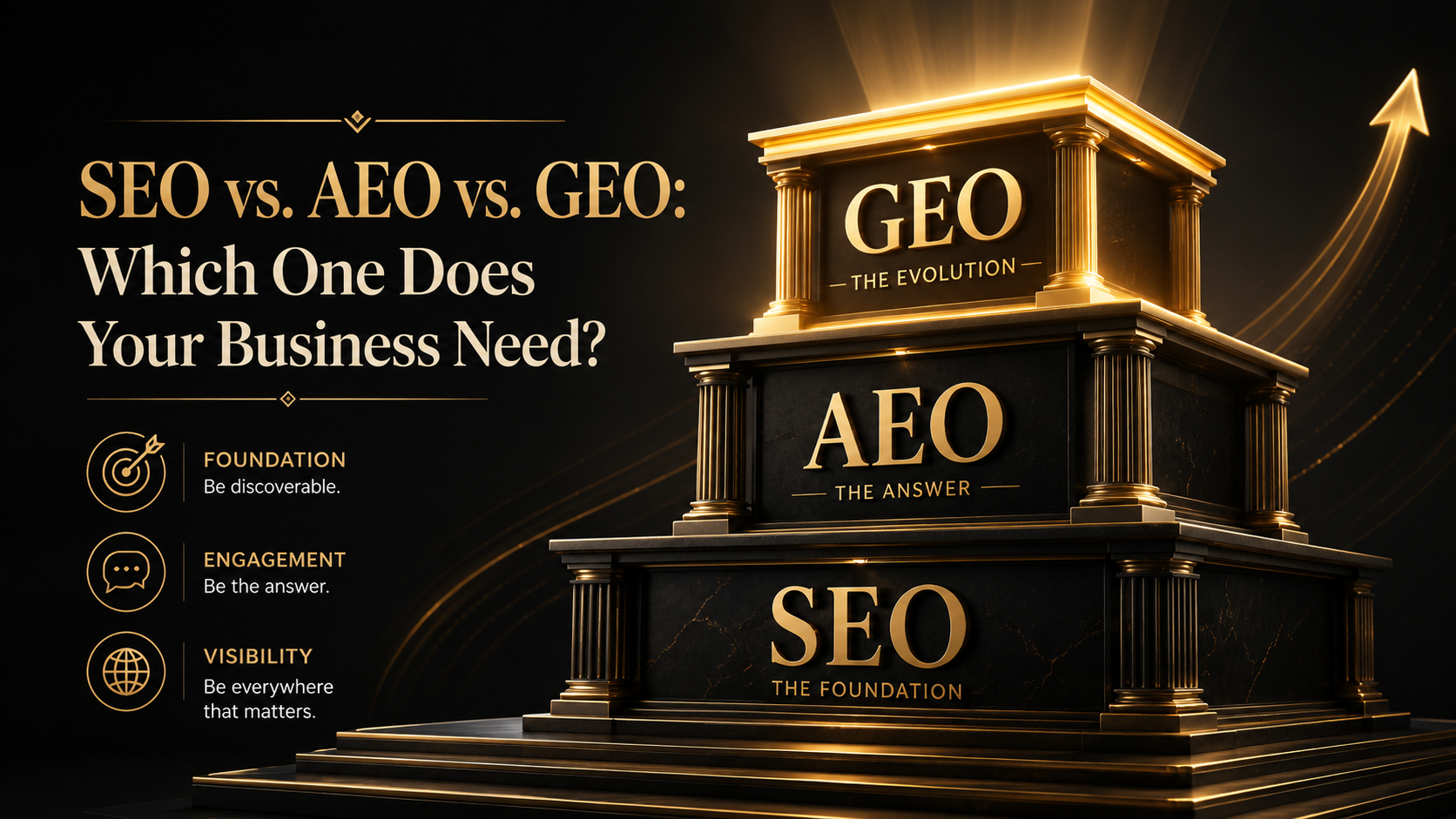
SEO is the foundation. AEO and GEO are what you build on top of it.
AEO (Answer Engine Optimisation) is the practice of structuring your content so that AI-powered answer engines can find it, understand it, and use it to answer user questions directly.
Answer engines include:
The key difference from SEO is intent. SEO is about getting someone to click a link to your website. AEO is about becoming the answer (whether or not the user ever visits your site).
If someone asks Google "how long does it take to set up a limited company in the UK?" and Google's AI Overview quotes your content directly, that's AEO working. Your brand appears as the authoritative source. The user may never click through, but they heard your name and absorbed your credibility.
AEO focuses on:
The relationship to SEO: AEO builds on SEO. You cannot optimise for answer engines if your technical SEO foundations are broken. AI systems need to be able to crawl, index and trust your content first.
If you want a quick sense of where your content currently stands, an AEO grader can test how well your pages are structured for answer engines (flagging the gaps before you start optimising).
GEO (Generative Engine Optimisation) is the practice of building your brand's presence, authority and trustworthiness so that generative AI tools recommend and cite you when users ask relevant questions.
Generative AI tools include:
ChatGPT, Gemini and Perplexity are growing fast as first-stop research tools (and the share of buyers starting their search there rather than Google is increasing every quarter).
When someone asks ChatGPT "which GEO agencies are worth looking at in the UK?" or asks Perplexity "who should I speak to about AI visibility for my business?", GEO is what determines whether your brand is mentioned (and what gets said about you).
This is different from AEO in a meaningful way.
AEO is largely about formatting and structure (making your content easy for AI to extract). GEO is about authority and entity trust (making your brand something AI systems recognise, understand and are willing to recommend).
GEO focuses on:
The important distinction: GEO is less about any one piece of content and more about whether your brand, as a whole, is understood and trusted by AI systems.
No. And this is probably the most important thing to understand.
SEO, AEO and GEO are not competing disciplines. They are layered. SEO is the base layer. AEO and GEO sit on top of it.
Here's why:
Generative AI tools like ChatGPT and Perplexity frequently reference content that already ranks well in Google search. If your content isn't ranking, it's less likely to be surfaced as a trusted source. If your website has technical problems (broken pages, slow loading, poor structure) AI crawlers will have the same trouble accessing it as Google does.
Google itself has been clear that AEO and GEO are extensions of SEO, not replacements for it. The same foundations that help you rank (quality content, clean architecture, authoritative links, accurate information) also help you get cited by AI systems.
Think of it this way:
All three reinforce each other. A business that does all three well is covered across the full discovery journey (from Google results, to AI summaries, to direct recommendations from ChatGPT).
| Discipline | Goal | Primary Target | Core Signals |
|---|---|---|---|
| SEO | Rank in search results | Google, Bing | Links, content, technical health |
| AEO | Become the answer | AI Overviews, voice search | Structure, schema, Q&A content |
| GEO | Get recommended by AI | ChatGPT, Gemini, Perplexity | Entity trust, topical authority, brand consistency |
It depends on where you are right now (but here's the honest answer for most UK SMEs).
If your SEO is weak or untouched: Start there. Fix your technical foundations, get your core pages optimised, and make sure your content is actually useful and well-structured. Without this, AEO and GEO won't land properly.
If your SEO is solid but you're invisible in AI search: This is where most established UK businesses find themselves in 2026. Your website performs reasonably well in Google, but you have no idea whether ChatGPT or Perplexity would recommend you if someone asked. This is the GEO and AEO gap (and it's the one that's going to cost businesses pipeline over the next 12 to 18 months).
If you're building from scratch: Do all three in parallel, led by content. Create content that answers the questions your buyers are actually asking, structure it properly, and build your brand presence consistently across platforms from day one.
The practical priority order for most UK B2B businesses:
This is where most businesses have a blind spot.
You can check your Google rankings. You can see your website traffic. But until recently there was no easy way to know whether ChatGPT would mention your business if someone asked about your sector, or what Perplexity would say if a prospect asked for a recommendation.
A basic AI visibility audit involves testing a set of relevant queries across the main AI platforms (ChatGPT, Gemini, Perplexity and Claude) and seeing whether your brand is mentioned, what context it's mentioned in, and what your competitors are getting recommended instead.
The results are often surprising. Many businesses that rank well in Google have almost no presence in generative AI responses. And the reverse can happen too (businesses that have invested in content and authority sometimes appear in AI recommendations before they appear in traditional search).
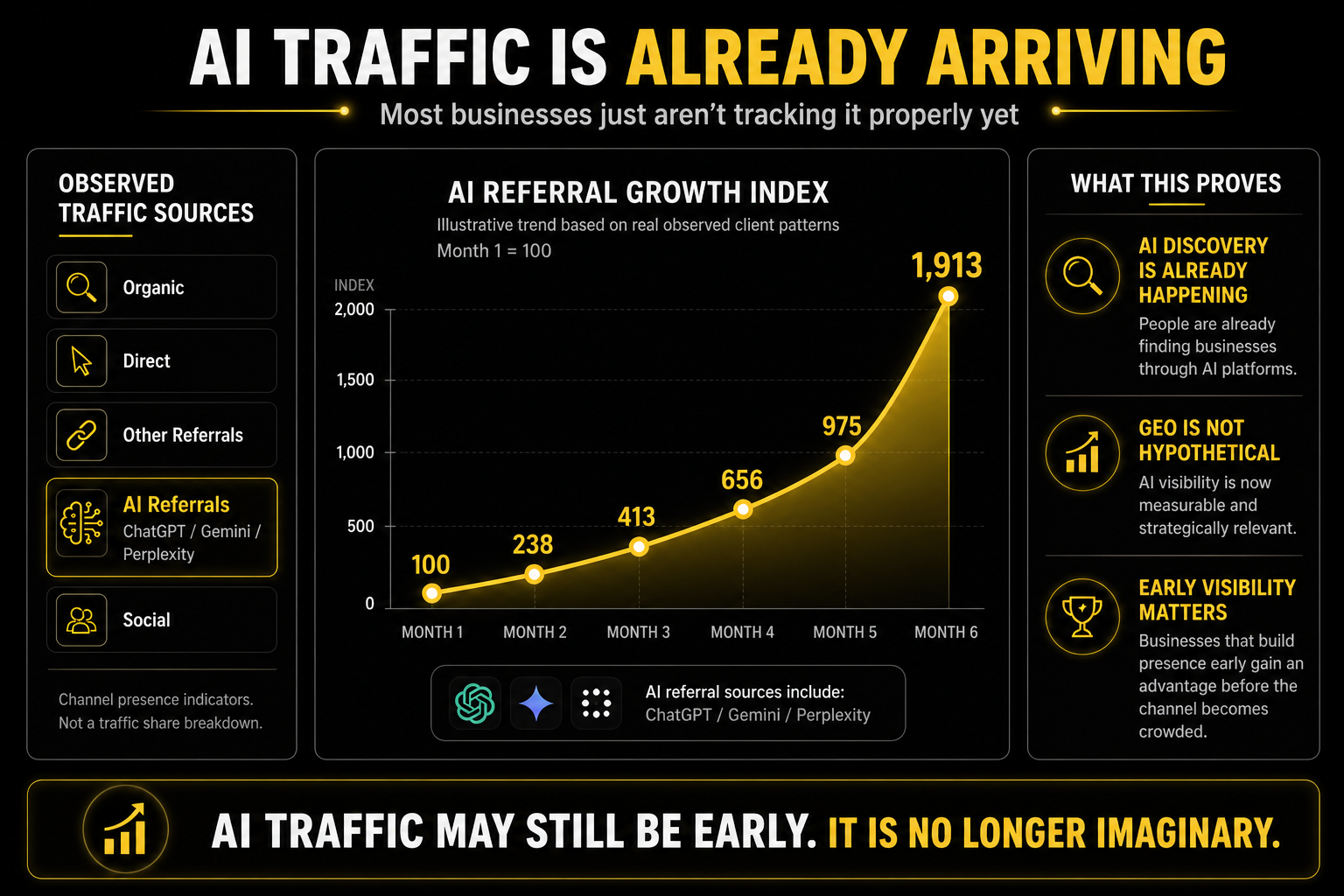
Knowing where you stand is the starting point. Without that baseline, you're optimising blind.
A UK business that is doing SEO, AEO and GEO well in 2026 looks something like this:
This is what we mean by AI visibility. It's not a single tactic. It's the cumulative result of doing all three disciplines consistently.
It also means staying close to how the discipline is evolving. The best AEO thought leaders in the UK are publishing regularly on how AI search behaviour is shifting (and the strategies that are working now will look different in 12 months).
The businesses getting this right now are building a significant advantage. The ones doing nothing are increasingly invisible to a growing segment of buyers who start their research with an AI tool rather than a search engine.
SEO, AEO and GEO are not the same thing (but they work together).
SEO gives you the foundation. AEO structures your content so AI systems can use it to answer questions. GEO builds the brand-level trust that gets you recommended by generative AI tools like ChatGPT, Gemini and Perplexity.
For most UK businesses in 2026, the most urgent question isn't whether to invest in these disciplines (it's finding out where you currently stand). Most will discover a significant AI visibility gap. The ones who close it first have a real commercial advantage.
If you want to know whether your business is already showing up in AI search (and what the gap looks like) an AI visibility audit is the right place to start. At Tenacious, that's exactly where we begin with every client. Find out how our GEO service works.
Related Reading
Related Reading
If you want to go deeper, these guides explain how the full AI visibility system fits together.
What Is GEO in 2026 and How Do You Get Cited in AI Answers?
This is the core definition guide for Generative Engine Optimisation and AI citations.
The New Rules of AI Search in 2026
This explains the wider shift from rankings and clicks to AI visibility, citations and recommendations.
How to Audit Your Website for AI Visibility in 2026
This gives you a practical checklist to find the gaps stopping AI systems from understanding or citing your brand.
Search Everywhere Optimisation: AI Visibility in 2026
This explains how to build visibility across Google, AI answers, LinkedIn, YouTube, Reddit, reviews, directories and trusted sources.
Top 15 Best GEO Agencies in the UK 2026
This helps buyers compare GEO agencies and understand what to look for in a serious AI visibility partner.
Is GEO just another name for SEO?
No. GEO (Generative Engine Optimisation) is specifically focused on building the brand trust and entity authority that causes generative AI tools like ChatGPT and Perplexity to recommend and cite your business. SEO is focused on ranking in traditional search engines like Google. They overlap, but they are distinct disciplines with different signals and different goals.
Do I need to do all three at once?
Not necessarily all at once, but they are interconnected. SEO provides the technical and content foundation that AEO and GEO build on. If your SEO is in good shape, starting AEO and GEO work makes sense. If it's broken, fix that first or you'll be building on weak ground.
How long does it take to see results from GEO?
GEO results typically take between three and six months to become measurable, depending on how established your brand already is and how competitive your sector is. Some businesses see movement in AI recommendations faster if they already have strong content and authority signals. Others start from near zero and need more groundwork first.
Can a small UK business compete with larger brands in AI search?
Yes (and in some ways more easily than in traditional SEO). Generative AI tools weigh topical depth and clear expertise heavily. A small business that answers a specific set of buyer questions better than anyone else can earn recommendations ahead of larger, more generic competitors. Niche authority matters in AI search.
What is an AEO specialist and do I need one?
An AEO specialist is someone who focuses specifically on optimising content for answer engines (structuring it so AI systems can extract and use it when answering user queries). Whether you need one depends on your stage. Many businesses benefit more from a joined-up approach across SEO, AEO and GEO than from specialist focus on any one area in isolation.
How do I find out if my business is already being recommended by AI tools?
The quickest way is to test it manually (ask ChatGPT, Perplexity, Gemini and Claude the questions your potential clients would ask about your sector, and see what comes back). For a more structured picture, an AI visibility audit will test a broader set of queries and map your current presence against competitors.