In 2025, MIT published a study that should have stopped a lot of boardroom AI conversations in their tracks.
After examining hundreds of enterprise AI projects, the researchers found that 95% of them delivered no measurable return on investment. No meaningful cost saving. No revenue impact. No demonstrable change to the bottom line.
Not because the AI tools did not work.
Because the businesses deploying them did not know how to use them at the level where the value actually lives.
This is the problem the 5T AI Impact Model, developed by TomorrowToday Global, is designed to solve. It gives leaders a clear map of where AI energy is being spent, and where it should be spent instead
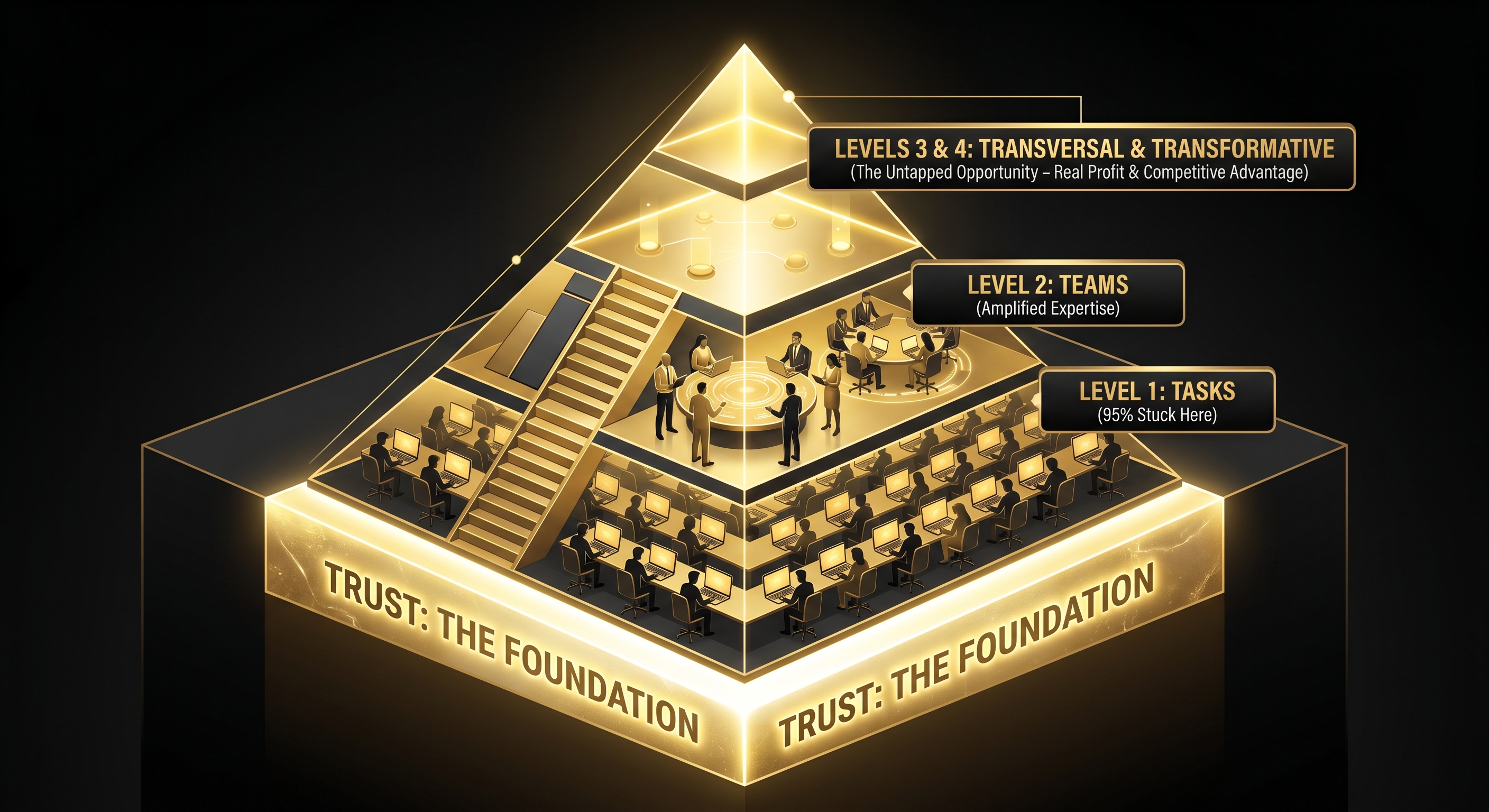
The 5T model identifies five levels of AI impact inside a business. Four are sequential stages. One is a pillar that supports all of them.
| Level | Name | What it means | Value delivered |
| 1 | Tasks | AI for personal productivity. Automating the small stuff. | Individual time saving |
| 2 | Teams | AI as a team member. Amplifying existing expertise. | Better decisions, faster delivery |
| 3 | Transversal | Workflow redesign across functions. | Real bottom-line profit |
| 4 | Transformative | Genuine business model innovation. | Competitive reinvention |
| 5 | Trust | A pillar running through all four levels. | The foundation everything else needs |
The model was built to help leaders understand why their AI efforts are not producing results, and to show them where to focus energy next.
According to TomorrowToday Global, 95% of organisations are still sitting at Level 1.
Because most businesses are deploying AI at the wrong level.
They have given their teams access to AI tools. People are using ChatGPT to write emails, summarise documents and generate content. Meetings are being transcribed. Admin is being automated.
This is Level 1. It is useful. It saves time. But it does not move the needle on revenue, margin or competitive position.
The problem is that most businesses stop here. They count the productivity gains, declare the AI rollout a success and move on.
What they have actually done is install better software on top of old infrastructure. The workflows are unchanged. The knowledge architecture is unchanged. The business model is unchanged.
The MIT research confirms this. The businesses that do see real returns from AI are the ones that have moved beyond tasks to redesigning how the organisation actually works. They represent the 5% that are getting it right.
The gap between the 5% and the 95% is not access to better AI tools. It is the depth of integration.
Level 1 looks like this.
Individual contributors are using AI to write, research, and communicate faster. Someone in marketing is using it to draft posts. Someone in sales is using it to personalise outreach. Someone in finance is using it to summarise reports.
These are all genuinely useful. But they are individual productivity gains. They do not change how the team works together, how workflows connect across functions, or how the business creates and delivers value.
The tell-tale sign that a business is stuck at Level 1 is this: if you removed the AI tools tomorrow, the core processes would run largely unchanged. AI is being used in the gaps between work, not woven into the work itself.
TomorrowToday Global describes this as using AI the way most organisations used computers in the 1980s: as a faster typewriter rather than as a network that changes everything.
The investment is real. The capability is there. The transformation has not happened.
Level 2 is where AI stops being a personal tool and starts being a team capability.
TomorrowToday Global uses the example of a doctor working with AI. A doctor using AI to write up notes faster is at Level 1. A doctor using AI to analyse patient data, cross-reference symptoms, surface relevant research, and support clinical decisions in real time is at Level 2.
The AI is not replacing the doctor's expertise. It is amplifying it. The doctor is still making the judgement call. But they are making it with more information, processed faster, than any individual could manage alone.
In a business context, this looks like teams where AI is a genuine contributor to how work gets done: surfacing relevant data in client meetings, flagging risks before they become problems, and helping teams make better decisions faster.
The important shift is that at Level 2, AI begins to affect outcomes, not just efficiency. It changes what the team is capable of, not just how quickly they get through their to-do list.
Level 3 is where TomorrowToday Global says almost no businesses have yet arrived, and where the real commercial value of AI is waiting.
Transversal means across. This is AI being used to redesign how work flows between functions: between sales and delivery, between marketing and product, between operations and customer success.
Most businesses are organised in silos. Each function optimises for its own goals. Handoffs between teams are clunky, information gets lost, and the customer experience suffers at the joins.
Transversal AI redesigns these workflows. Not by adding AI to each function separately, but by using AI to create new connective tissue between them.
An example: a business that uses AI to connect the signals from its marketing content performance to the questions that surface in sales calls, to the gaps that show up in delivery, to the knowledge base being built by the team. Each piece informs the others. The whole system becomes more intelligent than any individual function working alone.
This is where margin improvement, revenue growth, and structural competitive advantage begin to appear. It is hard to reach without getting Levels 1 and 2 right first. But it is the level where investment in AI starts to pay back meaningfully.
Level 4 is the destination most leaders describe when they talk about what they want from AI.
Genuine business model innovation. New services that were not possible before. New ways of creating and delivering value that competitors without the same AI foundation cannot replicate.
TomorrowToday Global are clear that Level 4 is unreachable without the first three levels in place. The organisations attempting to jump straight to business model transformation without having redesigned their workflows, built their team capabilities or structured their knowledge are the ones most likely to join that 95% that MIT studied.
Transformation is not a technology project. It is a business design project that uses technology as the enabling layer. The businesses that arrive at Level 4 will have spent real time at Levels 1, 2 and 3 first.
For most B2B service businesses, Level 4 looks like: entirely new service propositions built on AI capabilities, pricing models that reflect AI-delivered outcomes rather than time, and competitive positions that are structurally difficult for others to reach because they are built on proprietary knowledge and deep operational AI integration.
TomorrowToday Global is explicit that Trust is not a fifth level. It is a pillar running through all four.
Without trust in AI systems, from leadership, from teams, from customers, and from the AI systems themselves evaluating the business, nothing above Level 1 holds.
At the internal level, this means people trusting AI outputs enough to act on them, and organisations having governance frameworks robust enough to catch the cases where they should not.
But there is a second dimension to Trust that most conversations about the 5T model do not surface.
The AI systems that will increasingly sit between your business and your buyers also need to trust you.
When a buyer asks ChatGPT, Perplexity, or Google AI Mode to recommend a supplier, the AI is making a trust evaluation. It is looking for consistent authority signals, structured information, credible mentions, clear expertise, and a business that is genuinely understandable to an AI system.
Businesses that have not invested in that kind of AI-facing trust infrastructure will find that even if their internal AI operations are excellent, they remain invisible to the recommendation systems that are increasingly driving buyer decisions.
This is the bridge between the 5T model and what Tenacious Marketing works on every day. Trust, at the external level, is what GEO and AEO services are designed to build. It is the foundation that makes AI discovery, AI citation, and eventually AI-driven customer acquisition possible.
The 5T framework is useful because it gives leaders an honest answer to a question that most AI strategy conversations avoid.
Where are we actually?
Not where we say we are in the board update. Not where the case study suggests we should be by now. Where are we, honestly, in terms of how deeply AI is integrated into how value is created and delivered?
For most businesses, the honest answer is Level 1 with some early Level 2 experiments.
That is not a failure. It is a starting point. The businesses that will dominate the next decade are the ones that see that starting point clearly and build a deliberate path from Tasks to Trust, from personal productivity to structural competitive advantage.
The window is still open. The 95% that are stuck at Level 1 represent both the scale of the problem and the scale of the opportunity for the businesses willing to move further, faster.
If you want to understand where your AI marketing strategy sits on the 5T model, and what it would take to build real AI trust and authority with the systems that are increasingly making buyer recommendations, Tenacious Marketing's GEO and AEO services are the right starting point.
What is the 5T AI Impact Model?
The 5T AI Impact Model is a framework developed by TomorrowToday Global that maps five dimensions of AI impact inside a business: Tasks (personal productivity), Teams (AI amplifying expertise), Transversal (workflow redesign across functions), Transformative (business model innovation), and Trust (the foundational pillar running through all four). It was designed to help leaders understand why most AI deployments fail to deliver real value, and where to focus energy to change that.
Why do most enterprise AI projects fail?
A 2025 MIT study found that 95% of enterprise AI pilots deliver no measurable return on investment. The primary reason is not that the technology does not work, it is that businesses are deploying AI at Level 1 (personal productivity tools) without redesigning workflows, knowledge systems or organisational structure. Real value sits at Level 3 and beyond, which requires deliberate investment in how work is designed, not just which tools are used.
What is Transversal AI?
Transversal AI refers to the use of AI to redesign workflows across functions rather than optimising within individual silos. Instead of marketing using AI separately from sales, which uses it separately from delivery, Transversal AI connects these functions so that information flows between them, and the whole system becomes more intelligent. TomorrowToday Global identifies this as the level where real bottom-line profit emerges, and notes that almost no businesses have reached it yet.
How does Trust fit into the 5T model?
Trust is not a sequential level in the 5T model. It is a pillar that all four levels depend on. Internally, it means teams and leaders trusting AI outputs enough to act on them, with governance strong enough to catch errors. Externally, it means the AI systems that now sit between businesses and buyers are able to evaluate, understand, and trust your business enough to recommend it. This external Trust dimension is what GEO and AEO work is designed to build.
What is the connection between the 5T model and GEO?
The Trust pillar in the 5T model has an internal and an external dimension. Internal trust is about your teams trusting AI. External trust is about AI systems trusting your business. GEO (Generative Engine Optimisation) is how you build that external trust: structuring your content, authority signals, and knowledge architecture so that AI platforms like ChatGPT, Perplexity, and Google AI Overviews can understand, evaluate, and recommend your business with confidence.
How do I know which level my business is currently at?
The clearest test is this: if you removed your AI tools tomorrow, would your core processes run largely unchanged? If yes, you are at Level 1. If your teams are actively using AI to improve decisions and outcomes in real time, you are approaching Level 2. If AI is changing how information flows between your functions, you are entering Level 3. Most businesses asking this question for the first time find they are at Level 1 with early exploration of Level 2.