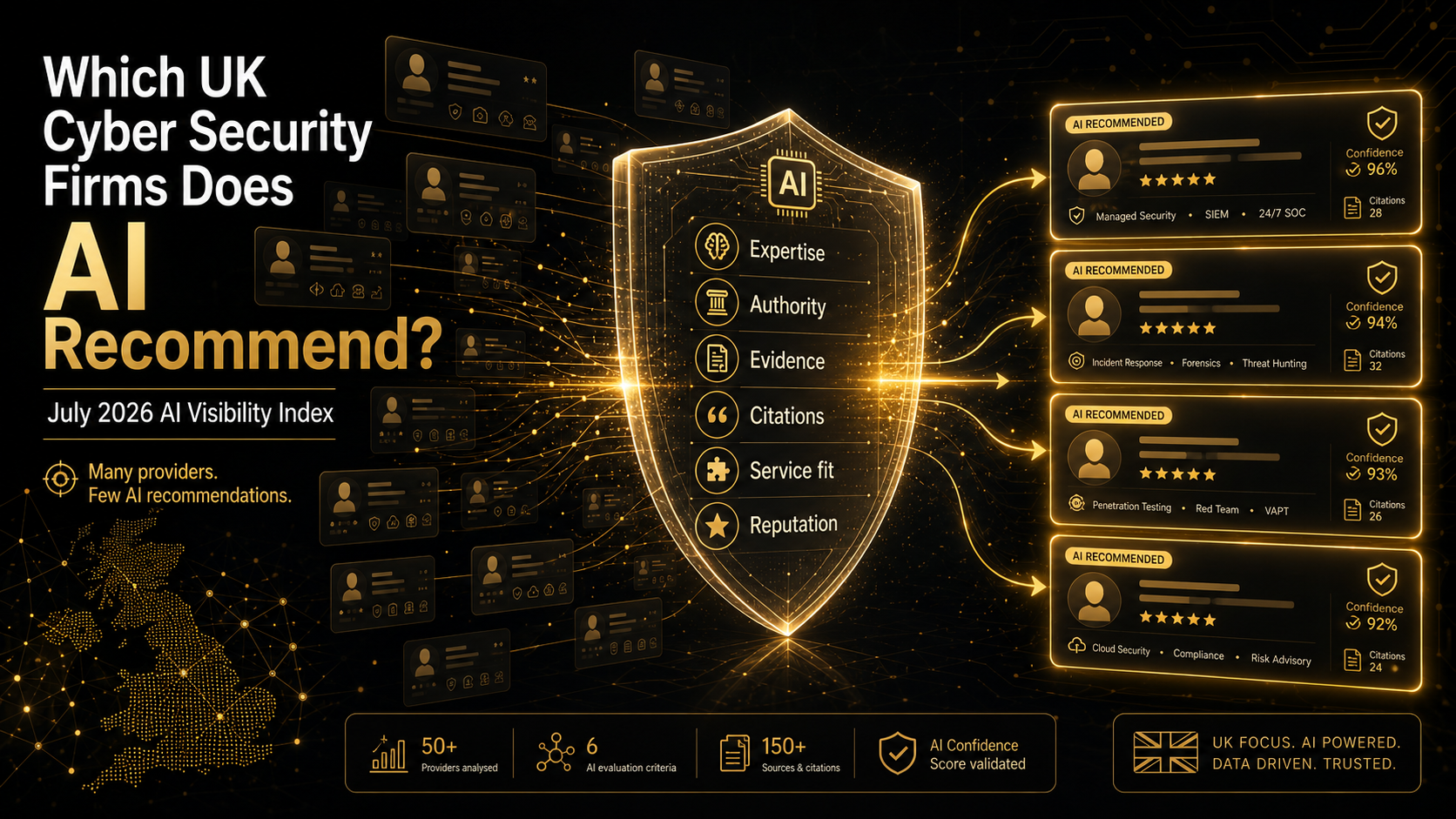
Cyber security buyers rarely begin with a provider name.
They begin with a risk.
They ask which firm can respond to ransomware, operate a managed security service, test critical systems, support a regulated organisation or advise the board on cyber exposure.
AI assistants are increasingly being used to turn those questions into an initial supplier shortlist.
That is why we launched the Tenacious AI Visibility Index.
Every month, we test the same buyer questions and record which companies are recommended. Over time, this lets us see which firms are becoming more visible, which are losing ground and how the recommendation patterns differ between AI models.
July is Month 2 of the Index for UK cyber security firms, and the results show meaningful movement from June.
Bridewell has moved from fifth to first. NCC Group remains one of the two strongest cross-model brands. Darktrace, June’s second-ranked firm, has left the combined Top 10.
The July cyber security rankings are led jointly on total mentions by Bridewell and NCC Group, with 31 appearances each across the four AI models and ten buyer questions.
Bridewell takes first place because the combined ranking prioritises broad model agreement before total mentions. Both firms appeared across ChatGPT, Claude, Gemini and Perplexity.
That changes the consensus picture from June.
In June, NCC Group and Darktrace were the only firms named across all three models. In July, the full-consensus pair is Bridewell and NCC Group. NCC Group is therefore the only provider to retain complete cross-model agreement across both months.
The wider Top 10 has also changed substantially. LRQA Nettitude, Kroll through its Redscan brand, IBM, Microsoft and Bulletproof enter the leading group. Darktrace, both BAE Systems entity variants, BT Security and KPMG leave it.
These are directional ranking changes rather than direct raw-score comparisons because the methodology expanded in July. June used three models and mixed sector-level with question-level data. July used four models and counted every provider at question level.
| Metric | June 2026 | July 2026 | Change |
| AI models included | 3 | 4 | Gemini added |
| Buyer questions | 10 | 10 | No change |
| Unique providers detected | 73 | 75 | Up 2 |
| Full-consensus providers | 2 | 2 | No numerical change |
| Full-consensus names | NCC Group, Darktrace | Bridewell, NCC Group | One retained |
| Top-ranked provider | NCC Group | Bridewell | Changed |
| Perplexity responses with named providers | 2 of 10 | 9 of 10 | Much broader coverage |
June recorded 73 unique companies and full agreement around NCC Group and Darktrace. July detected 75 providers, with Bridewell and NCC Group achieving four-model consensus.
The number of unique providers has barely changed, but the companies controlling the strongest visibility positions have.
Bridewell is the clearest climber.
It ranked fifth in June, appearing in Claude and Perplexity but not in ChatGPT’s sector shortlist.
In July, it appears in all four models and receives 31 combined question-level mentions:
That gives Bridewell both high frequency and broad agreement.
Deloitte rises four positions, from eighth in June to fourth in July.
Its July visibility comes from ChatGPT, Gemini and Perplexity, giving it 13 total mentions across three models. It does not appear in the July Claude count used for the combined Top 10, which shows that a firm can rank highly without being evenly visible across every platform.
PwC also improves its position, rising from tenth to seventh.
It appears across ChatGPT, Gemini and Perplexity in July, with 10 combined mentions. Like Deloitte, it remains a three-model rather than four-model recommendation.
NCC Group slips from first to second, but this is not a meaningful loss of visibility.
It matches Bridewell’s 31 total mentions and appears across every model:
It is also the only company that achieved full model consensus in both June and July. That makes NCC Group the most stable cross-month performer in the cybersecurity dataset.
Five providers enter the combined July Top 10:
LRQA Nettitude enters directly at number three, with 20 mentions across ChatGPT, Gemini and Perplexity. It is particularly strong in ChatGPT, where it appears in all ten buyer-question responses.
Kroll, normalised with its Redscan brand, enters at number five. It receives nine Claude mentions and appears in Gemini and Perplexity, producing 12 total mentions across three models.
IBM also records 12 mentions across ChatGPT, Gemini and Perplexity, placing sixth.
Microsoft reaches eighth through a different model pattern. Its ten mentions come from ChatGPT, Claude and Gemini, but it is absent from Perplexity’s detected provider set.
Bulletproof enters tenth, supported by Claude, Gemini and Perplexity.
Five June Top 10 firms are no longer in the July leading group:
This section should not be read as evidence that those companies disappeared from AI entirely.
Darktrace, for example, still appears in individual July responses, including Perplexity’s enterprise and provider-comparison results. It simply no longer collects enough breadth and frequency to remain in the combined Top 10.
The same applies to BAE Systems Digital Intelligence and BT Security, both of which continue to appear in particular managed-security and enterprise queries.
The movement is therefore about relative visibility across the full test set, not an absolute disappearance from AI recommendations.
| Rank | Company | ChatGPT | Claude | Gemini | Perplexity | Total | Models Agree |
| 1 | Bridewell | 10 | 9 | 7 | 5 | 31 | 4/4 |
| 2 | NCC Group | 10 | 9 | 4 | 8 | 31 | 4/4 |
| 3 | LRQA Nettitude | 10 | — | 4 | 6 | 20 | 3/4 |
| 4 | Deloitte | 6 | — | 5 | 2 | 13 | 3/4 |
| 5 | Kroll (Redscan) | — | 9 | 1 | 2 | 12 | 3/4 |
| 6 | IBM | 6 | — | 5 | 1 | 12 | 3/4 |
| 7 | PwC | 6 | — | 2 | 2 | 10 | 3/4 |
| 8 | Microsoft | 3 | 5 | 2 | — | 10 | 3/4 |
| 9 | Sophos | — | 5 | 1 | 2 | 8 | 3/4 |
| 10 | Bulletproof | — | 3 | 3 | 1 | 7 | 3/4 |
Counts show the number of ten buyer questions in which each model explicitly named the company. The maximum possible score is 40.
The top of the table contains two different types of visibility.
Bridewell and NCC Group combine high mention volume with complete model agreement.
LRQA Nettitude has strong total visibility but is absent from Claude’s aggregate count. Kroll performs extremely strongly in Claude but does not appear in ChatGPT’s count. Deloitte and IBM collect similar totals through different combinations of models.
That difference matters because AI visibility is not one universal ranking. It is a collection of overlapping recommendation environments.
| Company | June Rank | July Rank | Movement |
| Bridewell | 5 | 1 | Up 4 |
| NCC Group | 1 | 2 | Down 1 |
| LRQA Nettitude | Outside Top 10 | 3 | New entrant |
| Deloitte | 8 | 4 | Up 4 |
| Kroll (Redscan) | Outside Top 10 | 5 | New entrant |
| IBM | Outside Top 10 | 6 | New entrant |
| PwC | 10 | 7 | Up 3 |
| Microsoft | Outside Top 10 | 8 | New entrant |
| Sophos | 6 | 9 | Down 3 |
| Bulletproof | Outside Top 10 | 10 | New entrant |
| Darktrace | 2 | Outside Top 10 | Dropped out |
| BAE Systems Applied Intelligence | 3 | Outside Top 10 | Dropped out |
| BT Security | 4 | Outside Top 10 | Dropped out |
| BAE Systems Digital Intelligence | 7 | Outside Top 10 | Dropped out |
| KPMG | 9 | Outside Top 10 | Dropped out |
June’s combined ranking was led by NCC Group and Darktrace, followed by BAE Systems
Applied Intelligence, BT Security and Bridewell.
July’s table is visibly different. Bridewell and NCC Group now sit well ahead of the rest, while a new group of enterprise, managed-security and technology brands fills most of the remaining positions.
The largest ChatGPT change is methodological.
In June, ChatGPT returned one curated sector ranking. In July, it answered all ten buyer questions separately.
That makes July’s ChatGPT data richer, but it also means direct June-to-July mention comparisons would be misleading.
Within July, ChatGPT shows particularly strong consistency around Bridewell, NCC Group and LRQA Nettitude, each appearing across all ten questions.
It also gives substantial visibility to Deloitte, IBM and PwC, each named in six questions.
Claude’s July results are heavily concentrated.
Bridewell and NCC Group each appear in nine questions. Kroll through Redscan also appears in nine.
Sophos and Microsoft follow with five appearances each.
This is a meaningful change from June, when Claude named NCC Group seven times,
Darktrace six times and Bridewell four times. The directional movement suggests that Bridewell and Kroll became much more central to Claude’s July recommendations.
Gemini was not included in June, so it creates an entirely new source of visibility in July.
Bridewell leads with seven Gemini appearances. Deloitte and IBM record five each, while NCC Group and LRQA Nettitude receive four.
Gemini’s presence helps explain why enterprise-scale advisory and technology brands become more prominent in the July combined table.
Perplexity returned named cyber security providers in only two of ten June responses.
In July, it returned named providers in nine of ten. This is one of the most important methodological developments in the sector.
NCC Group leads July Perplexity visibility with eight question appearances, followed by LRQA Nettitude with six and Bridewell with five.
That much broader coverage gives the combined July ranking a more reliable picture of Perplexity’s recommendation behaviour than June could provide.
Three findings stand out.
First, NCC Group has the strongest continuity. It is the only provider to achieve complete model consensus in both months.
Second, Bridewell has made the most important upward move. It has gone from a two-model, fifth-ranked June position to joint-highest total visibility and first place in July.
Third, the recommendation set has shifted towards managed security, enterprise services and broader technology ecosystems. LRQA Nettitude, Kroll, IBM and Microsoft all enter the Top 10.
That does not prove a permanent change in market preference. Two months is still an early dataset, and July’s methodology is broader than June’s.
But it gives us a clear trend to track in August:
Will Bridewell and NCC Group remain the two consensus leaders?
Will Darktrace return to the Top 10?
Will Kroll and LRQA Nettitude retain their new positions?
That is the value of treating this as an ongoing index rather than ten disconnected monthly articles.
Cyber security buyers need evidence.
They are looking for proof around regulated-sector experience, incident response, managed detection, technical assurance, penetration testing and board-level risk.
AI systems need much the same thing before they can confidently recommend a provider.
The firms that build durable AI visibility tend to make their expertise easy to understand through:
Our AI visibility metrics guide explains how recommendation coverage should be measured beyond a single model or prompt.
The generative engine optimisation guide also explores how businesses can strengthen the signals AI systems use to understand expertise.
The important point is not to publish generic cyber content for the sake of volume. It is to create useful, structured evidence around the specific problems your ideal buyers are asking AI to solve.
That relationship between authority and useful content is explored further in our guide to what actually drives AI visibility.
The July 2026 Tenacious AI Visibility Index analysed ten UK-focused cyber security buyer questions across ChatGPT, Claude, Gemini and Perplexity.
A company was counted once for each model and question in which it was explicitly named.
Obvious brand variants were normalised, while generic categories and non-provider sources were excluded. Perplexity returned a named commercial provider in nine of ten July responses.
July was compared with the June Top 10 and recommendation patterns. Because June used three models and a different mix of sector-level and question-level data, month-on-month movements are directional rather than direct raw-score comparisons.
Disclosure: Results reflect responses collected on 10 July 2026. They measure named-provider visibility in this test set, not market share, service quality or an endorsement by Tenacious AI Marketing.
Want the Full Cyber Security AI Visibility Dataset?
This article covers the main July findings, but the complete dataset contains much more:
If your firm appears, you can see exactly which questions and models are surfacing it.
If it does not, you can see which competitors are entering the recommendation set instead.
Run your website through Answer Architect for a free AI Visibility Score and report, or book a free AI Visibility Audit, and we will test your business directly.
For support turning those findings into a practical visibility plan, explore our AI marketing services.
Bridewell and NCC Group were the only providers appearing across ChatGPT, Claude, Gemini and Perplexity in the July dataset.
Bridewell ranked first. It tied with NCC Group on 31 total mentions, but the combined ranking placed Bridewell first after applying the dataset’s ranking rules.
Bridewell made the clearest Top 10 move, climbing from fifth in June to first in July. Deloitte also rose four positions, from eighth to fourth.
The Index shows relative visibility across the full test set. Darktrace still appeared in some July responses, but other providers collected broader or more frequent recommendation coverage.
No. It measures named appearances in AI recommendations. It does not measure service quality, technical performance, market share or client satisfaction.
June used three models, with ChatGPT providing a sector-level list and Perplexity returning limited named citations. July used four models and question-level counts throughout. Ranking membership and recommendation patterns can be compared directionally, but raw totals are not like-for-like.