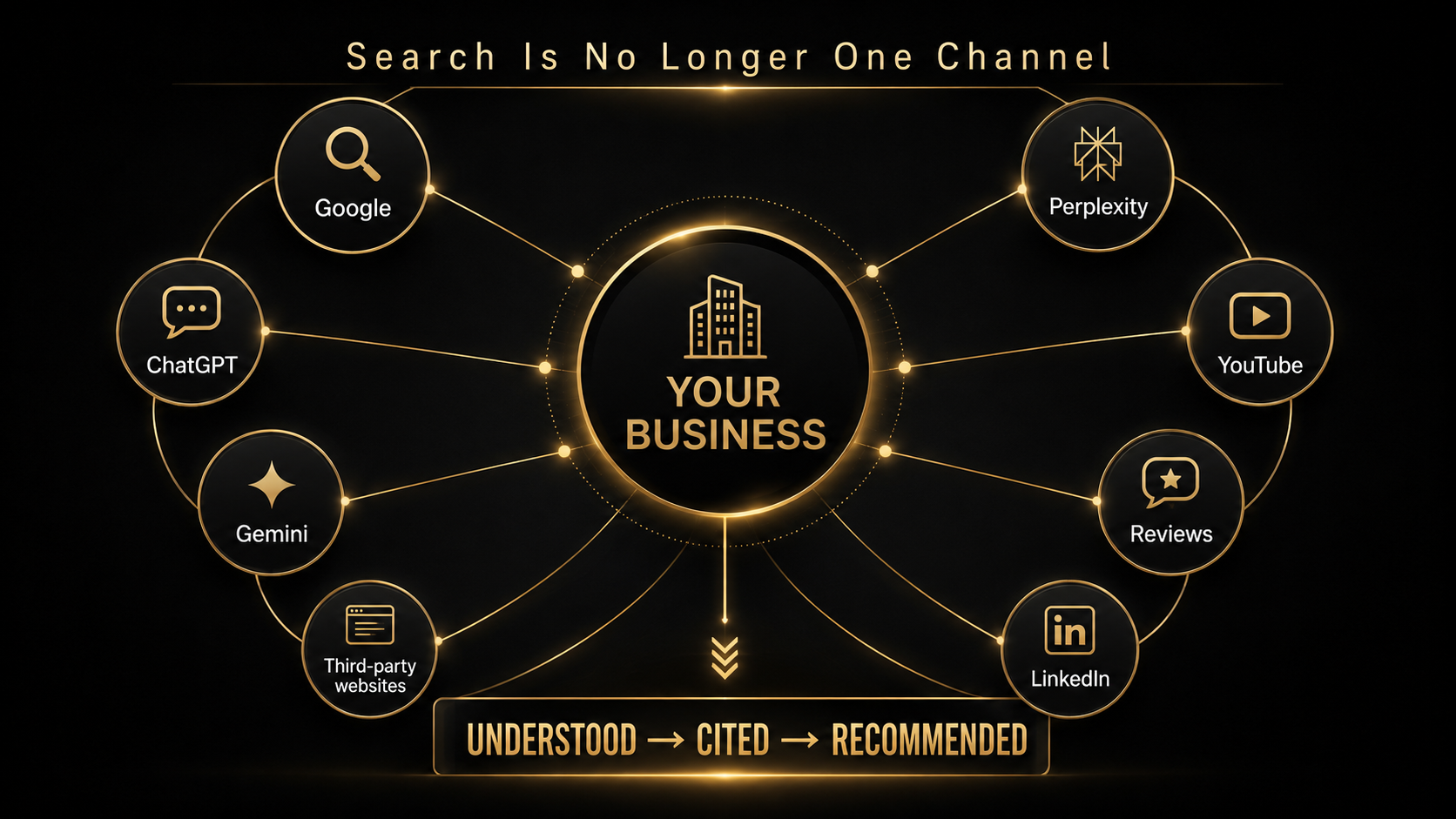
AI search is no longer a side topic.
It is now part of how people search, compare, research and make decisions.
That does not mean Google is dead. It does not mean websites are dead. And it does not mean every business needs to abandon SEO.
It means the discovery journey has changed.
People still search. They still click. They still visit websites. But they are also asking ChatGPT, Gemini, Perplexity, Claude, and Google AI features to explain markets, compare suppliers, summarise options and help them decide who is worth speaking to.
In the UK, Ofcom reported that Google Search is still used by 82% of adults, but AI is now built into the search experience. Around 30% of searches show AI Overviews, and 53% of adults say they see these summaries often. It also reported that ChatGPT had 1.8 billion UK visits in the first eight months of 2025, up from 368 million in the same period of 2024.
That is the state of search in 2026. It is not one channel anymore.
It is Google rankings, AI summaries, answer engines, recommendation systems, YouTube discovery, third-party citations, review signals, brand mentions and agentic search all working together.
For business owners, the question is no longer just: Do we rank?
The better question is: Are we visible when AI helps someone decide?
AI search in 2026 is the shift from search results to AI-assisted decisions.
Traditional search gave people a list of results. AI search gives people explanations, summaries, comparisons and shortlists.
That changes the commercial value of visibility.
A buyer might still start with Google. But they may also ask an AI tool: “Which company should I speak to if I need help getting my business visible in ChatGPT, Gemini and Google AI search?”
That is not a keyword. That is a buying situation.
The AI engine does not just need to find a page. It needs to understand the category, compare possible answers, judge trust signals and decide which sources or businesses to mention.
That is where SEO starts to look incomplete. Not useless. Incomplete.
A business can have rankings and still be missing from AI answers. It can have traffic and still not be recommended. It can have content and still be unclear to the systems buyers now use to make sense of the market.
That is why AI Visibility, AEO and GEO now matter.
Google I/O 2026 made the direction very clear. Search is becoming more conversational, more agentic and more AI-led.
Google brought advanced model capabilities into Search, including AI features that allow users to use agents simply by asking a question. It also described its new intelligent AI-powered Search box as the biggest upgrade to Search in more than 25 years.
That is not a small product update. That is Google saying the search box is becoming an AI interface.
The old behaviour was short and keyword-led: “marketing agency UK”
The new behaviour is longer, more specific and more decision-led: “Who can help a UK B2B service business become visible in ChatGPT, Perplexity, Gemini and Google AI search without relying only on paid ads?”
That is the shift. Search is no longer only matching pages to keywords.
It is increasingly trying to understand intent, context, credibility and the best next step.
AI Mode matters because it changes what a search experience feels like.
Google said AI Mode has passed 1 billion monthly active users, while AI Overviews has more than 2.5 billion monthly active users.
Google also said that when people use AI-powered features in Search, they use Search more, and that Search now feels more like an ongoing conversation than a set of individual queries.
That matters for business visibility.
In a normal search result, you are trying to win the click.
In an AI-led search experience, you are trying to be part of the explanation, the cited source, the comparison or the recommendation.
Google also says AI Mode is useful for nuanced questions, reasoning and complex comparisons, and that AI Mode and AI Overviews may use a “query fan-out” technique, where multiple related searches are issued across subtopics and data sources to build a response.
That means one simple keyword page is not enough.
If AI search breaks a query into several related questions, your business needs enough useful content and authority around the topic to be picked up across the wider pattern.
No. Websites are not dead.
But the old idea of a website as the main front door to the business is weaker than it used to be.
In the past, the job of a website was simple:
That journey still happens.
But it is no longer the only journey.
Now, a buyer may ask an AI system to compare providers before visiting a single website. They may see a Google AI Overview before clicking. They may watch a YouTube video. They may check LinkedIn. They may read reviews. They may ask ChatGPT for a shortlist.
So the website has a new job.
It has to act as a source of truth.
It needs to give AI systems and buyers clean evidence about:
The website is not just a shop window anymore.
It is part of the evidence layer.
That is the better version of the “websites are dead” argument.
Websites are not disappearing. Weak, vague, unstructured websites are becoming less useful.
AI agents change the search journey because they do more than answer questions.
They can monitor, compare, organise, recommend and take steps on behalf of the user.
Google entered the era of Search agents, where users can create and manage AI agents for tasks inside Search. It described information agents that can scan the web, monitor changes and send synthesised updates, as well as agentic booking capabilities for services and local experiences.
That has a clear implication for businesses.
If AI agents are helping users compare options, monitor services, shortlist providers or complete tasks, then businesses need to be machine-readable as well as human-readable.
A polished homepage is not enough.
Agents need structured information, clear service definitions, up-to-date details, proof, reviews, FAQs, comparison content and reliable signals across the web.
This is where GEO becomes practical.
GEO is not about tricking AI.
It is about making a business easier to find, understand, validate and recommend when AI systems are involved in the decision.
The biggest change is that visibility now happens before the website visit.
That is uncomfortable for businesses that still measure everything through sessions and pageviews.
A potential buyer may form an opinion about your business before they land on your site.
That means businesses need to measure more than rankings.
They need to know:
This is where tools like Answer Architect fit naturally. The value is not just “tracking AI search”.
The value is knowing where your business is visible, where competitors are winning, and which buyer questions are shaping the market.
At Tenacious AI Marketing, we have now analysed AI recommendation visibility across ten industries using the same core methodology: real buyer questions, tested across ChatGPT, Claude, Gemini and Perplexity, with every named commercial provider recorded and compared across models. The goal was not to decide which company is “best”. The goal was to understand which businesses AI systems recognise strongly enough to recommend, which sources appear to influence those recommendations, and what patterns repeat across different markets. The July reports use this kind of buyer-question methodology across sectors including legal services, accountancy, cyber security, construction, travel, recruitment, MSPs, marketing agencies, solar and FX.
The most important pattern was simple: AI visibility is not random.
Across the Index, AI systems repeatedly favoured businesses that were easier to understand, easier to validate and easier to connect to a specific buyer need. The companies that performed well were not always the largest businesses in their category. They were often the businesses with the clearest public evidence around what they do, who they help and why they should be trusted.
One of the strongest recurring patterns was clear positioning. In the marketing agency report, broad claims such as “full-service marketing agency” appeared less effective than specific positioning, while agencies with clear specialisms, authority signals and thought leadership were more likely to appear. In construction, the Index showed that product-category authority often mattered more than overall company size, with specialist manufacturers appearing when questions became more specific.
That matters because AI search is not only asking, “Who is big?” It is asking, “Who fits this exact situation?”
A construction buyer does not always ask for a generic supplier. They may ask for roofing systems, commercial flooring, façade products, acoustic materials or sustainable construction products. A B2B buyer searching for a marketing agency may ask for AI visibility, LinkedIn marketing, B2B demand generation or content-led growth. In both cases, AI systems appear to reward businesses that are easier to match to a specific category of need.
The second pattern was the importance of third-party validation. The FX broker report showed that recommendation visibility was closely linked to third-party validation, editorial coverage and authority signals, with firms benefiting from comparison platforms, financial publications and business-focused sources that AI models appeared to reference. The cyber security report showed a similar point: buyers need proof around regulated-sector experience, incident response, managed security, technical assurance and board-level risk, and AI systems need much the same evidence before they can recommend a provider confidently.
That is one of the biggest lessons for businesses.
Your own website matters, but it is not enough on its own.
AI systems build confidence from the wider evidence around a brand: reviews, directories, awards, accreditations, expert commentary, third-party mentions, case studies, partner pages, YouTube content, LinkedIn activity and media references. A business that only talks about itself has a weaker evidence footprint than a business being validated across multiple trusted sources.
The third pattern was cross-model consistency. Several reports showed that appearing strongly in one AI platform is useful, but not the same as being consistently visible across the wider AI search layer. In travel, Black Tomato matched Abercrombie & Kent on raw appearances, but ranked below it because Abercrombie & Kent appeared across all four models. In recruitment, Robert Walters had the highest mention count, but Korn Ferry and several executive-search firms ranked higher because they achieved broader model agreement.
This is an important commercial point.
A business can look strong in ChatGPT but be absent in Claude. It can appear repeatedly in Gemini but fail to show in Perplexity. It can have high raw mentions but weak consensus. That means AI visibility cannot be measured from one prompt, one model or one screenshot. It needs to be measured across multiple questions and multiple AI systems.
The fourth pattern was the growing role of founder authority and expert content. The strongest performers across professional services, marketing, cyber security, accountancy and recruitment tended to have stronger authority signals around people, expertise and proof. In accountancy, the report noted that firms appearing consistently tended to have clear service pages, topical authority, consistent brand signals, third-party citations, evidence-based content and direct answers to buyer questions. In law, firms that appeared repeatedly tended to have clear service positioning, strong topical authority, authoritative third-party references and detailed content answering buyer questions.
This is where LinkedIn, YouTube and founder-led content become more important.
AI systems are not only looking for a page. They are looking for a pattern of expertise. A founder who explains the same category clearly on LinkedIn, appears in relevant videos, contributes to podcasts, publishes useful articles and connects that expertise back to the business creates more public evidence than a founder who is invisible.
The fifth pattern was that generic content did not appear to create strong visibility on its own. Sectors with less educational content, fewer buyer-focused resources and weaker public proof appeared to have larger opportunity gaps. Construction was described as one of the least mature sectors for AI visibility, with suppliers often relying on trade relationships, merchant networks and offline reputation while AI systems instead depend on product pages, technical documentation, specification content, sustainability reports, trade publication coverage and industry citations.
That is the key difference between old SEO content and AI visibility content.
A generic article written to fill a keyword gap is not enough. AI systems need content that helps them understand the business, place it in the right category, compare it with alternatives and support a recommendation with evidence.
The sixth pattern was that AI recommendations can shift quickly. Across the Index, June-to-July movement was significant. Law saw a major reshuffle, with firms such as Osborne Clarke, CMS, Withers and Macfarlanes entering the leading group while several traditional names dropped out. Solar moved heavily towards commercial solar installers and distributed-energy specialists. MSPs remained highly fragmented, with no provider achieving full agreement across all four models.
That does not mean these movements prove permanent winners and losers.
It means AI visibility is alive.
Models change. Sources change. Prompts change. Competitors publish. Directories update. Reviews appear. New content is indexed. Third-party validation grows or weakens. A business that looks visible one month can become less visible the next if competitors build clearer evidence.
The most important finding was not industry specific.
Whether we analysed legal firms, accountants, IT providers, cyber security companies, FX brokers, marketing agencies, recruitment firms, construction suppliers, solar businesses or travel providers, the same principle kept appearing.
AI systems consistently recommended businesses with the clearest evidence, strongest authority signals and most consistent digital footprint.
The companies winning in AI search were not necessarily the biggest.
They were simply the easiest for AI to understand, verify and trust.
AI systems do not only look at a company’s homepage.
They build confidence from the wider evidence available across the web.
That can include:
This is why two businesses with similar websites can perform very differently in AI search.
One may have clear service pages but very little external validation.
Another may have strong reviews, founder videos, industry mentions, useful comparison content, case studies and consistent LinkedIn activity.
AI systems are not simply asking: Does this business have a website?
They are asking: Is there enough reliable evidence to understand, compare and recommend this business?
That is why organic visibility in 2026 needs to be measured across the whole digital footprint, not just one domain.
AI search is not driven by one signal.
It is a mix of technical access, content clarity, authority, source quality and external validation.
Google says the same SEO best practices remain relevant for AI features in Search. Pages still need to be crawlable, indexable, useful, reliable and accessible. Google also says important content should be available in textual form, internal links matter, structured data should match visible page content, and Business Profile information should be up to date.
But the wider AI visibility layer goes beyond classic SEO.
| What Matters Now | What It Means for Businesses |
| Clear category signals | AI should be able to place the business in the right market quickly |
| Answer-led content | Pages should answer the questions buyers and AI systems actually ask |
| Structured information | Services, FAQs, articles and business details should be easy to parse |
| External validation | Reviews, mentions, citations, lists and case studies help corroborate claims |
| Prompt coverage | The business should appear for the questions buyers ask before choosing |
| Content freshness | Important pages need to stay accurate as the market changes |
| Expert proof | Founder insight, case studies, videos and original frameworks help show real expertise |
| Multi-platform presence | AI systems look beyond one website when building confidence |
The AI Visibility Index supports this pattern. Across ten industries, the strongest performers were rarely relying on one signal. They usually combined clear service pages, third-party validation, consistent positioning, trusted citations, reviews, expert content and enough public evidence for AI systems to compare them fairly. That is why AI visibility has to be treated as a system, not a single SEO tactic.
This is the part many businesses miss.
Publishing more articles is not the same as becoming more visible.
The work is to build a stronger evidence base around the business.
| AI Visibility Area | Weighting Points | Why It Matters |
| Website clarity | 20 | AI needs to understand what the business does, who it helps and what category it belongs in |
| AI citations | 15 | Shows whether AI systems trust the business or its content enough to reference it |
| Third-party mentions | 15 | Provides external validation beyond the company’s own claims |
| Reviews and reputation | 10 | Helps support trust, credibility and buyer confidence |
| Founder authority | 10 | Connects expertise to a real person and strengthens the authority behind the business |
| YouTube presence | 10 | Adds human proof, explanations, transcripts and video-based authority |
| Comparison content | 10 | Helps AI compare the business fairly against competitors |
| Structured data | 5 | Gives search and AI systems clearer information about pages, people, services and entities |
| Content freshness | 5 | Helps prevent outdated information from shaping AI answers |
| Prompt visibility | 10 | Shows whether the business appears for real buyer questions, not just branded searches |
This scorecard should not be treated as a fixed algorithm.
It is a practical way to think about the evidence AI systems need.
The strongest AI visibility comes when these signals reinforce each other.
YouTube is becoming more important, but not because every business needs to chase views.
It matters because video creates proof.
At Google I/O 2026, YouTube announced Ask YouTube, a conversational search experience that lets users ask more complex questions, refine with follow-ups and receive structured responses using relevant videos across YouTube’s catalogue.
For businesses, that changes how video should be viewed.
A good video is not just a social asset.
It can become:
This does not mean YouTube replaces the website. It means YouTube can strengthen the proof layer around the business.
The practical response is not panic.
It is not chasing every AI trend.
It is building a visibility system that works across search, AI answers and trusted third-party surfaces.
Here is the cleaner version.
Start by testing the questions your buyers are likely to ask.
Do not only test your brand name.
Test commercial prompts like:
Then check whether your business appears, whether competitors appear, what sources are cited and whether the answer is accurate.
This gives you the baseline.
Your website should explain the business clearly enough for both a buyer and an AI system to understand.
That means stronger service pages, clearer category language, specific FAQs, useful comparison content, real examples, proof, internal links and visible expertise.
The goal is not to make the website bigger. It is to make it easier to use as evidence.
AI search is full of decision-stage prompts.
People ask what to compare, who to trust, what to avoid, what questions to ask and which option fits their situation.
That means content needs to answer commercial questions directly.
A useful page in 2026 should help a buyer make sense of the decision, not just match a search phrase.
AI systems do not rely only on your own website.
They pull confidence from the wider web.
That includes reviews, directories, LinkedIn, YouTube, PR, citations, listicles, podcasts, expert mentions, case studies and trusted third-party pages.
That is why organic visibility now needs to be measured beyond rankings alone.
The Organic Visibility Scorecard fits here because the problem is no longer just traffic. It is whether the business has enough visible proof across the places AI and buyers check.
AI visibility changes, competitors move, prompts also change, sources change and AI systems update.
That means a one-off audit is useful, but not enough.
Track:
This is how businesses move from guessing to managing AI visibility properly.
The state of AI search in 2026 is clear.
Search has not disappeared. Websites have not disappeared. SEO has not disappeared.
But each one now sits inside a bigger visibility system.
Google is becoming more AI-led. ChatGPT is part of UK search behaviour. AI Overviews are built into search results. AI Mode is changing how people explore. AI agents are starting to monitor and act. YouTube is becoming more conversational. Buyers are forming opinions before they visit a website.
That means businesses need to become easier for AI systems to understand, compare, cite and recommend.
Not by gaming the tools. By building stronger evidence.
The Tenacious AI Visibility Index shows the same pattern across industry after industry.
The companies appearing in AI recommendations are usually the ones with clearer positioning, stronger proof, better third-party validation, more consistent public signals and content that answers real buyer questions.
That is the core message for 2026.
AI does not recommend the loudest business.
It recommends the business with the strongest evidence.
Book a Free Live AI Visibility Audit to see where your business appears in AI search, where competitors are being recommended, and what evidence needs strengthening first.
What is AI search?
AI search is the use of AI systems to answer, summarise, compare and recommend information instead of only showing traditional search results. It includes tools and features such as ChatGPT, Perplexity, Gemini, Google AI Overviews and Google AI Mode.
Is SEO still important in 2026?
Yes. SEO is still important because websites need to be crawlable, useful, technically sound and accessible. However, SEO alone is no longer enough if buyers are also using AI systems to compare and shortlist businesses.
Are websites dead because of AI search?
No. Websites are not dead, but their role has changed. A website now needs to act as a structured source of truth that supports AI understanding, buyer trust and wider organic visibility.
What did Google I/O 2026 change for search?
Google I/O 2026 confirmed that Search is becoming more AI-powered, conversational and agentic. Google announced AI-powered Search upgrades, Search agents and wider AI Mode capabilities, which all point towards a more AI-led discovery journey.
What is the difference between SEO, AEO and GEO?
SEO helps pages rank in traditional search. AEO helps content become clear and answer-ready. GEO helps businesses become visible, cited and recommended inside generative AI systems.
What should businesses measure in AI search?
Businesses should measure AI mentions, citations, prompt visibility, competitor visibility, source quality, recommendation accuracy and whether AI systems describe the business correctly.
How can a business improve AI visibility?
Start by auditing AI search results for your key buyer prompts. Then improve service pages, FAQs, schema, comparison content, proof assets, reviews, third-party mentions and content freshness.
Why does organic visibility matter more in AI search?
Organic visibility matters because AI systems look for evidence across the wider web. A business with clear content, strong proof and consistent authority signals is easier to understand, cite and recommend.
What does the AI Visibility Index show?
The Tenacious AI Visibility Index shows which businesses AI platforms recommend when buyers ask real commercial questions. Across ten industries, the recurring pattern is that AI systems favour businesses with clear positioning, strong authority signals, third-party validation and consistent digital evidence.
Why does evidence matter in AI search?
Evidence matters because AI systems need to understand and verify a business before recommending it. Clear service pages, reviews, case studies, citations, founder authority, YouTube content, LinkedIn activity and third-party mentions all help AI systems build confidence.