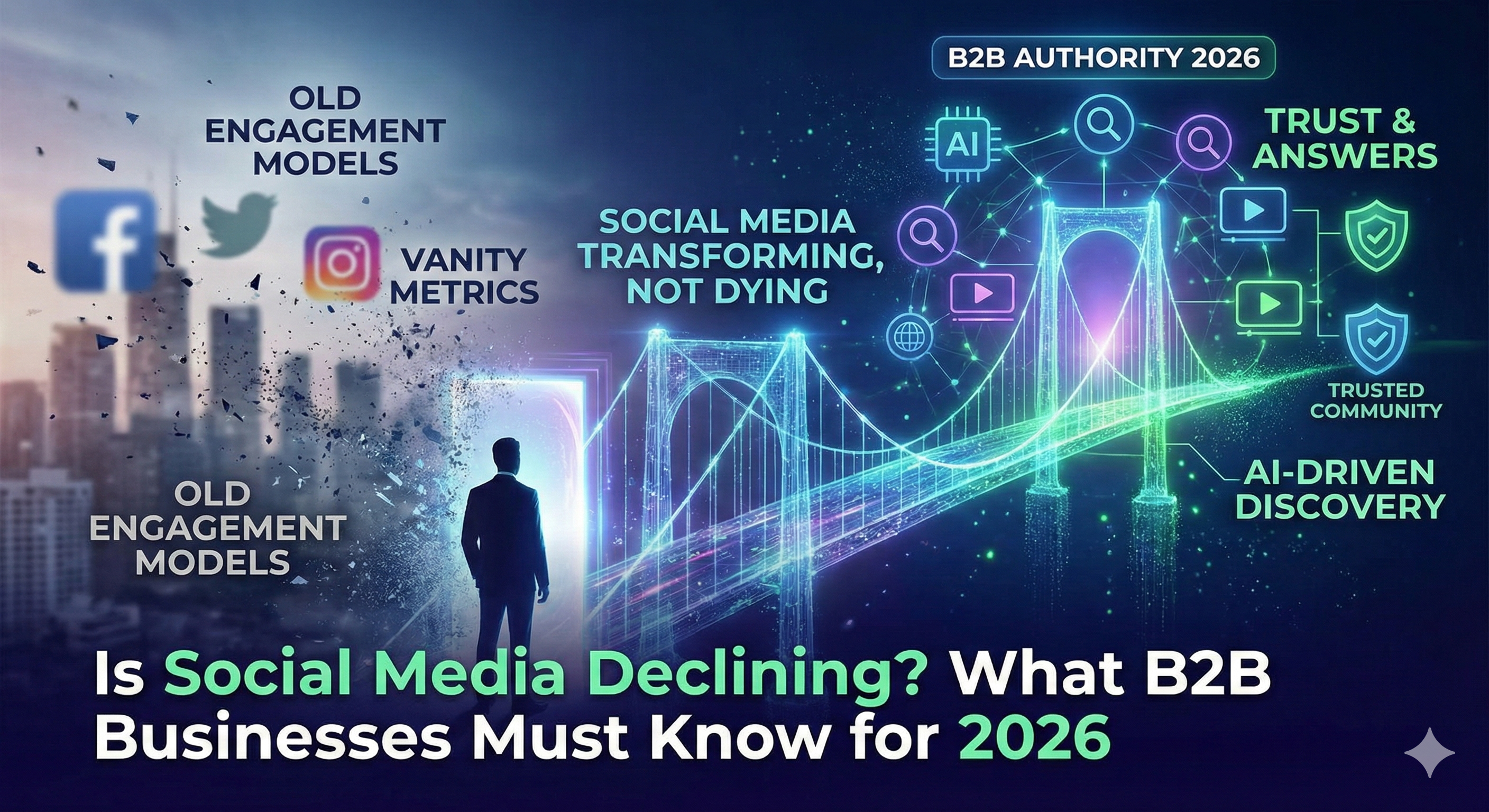
Social media is not collapsing.
But traditional engagement is weakening.
Research shows a growing number of consumers are limiting their interactions with social platforms. Users are scrolling faster, trusting less, and engaging more selectively than in previous years.
For B2B and service businesses, this matters because social media was once the primary discovery engine.
Now discovery is becoming fragmented.
The issue is not usage.
The issue is effectiveness.
Organic reach continues to decline. Paid promotion is increasingly required. Attribution is inconsistent. And engagement metrics often fail to connect directly to revenue.
So while platforms are still active, their ability to reliably drive business outcomes is changing.
Yes, but not in the same way.
Social media is effective for B2B businesses when:
It is ineffective when:
For service based companies, the objective is not reach.
It is credibility.
A small audience of decision-makers is more valuable than thousands of passive viewers.
The core issue is incentives.
Social platforms optimise for engagement, not outcomes.
This leads businesses to track:
But these metrics do not guarantee:
For B2B firms with high value contracts, even a handful of qualified enquiries can outperform large engagement numbers.
When social media cannot clearly answer “Did this generate revenue?”, frustration increases.
AI is now acting as a filter between users and content.
Instead of manually scrolling, users increasingly see:
This changes visibility.
AI does not prioritise popularity alone.
It evaluates:
For service businesses, this means visibility increasingly depends on being understood by AI systems, not just by social algorithms.
AI is turning social signals into structured knowledge.
Businesses that publish clear, answer-driven content are more likely to surface in AI summaries.
This blog on How to be cited by AI and trusted by people helps
Organic social media reach has been falling year after yearas dpeicted in this blog by hootsuite, making it harder for brands to connect with audiences without paid amplification. Social media marketing is evolving into a multi-surface visibility strategy.
Three major shifts are shaping 2026 and beyond.
Instead of relying on one or two dominant networks, audiences are spreading across:
For B2B companies, this means targeted presence matters more than mass exposure.
AI tools are summarising conversations and surfacing recommendations directly within:
This reduces reliance on traditional feeds.
Content must now be structured, specific, and authoritative to be surfaced.
If you want to understand how generative engine optimisation works and the playbook.
Validation is happening at the point of decision.
Buyers are researching through:
They may never scroll a feed before making contact.
Social influence is migrating into search and AI layers.
For service-based and B2B companies, key trends include:
The brands that win will prioritise trust, clarity, and depth over volume.
Produce content that directly answers:
This improves visibility across search, AI, and video.
Invest in:
Trust influences both human decisions and AI visibility.
Video, particularly YouTube, supports:
For B2B companies, even modest subscriber growth can drive significant revenue when aligned with buyer intent.
Shift reporting away from vanity metrics.
Track:
Visibility without conversion is not growth.
Social media is not declining in presence.
It is declining in traditional effectiveness.
For B2B and service-based businesses, the future is not about chasing new platforms.
It is about:
The brands that adapt to this behavioural shift will remain visible.
The brands that rely on old engagement models will struggle to measure impact.
The next era of social media marketing belongs to businesses that understand one core truth:
Visibility is no longer about feeds.
It is about being the trusted answer wherever decisions are made.
If you want help with your social media from a team that can think with an ai lens first then we can help with that visit or book a strategy call https://meetings-eu1.hubspot.com/dwhitby
Social media usage is not disappearing, but traditional engagement is declining. Organic reach is lower, trust is weaker, and users are more selective. For B2B businesses, this means social media must be used strategically rather than as a volume-based visibility tool.
Yes, social media is still effective for B2B when it builds authority and influences decision-making. It works best when aligned with search intent, video content, and trust signals rather than focusing on vanity metrics like likes or follower counts.
AI is reshaping discovery by summarising content, highlighting key themes, and influencing which brands get surfaced in search and AI-generated answers. Clear, structured, expert-driven content is more likely to be cited and recommended by AI systems.
Key trends include declining organic reach, AI-curated feeds, distributed discovery across search and video platforms, growing importance of trust signals, and increased reliance on authority-driven content for B2B growth.
Service-based businesses should prioritise measurable outcomes such as leads, booked calls, revenue, and client acquisition. Authority content, reviews, case studies, and decision-stage video content are more valuable than high engagement numbers alone.