LinkedIn is no longer just a place to post updates.
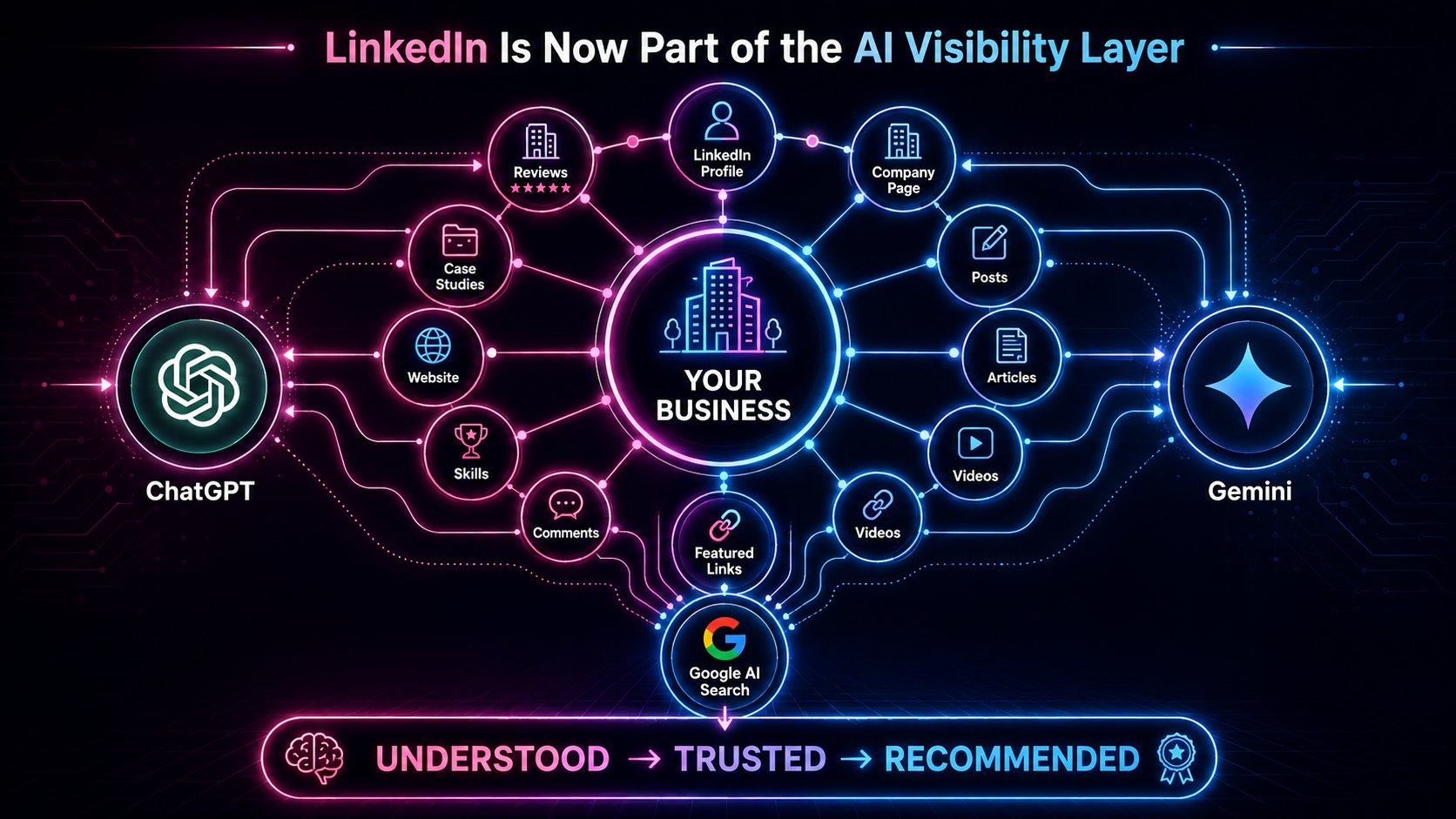
For founders, consultants, agencies and B2B service businesses, LinkedIn is becoming part of the AI visibility layer.
That does not mean every post you publish will be cited by ChatGPT. It does not mean LinkedIn replaces your website. And it does not mean likes suddenly equal authority.
It means something more practical.
Your LinkedIn profile, company page, posts, articles, comments, videos and featured links all add public context around who you are, what you talk about, what you are known for and whether your expertise is supported by visible proof.
That matters because AI search is not only looking for pages.
It is looking for entities it can understand and sources it can trust.
LinkedIn says it has more than 1 billion members, making it one of the largest professional datasets online. For B2B buyers, that makes it a useful place to validate people, companies, roles, expertise and thought leadership.
AEO helps turn your expertise into clear, answer-ready content.
LinkedIn helps attach that expertise to a real person, a real company and a visible professional footprint.
Together, they improve the chance that AI systems can understand, cite, compare and recommend you when buyers use ChatGPT, Gemini or Google AI Search to make decisions.
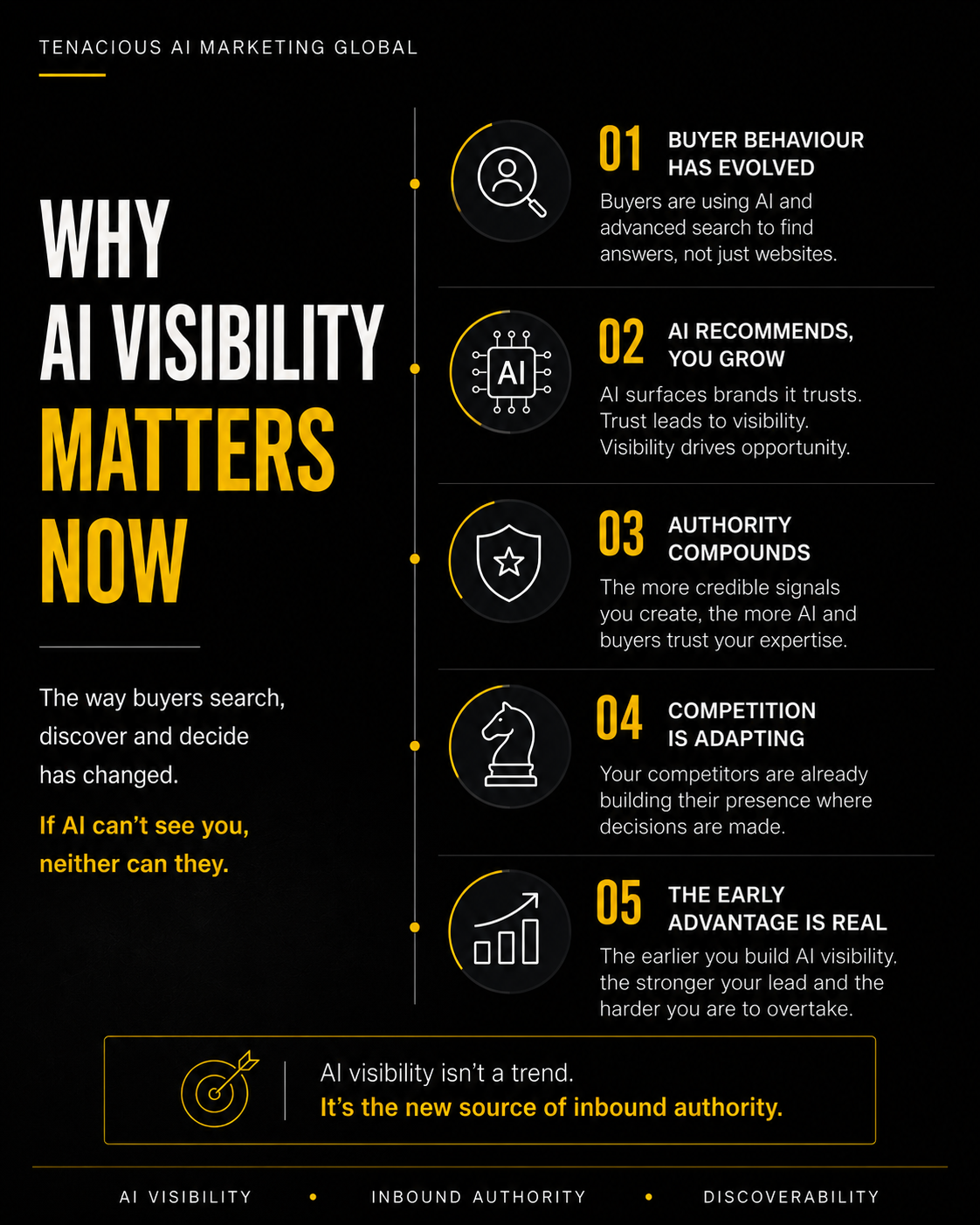
AEO, or Answer Engine Optimisation, is about making your expertise easy for AI systems to extract, understand and use in answers.
LinkedIn marketing is about building visible authority with the right audience.
The overlap is simple.
AEO gives your content structure. LinkedIn gives your expertise a public identity.
For example, a blog on your website might explain: “What is AI visibility?”
Your LinkedIn profile might show that you regularly talk about AI visibility, work with businesses on AI search, appear in relevant videos, and link to proof that supports that expertise.
That creates a stronger visibility loop.
The website explains the topic.
LinkedIn reinforces the person or company behind it.
AI systems and buyers get more evidence to work with.
AI systems need to connect topics to entities.
An entity can be a person, company, product, service, location or concept.
On LinkedIn, those signals are often clearly labelled:
That structure is useful because it gives context.
A founder who wants to be known for AEO, GEO and AI visibility should not have a profile that only says “Founder” or “Marketing Consultant”.
That may be true, but it is not specific enough.
A stronger profile makes the topic connection obvious.
For example:
Weak headline: Founder at Example Agency
Stronger headline: Helping B2B companies improve AI visibility, AEO and GEO so they can be cited in ChatGPT, Gemini and Google AI search
The second headline gives AI systems and humans more to work with.
That is the point of LinkedIn AEO.
Getting mentioned by an AI platform is only the first stage.
Once ChatGPT, Gemini, Copilot, Perplexity or another AI system recommends several companies, the buyer will often ask follow-up questions to compare them.
They may ask:
This is the traditional tender or supplier comparison process happening inside an AI conversation.
The buyer is no longer asking: Who could help me?
They are asking: Which of these companies should I choose, and why?
That means AI visibility is not only about appearing in the initial answer. It is also about giving AI systems enough clear and consistent evidence to compare your business accurately against its competitors.
This is where LinkedIn becomes commercially important.
A company website may explain what the business does, but LinkedIn adds another layer of professional context.
The founder’s profile can show their experience, expertise, point of view and public activity.
The company page can reinforce the organisation’s services, audience and positioning.
Posts, articles, recommendations, videos, case studies and featured content can provide additional proof.
The strongest position is created when the information on LinkedIn supports what appears across the rest of the company’s digital footprint.
For example, if the website says the company specialises in AI visibility for B2B businesses, but the founder’s LinkedIn profile only says “marketing consultant”, the positioning is unclear.
If the website targets startups, but the LinkedIn company page says the company helps everyone, the audience signal becomes weaker.
If the website describes one set of services while LinkedIn describes something different, AI systems and potential buyers have to work harder to understand what the company actually does.
However, when the website, LinkedIn profiles, company page, YouTube channel, case studies, reviews, media coverage and other public sources all communicate the same core position, the business becomes easier to understand and compare.
The information should be consistent around:
This creates stronger brand coherence and entity clarity.
LinkedIn may only be one part of the wider evidence available to an AI system, but ignoring it creates a gap.
A vague, outdated or inconsistent LinkedIn presence can weaken the picture around the business. A competitor with clearer positioning, stronger proof and more consistent public information may be easier for an AI system to understand and recommend.
Businesses should therefore optimise LinkedIn for two reasons.
The first is to improve the chance of being discovered, understood, mentioned or cited.
The second is to improve the chance of winning the comparison after the business has already appeared in an AI-generated shortlist.
Being mentioned is useful.
Being selected is the commercial outcome.
A machine-readable LinkedIn profile is not robotic.
It is clear.
The goal is to make your profile easy to understand in the first few seconds, both for buyers and for AI systems that may later compare you with competitors.
Your profile should quickly answer:
Your headline should explain what you do, who you help and what result you are associated with.
Avoid generic phrases like:
Use specific phrases that connect you to the category you want to own.
For example: Helping UK B2B firms improve AI visibility across ChatGPT, Gemini, Perplexity and Google AI search
That gives clear topic signals.
Most About sections are written like biographies.
That is fine for storytelling, but not enough for AI visibility.
Start with a direct answer.
Example: I help B2B service businesses become easier for AI search engines to understand, cite and recommend. My work focuses on AI visibility, AEO, GEO, answer-led content, entity clarity and authority building.
Then structure the rest with simple sections:
This makes the profile easier to scan, easier to quote and easier to connect to the right topics.
Generic skills create weak signals.
Skills like “Leadership”, “Communication” or “Strategy” may be true, but they do not help much if you want to be associated with a specific search category.
Use skills that match the topics you want to be known for.
For example:
This is not keyword stuffing. It is topic clarity.
The Featured section should not be random.
Use it to show evidence.
That can include:
The purpose is to help a buyer or AI system see what supports your authority.
If your profile claims expertise, the Featured section should prove it.
This is a practical step many people miss.
If your public profile is restricted, search engines and AI-powered systems have less public information to work with.
Review LinkedIn’s visibility settings and make sure your public profile is discoverable outside LinkedIn where appropriate.
This does not mean exposing private data.
It means making sure your professional authority is not hidden from the search layer.
The aim is not to post more.
The aim is to publish clearer signals.
If your LinkedIn posts are vague, generic or motivational, they give AI systems very little useful information about your expertise.
When you answer real customer questions in clear and specific language, AI systems and buyers can understand what you know, who you help and what problems you solve.
AEO-driven LinkedIn content should answer the questions your market is already asking.
That means fewer vague updates and more useful explanations.
For example:
This type of content helps because it is useful to humans and easier for AI systems to interpret.
A post that says: “AI search is changing fast. Businesses need to adapt.” is forgettable.
A post that says: “If ChatGPT cannot describe your business accurately, the problem is usually not the AI tool. It is the public evidence around your brand. Your website, profiles, reviews, videos and third-party mentions need to support the same category.” is more useful.
AI citations usually come from accessible, trusted sources.
LinkedIn posts are not always the easiest citation source compared with articles, reports or web pages.
So LinkedIn should not be treated as the only citation strategy.
It should be treated as support infrastructure.
The important point is that LinkedIn does not only support whether a business appears.
It also supports how that business is judged after it appears.
If a buyer asks AI to compare three providers, the system may look for signals that explain experience, specialism, credibility, proof and suitability.
LinkedIn can help supply some of that context when the profile, company page and content are clear and consistent.
LinkedIn can help by:
The strongest approach is to connect LinkedIn to owned assets.
That combination is stronger than posting alone.
| LinkedIn Asset | What to Improve | How It Supports AI Visibility |
| Headline | Add clear category, audience and outcome | Helps connect the person to the right topics and comparison criteria |
| About section | Use direct answers, headings and proof | Makes expertise easier to understand and compare |
| Skills | Replace generic skills with topic-specific skills | Reinforces the areas you want to be associated with |
| Featured section | Add research, case studies, videos and key articles | Creates a visible proof layer for buyers and AI systems |
| Posts | Answer real buyer questions | Builds a repeatable topic signal |
| Articles | Publish deeper explanations and frameworks | Gives stronger long-form evidence |
| Recommendations | Encourage relevant recommendations | Adds third-party proof around credibility and experience |
| Company page | Align services, audience, positioning and proof | Connects personal authority to business authority |
| Video | Explain ideas clearly with captions or transcripts | Adds human proof and reusable content |
| Public visibility | Keep professional information discoverable | Reduces friction for search and AI systems |
For AI visibility, the company page and founder profile should not feel disconnected.
The company page should explain the business.
The founder profile should explain the expertise and point of view behind it.
The two should reinforce each other.
For example, if the company helps with AI visibility, the founder should not only post about generic marketing motivation.
They should regularly explain:
This helps build a clear association between the person, the company and the category.
That association is what AI systems need to understand before citation or recommendation becomes likely.
This matters even more when AI compares providers.
If the company page says one thing and the founder profile says another, the comparison becomes weaker.
If both support the same services, audience, specialism and proof, AI has a clearer basis for understanding why that company may be the right choice.
Thought leadership matters because AI search rewards useful, specific and well-supported information.
LinkedIn and Edelman found that nearly three-fourths of decision-makers say thought leadership is a more trustworthy basis for assessing a company’s capabilities than traditional marketing materials or product sheets. They also report that 9 in 10 decision-makers and C-suite executives are more receptive to outreach from companies that consistently produce high-quality thought leadership.
That is why LinkedIn content should not be treated as filler.
For founders, it is a trust asset.
It also becomes part of the evidence AI systems may use when comparing one founder, company or provider against another.
But it needs substance.
Good thought leadership usually includes:
Weak thought leadership says what everyone already says.
Strong thought leadership helps the market understand what is changing and what to do next.
The best LinkedIn strategy does not live only on LinkedIn.
It connects to the wider AI visibility system.
Here is a simple flow:
This turns LinkedIn into a distribution and reinforcement layer.
It also prevents LinkedIn content from disappearing after a few days. The idea becomes part of a wider authority footprint.
Most LinkedIn activity is not helping AI visibility.
It is just noise.
Businesses should stop:
The issue is not activity. The issue is signal quality.
AEO-led LinkedIn marketing is not about being louder.
It is about becoming easier to understand and harder to ignore.
You cannot measure this only through likes, impressions or follower growth.
Those numbers are useful, but they do not show whether AI systems understand or cite you.
Track:
Businesses should not only test whether they appear in AI answers.
They should also test how AI systems compare them with competitors.
Useful comparison prompts include:
These prompts help reveal whether your positioning is clear, whether your evidence is visible and whether AI systems understand what makes you different.
An AI citation is not the finish line.
The commercial outcome is being selected.
This is where Answer Architect fits naturally. A Free AI Visibility Score can show whether your business is appearing across AI search, where competitors are being recommended, how AI compares your business, and which questions are shaping your category.
Start with the profile before the posting schedule.
A better content plan will not fix a weak identity signal.
Use this order:
Make the category clear. Say what you do, who you help and what outcome you are connected to.
Make it structured. Use direct language, short sections and proof.
Remove generic noise. Add the topics you want to be associated with.
Add proof assets. Lead with content that shows expertise, not just promotion.
Make sure the company page supports the same category, services and audience.
Make sure LinkedIn points towards proof that helps a buyer compare you fairly. This could include case studies, client results, testimonials, sector experience, founder videos, podcast appearances or original research.
Post around the questions buyers ask before choosing.
Check whether the changes are influencing AI mentions, citations and competitor visibility.
LinkedIn marketing and AEO are no longer separate conversations.
LinkedIn helps define the person and company behind the expertise.
AEO helps structure the answers.
Together, they help AI systems and buyers understand what you should be known for.
But the bigger commercial point is this:
LinkedIn does not only help a business get discovered or cited by AI.
It can also help the business present a stronger case when AI compares it with competitors.
An AI citation is not the finish line.
The commercial outcome is being selected.
That does not happen because you post every day.
It happens because your profile, content, proof, company page and wider website all point towards the same authority position.
A strong LinkedIn presence will not guarantee AI citations.
But a weak, vague or hidden LinkedIn presence makes it harder to be understood, trusted, compared and recommended.
In 2026, visibility is not just about where you rank.
It is about whether AI systems can confidently connect your name, your company, your expertise and your proof to the questions buyers are already asking.
Get your Free AI Visibility Score to see whether your business is appearing in AI search, how competitors are being recommended, and what needs fixing first.
How does LinkedIn help with AEO?
LinkedIn helps AEO by strengthening the public signals around a person or company. A clear headline, structured About section, relevant skills, useful posts and visible proof all help connect your expertise to the topics you want to be known for.
Can LinkedIn posts help win AI citations?
They can support AI visibility, but they should not be treated as a guaranteed citation source. LinkedIn works best when posts connect to deeper assets such as blogs, videos, case studies, research and third-party mentions.
What is a machine-readable LinkedIn profile?
A machine-readable LinkedIn profile is clear, structured and specific. It explains who you help, what you do, what topics you are associated with and what proof supports your expertise.
What should I put in my LinkedIn headline for AI visibility?
Use your headline to state your category, audience and outcome. Avoid generic titles alone. A strong headline should help people and AI systems quickly understand what expertise you want to be associated with.
Should founders post more often on LinkedIn for AEO?
Frequency helps only if the content is useful. One strong post that answers a real buyer question is more valuable than several generic posts written for reach alone.
Does the LinkedIn company page matter for AI visibility?
Yes. The company page helps connect founder authority to business authority. It should clearly explain services, audience, positioning, location and proof.
What is the biggest LinkedIn mistake in AI search?
The biggest mistake is treating LinkedIn like a CV or social feed only. In AI search, LinkedIn also acts as a public authority signal. If it is vague or inconsistent, it weakens the evidence around your expertise.
Does LinkedIn help when AI compares my business with competitors?
Yes. LinkedIn can help AI systems and buyers understand your expertise, experience, proof, audience and positioning. If your founder profile, company page and LinkedIn content support the same message as your website, your business becomes easier to compare accurately.
What should I test after AI mentions my business?
Test follow-up comparison prompts. Ask how your business compares with competitors, which provider has stronger proof, which company is best suited to your target customer, what information is missing and what could make a buyer choose someone else.
What should businesses measure beyond LinkedIn likes and impressions?
Measure AI mentions, citations, prompt visibility, competitor recommendations, source quality and whether AI systems describe your expertise accurately. Engagement is useful, but AI visibility shows whether the market is starting to understand you.